


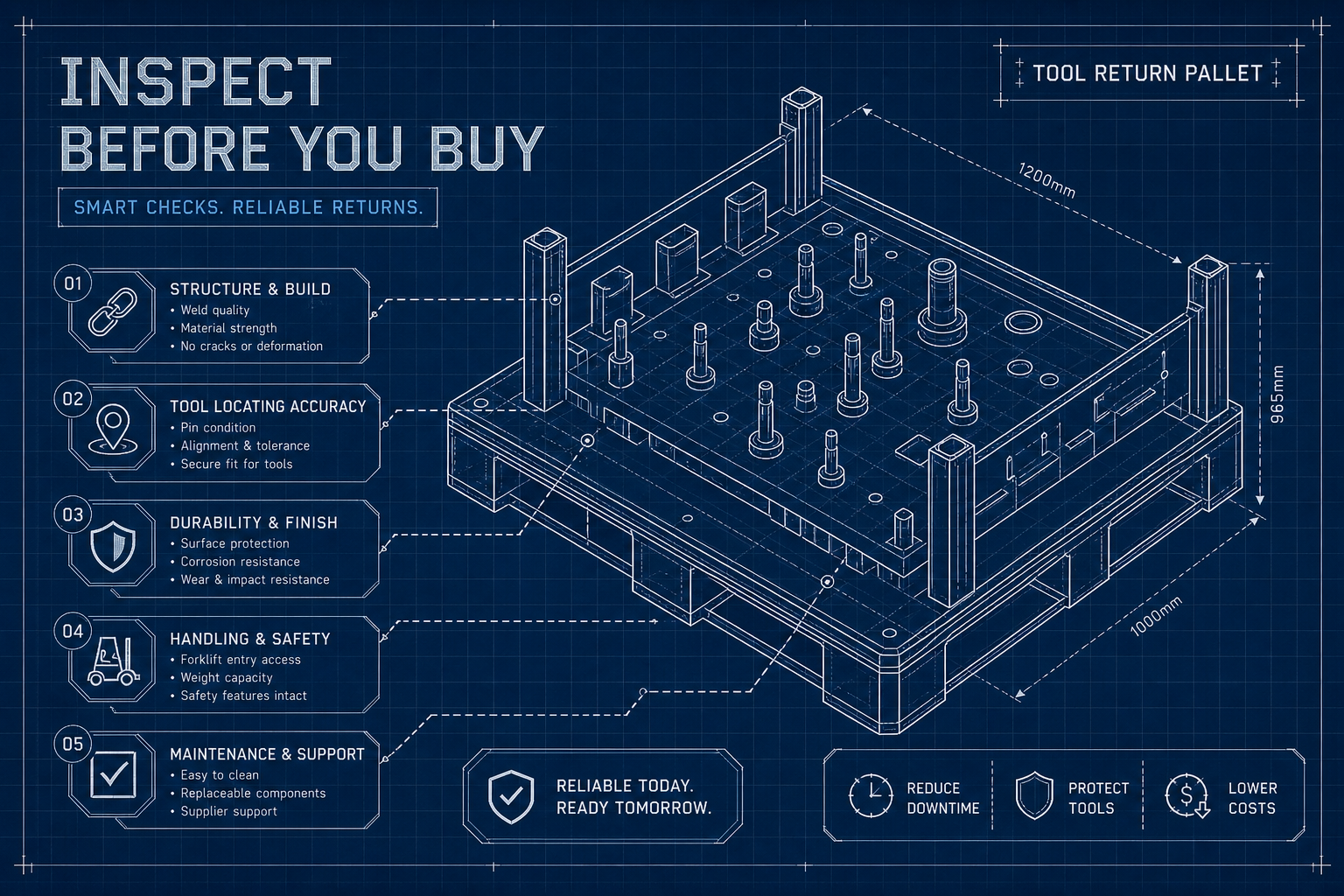
Tool Return Pallets: What to Inspect Before Buying
Brands like DeWalt, Milwaukee, and Ryobi showing up at 70, 90% below retail is not a rumor. It happens every week through tool return pallets sourced directly from major US retailers, and experienced resellers consistently rank this category among the highest-margin plays in the liquidation market. That combination of brand recognition and steep discounts attracts serious resellers who build real businesses around it. It also attracts buyers who move too fast, skip the basics, and end up absorbing losses they could have avoided entirely.
The difference between a profitable pallet and a money pit almost always comes down to what you check before you pay. A pallet with $18,000 in MSRP and a 30% Grade D concentration is not a deal. One with $12,000 in MSRP, a strong A/B condition split, and a clean manifest is. Knowing which is which requires a framework. This article gives you that inspection process so you can evaluate any tool return pallet before you commit.
What’s Actually Inside a Tool Return Pallet
Most tool return pallets come from big-box retailers as a mix of customer returns, shelf pulls, and overstock, packaged into a standard 48×40-inch gaylord weighing 800, 1,200 lbs. Total MSRP on paper often runs $8,000, $25,000. That number looks attractive until you understand that actual recovery value after sorting through defective units typically averages 25, 40% of MSRP, depending on the condition split and how efficiently you move inventory.
Brand Mixes and Item Counts You Can Expect
DeWalt and Milwaukee drive 40, 50% of total retail value on most power tool return pallets. These are your margin leaders, with individual units often carrying $150, $500 MSRP each. Ryobi, Craftsman, and Bosch fill the mid-tier, while budget brands and accessories round out the rest. Item counts typically range from 150, 400 per pallet depending on tool size: a pallet heavy with circular saws and impact wrenches will have fewer items than one loaded with bits, chargers, and hand tool accessories.
Pay attention to SKU depth versus SKU diversity when reviewing a lot. A pallet with 50+ unique SKUs and modest quantities per item is better for most resellers than one with deep duplicates of a single model. Shallow SKUs give you pricing flexibility across multiple channels; deep duplicates force you to sell volume fast, often at lower margins.
The Four Condition Grades and What They Mean for Resale
Grade A (new or open-box, typically 20, 35% of a healthy pallet) is your highest-margin inventory with minimal prep required. Grade B (like-new with minor wear or box damage, 25, 40%) sells well on eBay and Amazon without significant reconditioning. Grade C (functional issues or missing accessories like batteries and chargers, 20, 30%) requires triage: you need to decide what’s worth repairing or parting out and what goes to salvage. Grade D (parts-only or non-functional, 10, 20%) is where margins evaporate if you miscalculate the share it represents.
A healthy pallet skews toward A and B grades. Any lot where C and D combined exceed 35% of the total needs a meaningful price reduction to make economic sense. Factor this into your bid before you commit, not after the pallet arrives.
How to Read a Tool Return Pallet Manifest Before You Commit
A manifest is your proof of purchase before the purchase. Every legitimate wholesale tool pallet comes with one, and your ability to extract useful data from it determines whether your bid is calculated or reckless. Many auction platforms provide manifests as downloadable spreadsheets with grouping tabs for category, brand, model, and condition. Learn to navigate these before you spend anything significant. For a practical primer on manifests, see buying basics and manifests.
The essential fields are QTY (unit count per SKU), UPC or Model Number, MSRP, Extended MSRP (QTY multiplied by MSRP), Item Description, Category, and Condition. Extended MSRP is the number most beginners misread as actual value. It is not. It’s a ceiling, not a floor. Your real number is the estimated recovery rate: what you can realistically sell the items for after accounting for defects, missing parts, and market saturation on common models.
Build a simple spreadsheet filter when you receive a manifest. Pull the top 20% of line items by Extended MSRP and cross-reference those specific models against eBay sold listings, not asking prices, sold prices. That exercise alone gives you a realistic revenue ceiling in under 30 minutes and separates strong lots from overpriced ones fast. For an in-depth walkthrough aimed at new resellers, consult Buying Liquidation Pallets: Complete Guide For New Resellers.
Condition Codes and Abbreviations Decoded
Manifests use shorthand consistently across the industry. CR means Customer Return. DOA means Dead on Arrival. RMA is Return Merchandise Authorization. RTV is Return to Vendor. NIB is New in Box. AS-IS means sold without any guarantee of function. Grade codes follow A through D or numeric equivalents, but grading systems vary by seller and platform, so always check the legend or seller notes before interpreting a condition column.
A manifest with no condition column is a red flag, not a bargain opportunity. It means you’re flying blind on the most critical variable in your recovery estimate. Without that data, you have no reliable way to project what percentage of the lot is sellable or at what price tier. Walk away unless the price fully reflects maximum risk.
Inspecting Tool Return Pallets: Your Pre-Purchase Checklist
You need a systematic process before the pallet ships and again when it arrives. Skipping either stage is how resellers end up filing disputes or absorbing losses that were entirely preventable. The checklist below covers both phases.
What to Verify on the Manifest Before Paying
Cross-check the top 20% of SKUs by MSRP against eBay sold listings to build a real recovery estimate before you bid. Flag any lot where more than 30% of line items show C or D grades. Look for vague item descriptions like “Power Tool” without a model number, and watch for duplicate SKUs with conflicting condition codes. Both signal poor inventory control on the seller’s end.
Confirm that the total item count on the manifest aligns with the stated pallet weight and dimensions. A manifest claiming 300 items on an 800 lb pallet is plausible for accessories. That same manifest claiming 300 items on a 1,200 lb pallet filled with circular saws deserves scrutiny. If the numbers don’t add up, ask the seller to clarify before placing a bid.
What to Physically Check When the Pallet Arrives
Photograph the pallet before opening it and document visible damage to boxes and outer packaging immediately. Then sort all items by condition grade and verify the sort against the manifest. This step catches discrepancies early and gives you documentation for any buyer protection claim you need to file. For open-box tool pallets specifically, test battery-powered tools first, dead batteries and incompatible voltage platforms are the most common defect category in returned tools, and they directly reduce resale value on otherwise functional units.
Check for missing accessories: chargers, carrying cases, drill bits, and blade guards all affect what you can ask for an item on the secondary market. An item listed as Grade A or B that arrives missing its charger and case is functionally a Grade C. Document every discrepancy, photograph every item in question, and use that documentation to support any dispute through your vendor’s buyer protection process.
Red Flags That Signal a Bad Pallet Deal
Losses in this category often trace back not to bad pallets but to bad vendors. Knowing the warning signs on both the manifest side and the seller side protects your capital before it ever leaves your account.
On the manifest side, the biggest warning sign is the absence of condition codes. Beyond that, watch for MSRP values that appear inflated or inconsistent with known retail prices, a heavy concentration of discontinued SKUs with limited eBay demand, more than 15, 20% of items listed as DOA or Parts Only, and item descriptions that omit brand names or model numbers entirely. Blind lots or mystery pallets for tool categories priced above $500 carry disproportionate risk and should be avoided unless you have extensive direct experience with that specific vendor.
On the vendor side, walk away from any seller who lacks a written refund or return policy, provides no photos or inspection video for high-value lots, pressures you to bid quickly, or requests payment outside the platform. Reputable sources tie payments to verified manifests and offer dispute mechanisms. A vendor who refuses to provide a manifest for surplus tool pallets, or who won’t answer basic questions about the condition split before purchase, is not worth whatever discount they’re offering. Also be aware of common pallet liquidation scams and how to recognize them, they often display many of the vendor-side red flags listed above.
Break-Even Calculations for Tool Return Pallets
Most buyers who lose money on tool liquidation pallets skip the margin math entirely or use MSRP as a proxy for value. Real profitability comes from calculating three numbers before you commit: your all-in acquisition cost, your realistic recovery rate, and your per-item resale ceiling.
Add $300, $500 to every pallet purchase as your baseline freight cost for nationwide LTL delivery of an 800, 1,200 lb tool lot. Regional shipments under 250 miles can drop to $150, $300; cross-country delivery runs $500, $800 before liftgate and residential surcharges. Factoring freight into your cost basis from the start prevents the single most common miscalculation in pallet buying. For current estimates, check published current freight rates and typical pallet shipping cost guidelines to ground your assumptions in today’s market.
Use the 4x cost recovery benchmark to pressure-test every deal. If you pay $2,000 for a pallet, you need $8,000 in realistic resale revenue to hit a healthy margin after platform fees, per-item shipping costs, and the 15, 20% of units that typically won’t be resellable on returned tool lots. If your conservative revenue estimate from eBay sold listings doesn’t clear 3x your all-in cost, the pallet is priced too high for your target margin. Run this math on every lot before your money moves.
Where to Source Manifested Tool Return Pallets
Auction platforms offer legitimate manifested lots but require bidding experience and carry limited recourse once a lot ships. For buyers who want more predictable access to consistent inventory, direct wholesale sourcing with transparent grading and strong buyer protections is the more reliable route.
A trustworthy source for returned tools pallets provides a full manifest with condition codes, publishes clear refund and buyer protection terms, sources directly from recognized US retailers rather than aggregating secondary lots of unknown origin, and refreshes inventory regularly so you’re not buying stale stock. Responsive customer support matters too, especially when a pallet arrives with a significant manifest discrepancy that needs quick resolution.
Pallet Liquidation: Your Guide To Buying And Profit sources tool inventory weekly from major US retailers, offering fully manifested lots across power tools, hand tools, and accessories at 70, 90% below retail. Every purchase includes a 100% money-back guarantee, and orders over $2,500 ship free nationwide. With 24/7 live support and consistent inventory rotation, resellers get both the protection and the sourcing frequency they need to build a reliable tool resale operation. Browse current tool lots on the Pallets Liquidation USA site to see what’s available this week.
Build the System, Then Scale It
Tool return pallets are one of the strongest margin opportunities in the resale market, but only when you buy with a system. Read the manifest before you bid, verify condition grades against what actually arrives, and walk away from any vendor who can’t provide both. Factor shipping into your cost basis from day one, and use the 4x cost recovery benchmark to pressure-test every deal before your money moves.
When you source through a platform that offers manifested inventory, real buyer protections, and weekly stock from recognized US retailers, the uncertainty disappears. What remains is a repeatable process you can refine and scale. Start with one well-evaluated tool pallet, run the numbers honestly, and build from there. For additional strategies on maximizing margins and wholesale savings, see Unlocking Profits With Liquidation Pallet: Your Key To Wholesale Savings, Pallets Liquidation.
Leave a Reply
You must be logged in to post a comment.