


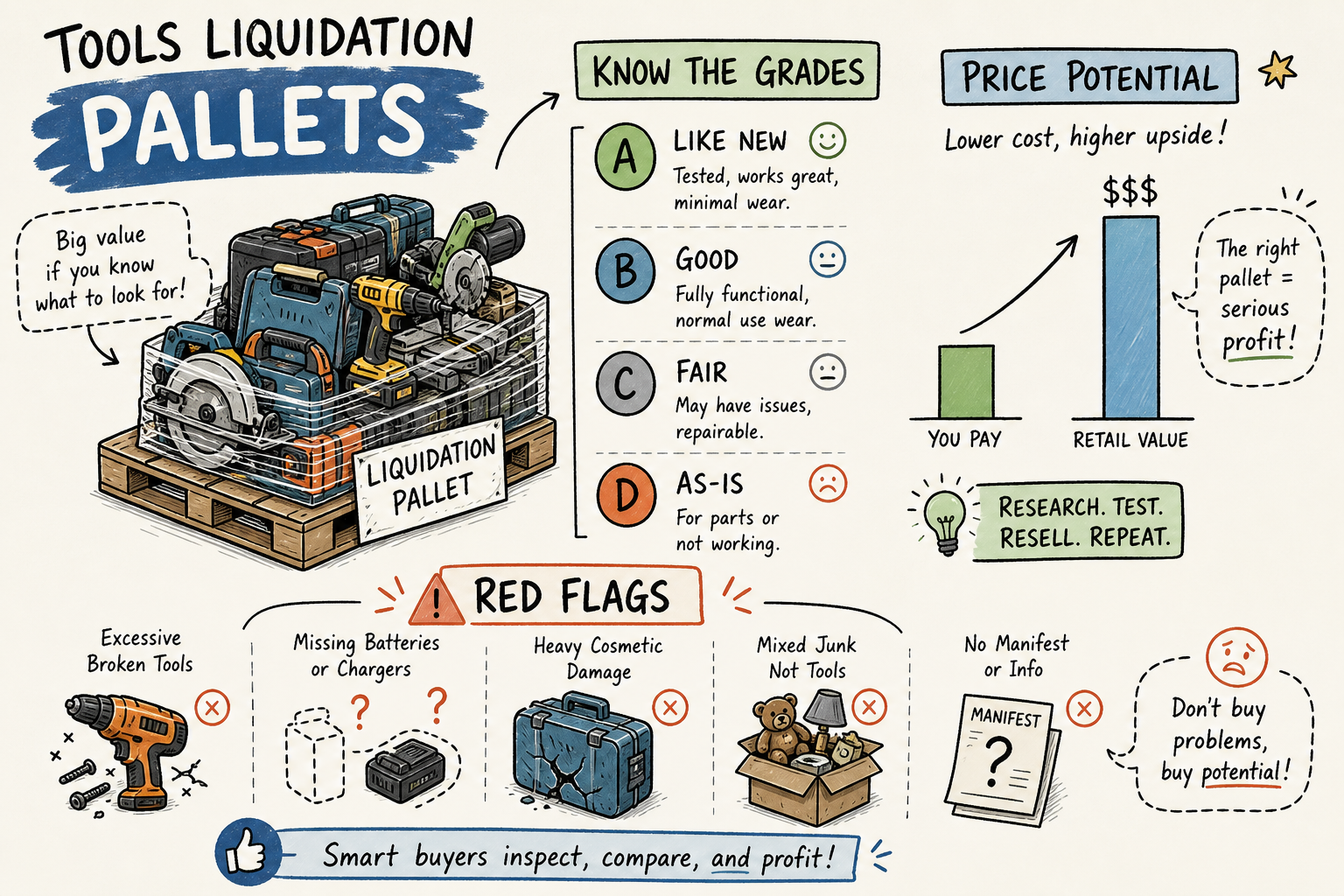
Tools liquidation pallets: grades, pricing, and red flags
A pallet of name-brand power tools sounds like a straightforward win: Milwaukee drills at pennies on the dollar, DeWalt combo kits moving fast on eBay, margins stacking up before the freight truck even pulls away. The reality is more complicated. One mixed lot can hold working drills worth $150 each on the used market, or it can be a stack of dead batteries, incomplete sets, and empty boxes with inflated retail values on the manifest. The difference between those two outcomes is almost never luck. It comes down to what you know before you buy tools liquidation pallets.
Resellers who source bulk tool pallets consistently outperform buyers who chase the cheapest listing. They read documentation before committing, understand condition tiers, calculate freight costs down to the liftgate fee, and choose suppliers who back their inventory with genuine buyer protections. Suppliers that offer documented manifests and clear return policies give you something most of this market doesn’t: a foundation of trust before the pallet ships. This guide covers everything you need to turn a tool lot into a profitable flip, grades, true costs, inspection process, and the red flags that signal a bad deal before you wire a dollar.
How quality tiers work in tools liquidation pallets
Not all power tool pallets are equal, and the condition grade assigned to a lot shapes everything downstream: your purchase price, your expected sell-through rate, and the labor required before a single item lists. Understanding the full condition spectrum lets you evaluate any listing with confidence instead of guessing.
The condition spectrum from shelf-pulls to salvage
Brand new and overstock pallets contain unsold inventory in factory packaging and carry the strongest resale value. Shelf-pulls sit just below that tier: opened but unused, cosmetically intact, and easy to move. Customer returns, uninspected, are the wildcard category, items were returned for any reason and haven’t been tested or sorted, so you absorb meaningful risk. Tested and graded returns have been screened by the seller, with working, cosmetically imperfect, and parts-only units separated. Salvage lots are parts-only and priced accordingly.
Budget for roughly 15% unsellable even in a well-sourced return lot (including damaged items and parts-only pieces that won’t sell individually), and raise that estimate to 20, 40% for uninspected pallets. That 15% doesn’t mean the deal falls apart; it means your margin calculation has to account for it upfront, not after the fact. Industry reseller communities and liquidation marketplace data support these ranges as working benchmarks.
How brand mix shapes your margin potential
A pallet of DeWalt, Milwaukee, and Makita is a fundamentally different investment than one filled with off-brand or no-name tools. Name-brand pallets cost more per unit at purchase, but they support higher resale prices, faster turn rates, and stronger buyer confidence on Amazon, eBay, and Facebook Marketplace. A working Milwaukee M18 drill sells. A working no-name drill sits. The brand mix on the manifest is one of the first things to check, it’s a direct signal of the lot’s ceiling.
Why condition grading without documentation is guesswork
A seller who describes a lot as “mixed tools, various conditions” isn’t grading anything. They’re asking you to absorb all the risk without providing the information you need to price it. Condition reports tied to verified inspection data, not seller estimates, are the standard you should demand before spending a dollar on any palletized tool lot. When that documentation exists, you get fewer delivery disputes and far better margin predictability.
Reading pallet documentation before you commit
Documentation review is the most underrated skill in buying tools liquidation pallets for resale. Most first-time buyers skip it, or accept a vague description and discover later what they actually bought. The ability to read a manifest accurately is what separates consistent margins from costly surprises.
What a legitimate manifest actually includes
A proper manifest lists SKUs or UPCs, item descriptions, quantities, retail value per unit, and condition codes for each line item. It should align with any photos or video the seller provides. If a supplier offers only a category label like “power tools, assorted,” that is not a manifest, it’s a description. A verified manifest tells you what’s in the box, how many units, what condition each item is in, and what retail value was assigned, so you can cross-check against current market prices before committing.
Red flags that signal a risky or fraudulent listing
Vague condition language is the first warning sign. Phrases like “some items may be damaged” or “as-is, no guarantees” without a per-item breakdown mean the seller hasn’t done the sorting work, and you’ll be doing it blind after the pallet lands. Retail value inflation is a common manipulation tactic: a lot with $8,000 in “retail value” priced off discontinued or artificially high MSRPs is worth far less on the open market. No photo verification, no per-item breakdown, and manually typed manifests with no third-party backing all point to elevated risk.
How verified condition reports reduce your buying risk
Suppliers worth trusting provide condition reports generated from on-site inspection data or direct retailer sourcing, not estimates typed into a spreadsheet. When the report reflects verified inspection, you get fewer delivery disputes, fewer surprises, and much better margin predictability across your tool liquidation pallets. That document becomes the baseline for every listing you create and every price you set.
Real costs and resale values for tools liquidation pallets
Running the numbers before you commit to a lot is non-negotiable. Purchase price is just the starting point, freight, fees, and sell-through rate all factor into your actual return.
Typical pricing by pallet grade
Overstock and shelf-pull tool pallets cost more per unit but carry stronger resale value and faster turns. Uninspected return pallets generally start in the $400, $1,050 range, depending on the supplier, brand composition, and lot size. Graded mixed tool lots sit in a middle range that reflects the sorting work already completed. Always model costs as a range, because brand mix and lot size shift pricing significantly, any single-number estimate will mislead you.
Freight and shipping costs you cannot ignore
A standard tool pallet typically runs 1,000 to 1,500 lbs on a 48×40-inch base. Freight class is calculated by carriers based on density (weight divided by cubic feet), and tool pallets in this weight range often fall in the class 70, 85 bracket, though your carrier will determine the final class based on the actual shipment dimensions and weight; to estimate class for quoting, consult a freight class calculator. LTL shipping costs range from roughly $150 for short regional hauls to $800 or more for coast-to-coast delivery. Add liftgate fees ($50, $100), residential delivery surcharges ($75, $150), and appointment fees ($25, $50) to your baseline. These costs are predictable when you calculate them upfront. Suppliers that offer free shipping thresholds on multi-pallet orders can meaningfully improve your per-unit economics, it’s worth asking about shipping terms before you commit to a lot.
Resale margins by brand and condition
Working used DeWalt and Makita drills typically sell at 40, 60% of retail on eBay, with Milwaukee holding slightly better at 45, 65% due to strong contractor demand. Refurbished units with replaced batteries and clean cosmetics push into the 50, 75% range. Parts-only items across all brands land at 10, 25% of retail, meaning they contribute margin only at scale. A Ryobi lot is a high-volume play: working units at around 50% of retail is realistic based on pallet flip data shared in reseller communities, and the One+ battery ecosystem drives steady DIY buyer demand. Milwaukee, by contrast, is stronger for individual unit resale to contractors on eBay or through local sales channels.
How to inspect and grade pallets when they arrive
What happens in the first hour after delivery determines how accurate your listings are and how well your resale reputation holds up across platforms.
What to do the moment the pallet is delivered
Before the driver leaves, photograph the pallet from all four sides. Note any visible damage to the shrink wrap, strapping, or outer boxes. If freight damage is present, record it on the Bill of Lading before signing, that notation is your only leverage for a freight claim. Once you’ve signed and the truck leaves, your documentation window closes.
Sorting by condition tier and building your own grade report
Unpack methodically rather than all at once. Test each unit, sort into working, open-box, parts-only, and scrap categories, and track your counts against the manifest. Any discrepancy between what was listed and what arrived is a dispute trigger, and your buyer-generated condition log is the evidence. That same log becomes the foundation for accurate, defensible listings on every sales channel. Buyers who list honestly sell more and face fewer returns.
Common scams and what buyer protections actually cover
Most tool pallet sales are final. That’s the nature of the market, and understanding it upfront prevents the kind of surprise that costs real money.
The most common problems buyers report
Miscounts, empty boxes, manifest inflation, and condition misrepresentation are the four issues that come up most frequently in reseller forums and liquidation marketplace complaint threads. Manifest inflation is particularly common: sellers assign inflated or outdated retail values to make a lot look more attractive, and buyers who don’t verify those numbers against current market prices end up overpaying. The absence of a per-item manifest is the single biggest risk factor in any tool liquidation pallet purchase. Without it, you have no baseline to dispute against if the lot doesn’t match what was advertised.
How to protect yourself when things go wrong
Your protection in this market comes from supplier selection, not dispute processes. Most as-is liquidation sellers don’t offer meaningful recourse after a sale closes. The suppliers worth buying from stand behind their inventory before you need to file a claim. A money-back guarantee signals that the supplier has confidence in what they’re selling, it’s not just marketing language, it reflects quality control upstream. Responsive support matters too: when you’re evaluating a lot on a Sunday night, a two-business-day response window isn’t workable. Those structural protections matter more than any buried dispute clause in a terms-of-service page.
Where to source surplus tool pallets from suppliers worth trusting
The supplier you choose determines almost everything: inventory quality, documentation accuracy, freight costs, and your ability to resolve problems when they arise. This decision deserves the same scrutiny you’d apply to the lot itself.
What separates a reliable source from a risky one
Reliable suppliers provide fully itemized manifests, verified condition reports, clear shipping terms, and documented buyer protections. They source directly from major U.S. retailers rather than secondary middlemen who have already pulled the best inventory. Consistent weekly restocking is another signal worth watching, it indicates ongoing retailer relationships, not sporadic one-off lots that can’t be vetted or repeated. If a supplier can’t tell you where the inventory came from, that’s your answer.
Why Pallets Liquidation USA works for resellers who buy to scale
Pallets Liquidation USA sources power tool pallets and mixed tool lots directly from major U.S. retailers, bringing in fresh inventory with documented manifests and no third-party sourcing markup. Their buyer protection policy and responsive support team give resellers a clear path when questions arise before or after a purchase. For buyers moving multiple pallets per order, their shipping terms are worth reviewing, reduced freight costs on larger orders change the per-unit math in ways that add up quickly. Consistent inventory availability across tool categories makes planning easier, and the combination of direct sourcing and transparent documentation is why repeat buyers treat them as a primary supplier rather than a fallback option. Additional perspectives on sourcing and Amazon return lots are available from industry resources like Direct Liquidation’s guide and AMZPrep’s overview of Amazon return pallets.
The framework that keeps tool pallet buyers profitable
Five habits separate resellers who build consistent margins from those who chalk up losses to bad luck: understanding condition tiers, reading documentation carefully, calculating true costs before committing, inspecting pallets methodically on arrival, and choosing suppliers who back their inventory with genuine protections. None of these are complicated. All of them require discipline.
Tools liquidation pallets reward preparation, not optimism. Sourcing from a supplier that provides verified manifests, transparent buyer protections, and direct retailer relationships is the highest-leverage decision you can make in this space. Get that piece right, and everything else is execution.
Browse Pallets Liquidation USA’s current tool pallet inventory to see what’s available this week, full manifests, verified condition grades, and buyer protections included on every lot.
Leave a Reply
You must be logged in to post a comment.