


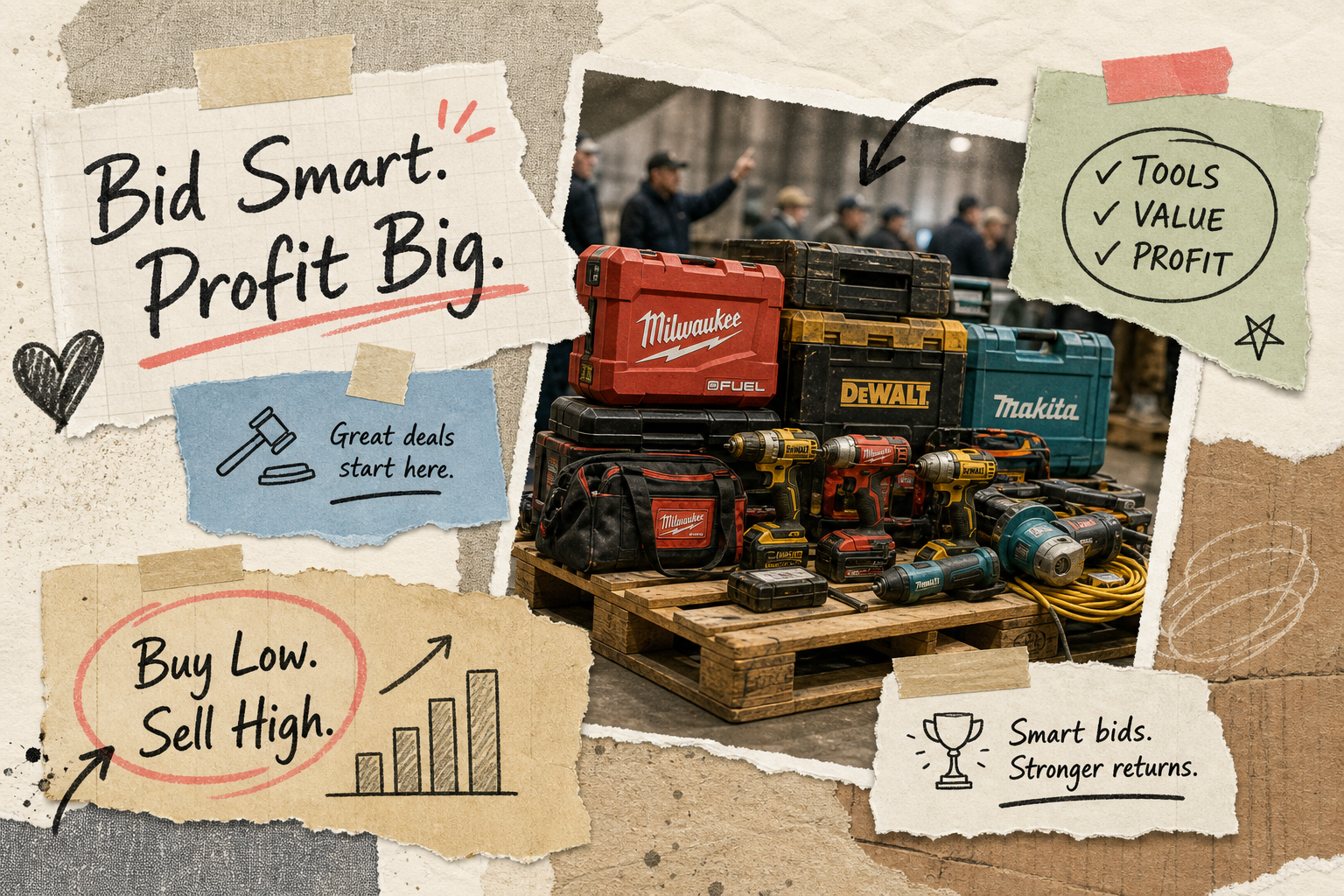
Tool pallet auctions: bid smart and profit in 2026
Tool pallets auction listings attract resellers for an obvious reason: DeWalt, Milwaukee, and Ryobi inventory at steep discounts, often 60, 80% below retail, is not mythology. These lots exist, they move fast, and experienced buyers build profitable businesses around them. Finding the right tool pallets auction, however, takes more than showing up and placing bids.
The problem is that the same auction format that produces a $900 profit per pallet can burn a buyer who skips the prep work. Plenty of resellers have won a bid, opened their pallet, and found stripped housings, dead battery packs, and tools that were clearly cannibalized before they reached the lot. Experienced buyers report that resellers who don’t set firm ceilings often overpay repeatedly, because they treat the auction like a competition instead of a math problem.
This guide covers what you actually need to know: where legitimate wholesale tool pallets list, how to read a manifest before you bid, how to calculate your real costs, and which warning signs mean you close the tab and move on.
Where reputable tool pallets auction sites actually list inventory
The main platforms and how they operate
The major platforms for auctioned tool pallets each operate differently, and that difference affects your entire strategy. Liquidation.com’s power-tools listings run sealed-bid auctions, carry a BBB A+ rating, and list verified brand lots including power tool pallets from national retailers. B-Stock operates a retailer-direct model, meaning the seller is often the original retailer rather than a middleman, which matters for manifest accuracy and return policy reliability.
Pallet Auctions by Erkelens and Olson runs weekly online-only events with 900-plus active bidders and specializes in lost freight, surplus, and liquidation inventory. Direct Liquidation and The Select Source, with around 441 active auctions at any given time, offer broader inventory mixes. Each platform uses either sealed-bid or open competitive bidding, and that format changes how you set your ceiling, which we’ll cover in detail below.
Texas Tool Pallets operates a direct-purchase model with no bidding at all, which technically sits outside the auction category but blurs the line between sourcing channels. Fixed-price models like this are worth understanding because they offer a useful comparison point when you’re evaluating whether a given tool pallets auction lot is actually priced well.
What separates a trustworthy listing from a risky one
Seller rating history is the first filter. On any major platform, look for sellers with substantial transaction volume and a track record of resolved disputes. A new seller account with zero feedback on a large power tool pallets lot is a risk you don’t need to take when better-verified options exist on the same platform.
The clearest signal of a legitimate listing is whether the lot is manifested or listed as AS-IS with unknown contents. Manifested tool lots give you a workable cost basis. AS-IS listings are speculation, and for liquidation tool lots specifically, “unknown contents” often means someone already pulled the best items. Volume buyers consistently favor platform sellers who are the original retailer, not third-party aggregators with no accountability for what’s inside the pallet.
How to read a tool pallets auction manifest before you bid
What a real manifest tells you
A legitimate manifest includes the pallet ID, SKU per item, unit quantities, product descriptions, individual retail values, and condition codes. That data is your entire valuation foundation. Without it, you’re guessing at margin, and guessing at margin is how resellers lose money on otherwise good-looking lots.
Cross-reference the SKU data before you trust the stated retail values. Pull 10, 20 line items from the manifest, look them up on eBay sold listings, not asking prices, sold listings, and compare what the seller claims as retail against what the market actually pays. If the stated retail values on the manifest run significantly higher than current sold comps, weight your own numbers, not the listing. Reseller forums on platforms like Liquidation.com consistently flag inflated manifest values as a known tactic used to make marginal lots appear more attractive than they are. For a deeper step-by-step approach to evaluating manifests, see the Buying Liquidation Pallets: Complete Guide For New Resellers.
Reading condition codes accurately
Most platforms use some version of a four-tier grading system. Grade A is new or like-new, unused, often still in original packaging, and commands 70, 90% of retail on resale. Grade B is open-box and functional with minor cosmetic issues, typically yielding 40, 60% of retail. Grade C covers used tools that need repair or parts, with a realistic resale range of 10, 25% of retail. Grade D means parts only with no meaningful resale value.
Most power-tool return pallets are Grade B and C mixes. Any listing claiming 80% or more Grade A items on a customer-return tool lot should get extra scrutiny. Retailers don’t return brand-new, unopened power tools at that rate. A commonly cited default assumption for mixed return pallets runs roughly 30% Grade A/B, around 50% Grade C, and 20% Grade D, though the actual split varies by lot type and source retailer. Use that range as your baseline until the manifest gives you reason to adjust it.
Estimating resale value and your break-even number
The quick valuation method that actually works
Pull a 10, 15 item sample from the manifest and look up each one on eBay under “sold listings.” Get actual transaction prices. Add those up, divide by your sample size to get an average, then multiply by the total unit count on the pallet. That gives you a rough resale ceiling for the lot, and it’s based on what buyers actually paid, not what sellers wished they’d received.
The working benchmark for profitable pallet lots for resale is a 2× return on your pallet price before shipping. If your estimated recoverable resale value isn’t at least twice what you’re paying for the pallet, the math is soft and the risk is high. That benchmark doesn’t guarantee profit, but any lot that can’t clear it on paper shouldn’t clear your bidding ceiling either.
Applying condition multipliers to your estimate
Once you have your estimated pallet retail value, apply the condition multipliers to each grade segment. Grade A tools: 70, 90% of retail. Grade B: 40, 60%. Grade C: 10, 25%. Grade D: zero. Use your grade split assumption, or the manifest’s stated breakdown, to weight each segment and add them up for your estimated recoverable resale value.
Platform selling fees eat into every number you calculate. eBay and Amazon both run 10, 15% on tool sales, and per-item shipping to buyers adds more on top of that. Factor those costs in before you finalize your recoverable value estimate. Every dollar you forget to subtract is profit you think you have but don’t actually own.
Building a bidding strategy that accounts for all true costs
Understanding the full fee structure before you bid
Buyer’s premiums on most liquidation auction platforms run 10, 25% on top of the winning bid. Payment processing adds another 2, 3%. Some platforms stack storage fees if you don’t arrange pickup or freight within a tight window after winning. None of these are hidden, but buyers who focus only on the hammer price commonly underestimate their true all-in cost by a significant margin.
Walk through the real math: a $600 winning bid on a tool lot, plus a 15% buyer’s premium ($90), plus a 3% payment processing fee ($18), plus LTL shipping costs to your location ($275) equals $983 total before you touch the first tool. You bid $600, but you spent $983. That’s a 64% cost increase, and every calculation you made based on the $600 number was wrong. Run this calculation for every lot before you place a number.
Setting your maximum bid before the auction opens
Calculate your maximum bid by working backward from your numbers: take your estimated recoverable resale value, apply your target margin, then subtract all fees and estimated freight. The result is your true ceiling, and it’s a fixed number. Write it down before the auction opens.
Never adjust your ceiling upward because bidding pressure makes you feel like you’re about to lose a good deal. That impulse is the single most common reason resellers overpay on a tool pallets auction. The format is designed to create urgency. Your ceiling is your defense against that urgency. If the lot goes above your number, someone else overpaid and you found out for free. For practical bidding and resale tips that reinforce disciplined decision-making, see Pallet Liquidation: Tips For Successful Reselling.
Red flags that signal a bad lot before you commit
Warning signs in the listing itself
No manifest or a listing marked “contents unknown” should be treated as high-risk, some platforms and consignors do list lots this way, but when a seller on a tool pallets auction can’t or won’t provide at least a partial SKU count, you have no reliable cost basis to work from. Sellers who decline to produce a manifest either don’t know what’s in the lot or already know and don’t want you to. Either way, the lot isn’t worth bidding on.
Vague condition language like “untested” or “customer returns, condition varies” without any grade percentage breakdown signals the seller is declining to tell you something useful. Photos showing only the outside of a wrapped pallet, or listings using stock images instead of actual lot photos, are consistent red flags seen across Liquidation.com, B-Stock, and Direct Liquidation. As a rule of thumb, if a pallet’s stated retail value runs several times higher than the opening bid on a manifested lot, verify the stated values manually before trusting the implied margin. Inflated manifests are a well-known concern among experienced buyers on every major resale forum.
Platform and seller patterns to watch
New seller accounts with no feedback history present a risk that established accounts don’t, especially for high-value tool lots. Combine that with a lot priced far below comparable inventory on the same platform, and the risk profile rises significantly. Any lot that looks dramatically better than everything else in its category deserves more scrutiny, not less.
Watch for lots where the manifest lists items but doesn’t specify per-unit condition. A manifest that tells you what’s on the pallet but not what condition those items are in still leaves a major variable unresolved. That’s better than no manifest, but it’s not enough to build a reliable margin estimate. Demand grade breakdowns the same way you’d demand SKU counts.
When skipping the auction makes more sense
Why veteran resellers increasingly buy fixed-price tool pallets
Auctions carry real friction beyond just the bidding. You spend time monitoring lots, absorb fee uncertainty until the final settlement, coordinate freight without knowing if you’ll actually win, and eat the psychological cost of a loss after thorough prep work. For high-volume resellers moving multiple pallets a week, that accumulated time carries a significant dollar value.
Fixed-price sourcing on liquidation tool lots eliminates buyer’s premiums entirely, lets you plan freight costs before you commit, and gives you a known margin before purchase rather than a best-guess estimate. For resellers who need predictable operations, that predictability compounds into real profit advantages over time.
Where to source brand-name tool pallets without the bidding
Pallet Liquidation USA (southernliquidationpallet.com) offers an alternative to the tool pallets auction route for resellers who want fixed pricing and predictable margins. The site lists DeWalt and Milwaukee tool pallets with transparent per-pallet pricing, so you run your margin calculation against a real number rather than a bid estimate subject to auction pressure and stacked buyer’s premiums. Sourcing is direct from major U.S. retailers, and the inventory turns weekly.
For resellers weighing fixed-price sourcing against active auction lots, comparing what’s available at southernliquidationpallet.com against current platform listings is a practical first step. That comparison often clarifies whether a given auction’s all-in cost actually beats a no-premium, fixed-price alternative, and for many buyers, it doesn’t. For broader context on pallet logistics and typical freight pricing you can also review real-world LTL freight cost examples from providers like uShip’s LTL freight cost guide.
The bottom line on tool pallets auction sourcing
Tool pallets auction channels are a legitimate sourcing route. The resellers who consistently profit from them aren’t the most aggressive bidders in the room. They’re the ones who do the math before the auction opens, set a ceiling and hold it, and walk away from the majority of lots where the numbers don’t support the price.
The framework is straightforward: know your platform’s fee structure, verify the manifest before you trust it, run your comps on eBay sold listings, calculate your complete all-in cost, and treat any listing without grade-level detail as a higher-risk bet. If a lot clears every filter, bid to your ceiling and stop there. If it doesn’t, move on without hesitation. Whether you source through auctions or fixed-price channels like Pallet Liquidation USA, disciplined math, not urgency, is what separates profitable buyers from the rest. For a deeper discussion of profit frameworks and long-term reselling strategy, see Pallet Liquidation: A Comprehensive Guide To Profit.
Leave a Reply
You must be logged in to post a comment.