


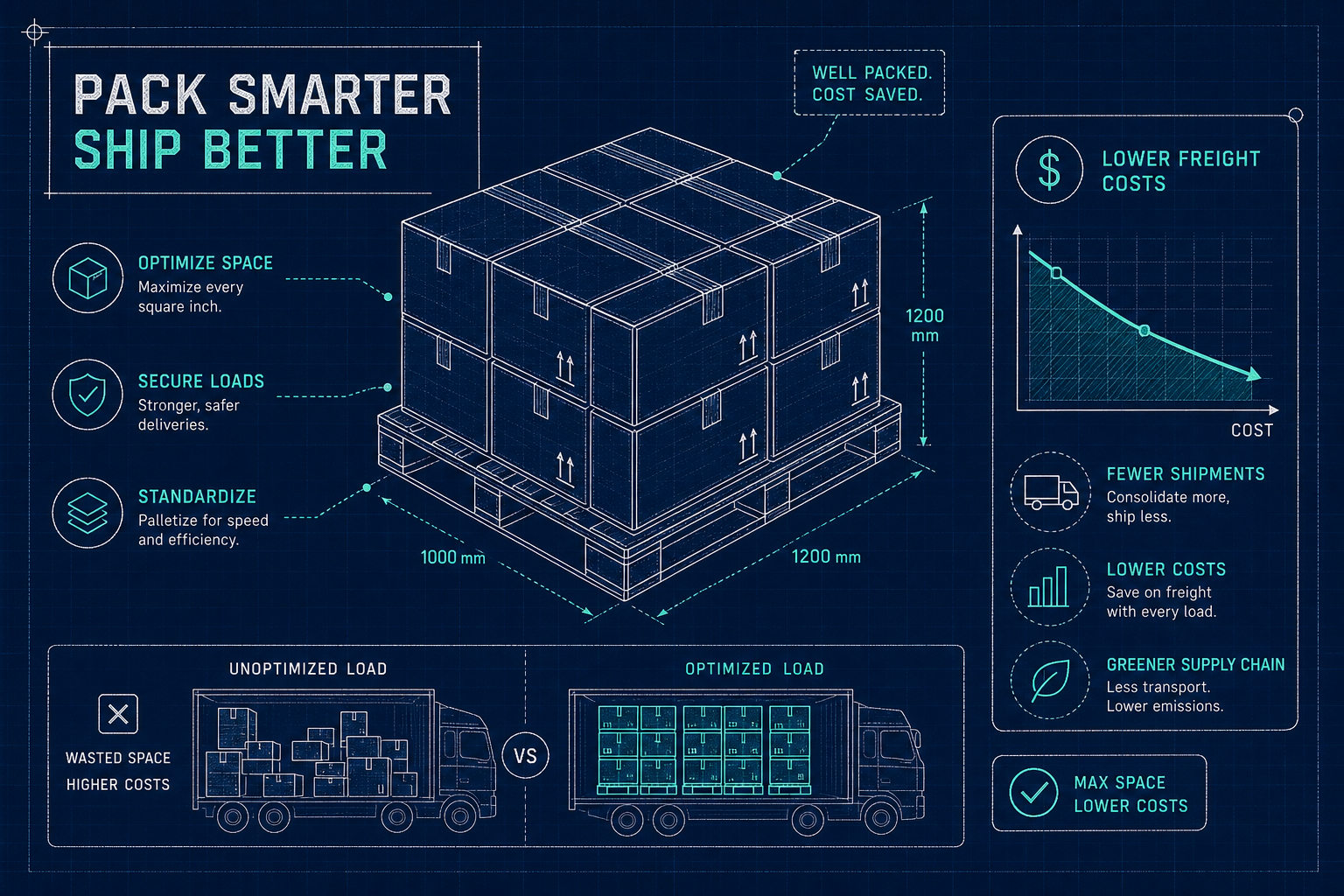
Palletized shipments: pack smarter and cut freight costs
A single rejected palletized shipment can cost you $100 to $500 before you ship a single item again. That number covers re-palletizing fees, return freight, rescheduled pickups, and replacement product costs, figures consistent with carrier accessorial tariffs and LTL industry cost structures. These losses most commonly trace back to three fixable mistakes: wrong pallet prep, incomplete paperwork, and no visibility into where your freight is once it leaves the dock.
Experienced resellers who source inventory through platforms like Pallet Liquidation USA already have the buying side dialed in, the weekly-rotating manifest inventory, transparent per-pallet pricing, and a money-back guarantee provide a solid operational foundation. But what happens after you click purchase matters just as much as what you buy. Incoming palletized freight needs the same operational rigor as outbound pallet shipping.
This guide covers five areas that determine whether your palletized shipments run clean or cost you: pallet sizing and weight limits, packing and securing methods, carrier compliance requirements, LTL versus FTL cost math, and the labeling and tracking systems that tie it all together. Work through each section and you’ll have a repeatable system, not just a checklist.
Pallet sizes and weight limits that actually matter
Before you load a single box, the pallet itself has to be right. The wrong dimensions or excess weight don’t just cause problems at delivery; they trigger fees at pickup that you never see coming.
The GMA 48×40 and when to use other sizes
The 48×40-inch GMA (Grocery Manufacturers Association) pallet is the default for virtually every US carrier and warehouse racking system. It accounts for roughly 30% of all pallets in circulation and is optimized for standard trailer widths, rail cars, and LTL dock workflows. Other sizes exist for specific industries: 48×48 for chemicals and liquid drums, 42×42 for beverages, 40×40 for dairy. If you’re shipping on anything other than a 48×40, call the carrier before booking. Non-standard sizes frequently require flatbed service or trigger oversize fees that can double your freight bill. For a concise reference on common sizes and international differences, see pallet sizes and dimensions.
Weight limits by pallet type and carrier
Heavy-duty wooden pallets can handle 4,600 to 5,500 lbs in static (floor-loaded) conditions. Dynamic transit limits are a different story. Most LTL carriers cap standard pricing at 2,500 to 3,000 lbs per pallet; going above that doesn’t just cost more, it can result in pickup refusal at your dock. One detail most shippers miss: an empty GMA pallet sits 6 to 6.5 inches tall. That height counts toward your total stack calculation, and exceeding the standard 84-inch carrier limit triggers accessorial fees before the freight even moves.
International pallet standards for cross-border palletized shipments
Euro pallets (120×80 cm, roughly 2,645 lbs max) are about 27% narrower than the US standard. Australian pallets run 116.5×116.5 cm, and Asian standards sit at 110×110 cm. None of these align with the 48×40 system. ISO 6780 is the reference document that covers all six global standard sizes. The practical rule: if you’re shipping internationally, verify regional pallet requirements with your carrier before loading. Mismatched dimensions create re-palletizing costs at the border that eat into your margins fast.
How to pack palletized shipments for transit
Most freight damage claims don’t happen on the highway. They trace back to how the load was built at origin. Getting the packing right removes the biggest variable in your claims rate.
Stacking patterns that resist transit forces
Three patterns cover most shipping scenarios. The brick or interlocking pattern staggers boxes across layers the way brickwork staggers courses, creating lateral resistance against side-to-side forces during transit. The pinwheel pattern alternates layer orientations around a central void and handles vibration particularly well on longer hauls. Column stacking, where boxes align in straight vertical rows, is only appropriate for uniform rigid containers and must be paired with strapping and tie sheets. Regardless of which pattern you use, one rule stays constant: heavy items go on the bottom, and you hand-test the load for stability before wrapping.
Stretch wrap, strapping, and corner boards
The layered approach that actually works starts at the base. Use film roping (twisting the stretch film into a cable-like band) to anchor the bottom layer directly to the pallet deck, then spiral upward with 50 to 60% overlap and 80% pre-stretch. Corner boards and edge protectors go on before the wrap, not after. They prevent the film from tearing on sharp box edges and add real crush resistance on fragile loads. For anything heavy or tall, add polyester or steel straps over the wrap. FMCSA requirements mandate a minimum of four securement devices on loads exceeding 10,000 lbs. Manufacturer guidance on secure wrapping techniques can help ensure consistent containment, see how to make sure pallet loads are wrapped securely for practical tips you can apply at the dock.
Load bars, dunnage, and trailer bracing
Securing the pallet itself is only part of the job. Inside the trailer, adjustable load bars should brace pallets every 6 to 8 feet, with an additional bar at the final row. Air bags and foam dunnage fill the voids between pallet loads and prevent lateral shifting during braking. Smaller shippers routinely skip this step, and it explains why loads arrive shifted even when the exterior wrap looks intact. For best practices on using load bars to avoid pallet tipping, consult guidance on using load bars to prevent pallets tipping.
Carrier requirements that cause refusals and extra charges
A perfectly packed pallet still gets refused when the paperwork or labeling doesn’t hold up. This is where the $200 accessorial fee you didn’t plan for comes from.
Pallet labeling and barcode compliance
Every pallet needs a unique license plate barcode in GS1-128 format (SSCC, or AMZNCC for Amazon fulfillment centers), visible pallet weight, a sequence number such as “1 of 3,” and clear ship-from and ship-to addresses. For pallets taller than 16 inches, labels must appear on multiple sides. Amazon tightened these rules in July 2024; a non-compliant pallet label results in warehouse refusal, not a fee notice and a second chance. Individual cartons within the pallet need their own logistic barcodes (GTIN-14), item descriptions, and quantities. Many carriers and major retailers require fully scannable GS1-128/SSCC labels for automated receiving, missing or unreadable labels frequently trigger refusals or manual processing delays that push back your entire delivery schedule.
Bill of lading documentation that holds up under scrutiny
The BOL determines who holds liability when something goes wrong, which makes precision non-negotiable. It must specify exact pallet count, carton and piece count per pallet, weights, and full carrier details including PRO and BOL numbers. Never use vague language like “STC” (said to contain) or “SLC” (shipper load count). Without specific counts, the carrier won’t sign for the load, and you lose the legal standing to file a valid damage claim. Attach packing slips to every pallet; they serve as the backup record if the BOL gets disputed at delivery.
Height, overhang, and packaging thresholds
Most LTL carriers cap stack height at 84 inches and limit shipments to six pallets without advance notice. Overhanging boxes lose roughly 32% of their stacking strength and create load shifts that transfer damage liability directly to the shipper. Knowing these hard limits before you load saves re-palletizing fees that typically run $100 to $200 per incident, and eliminates pickup refusals that set your delivery back by days.
LTL vs FTL: what palletized shipments actually cost per pallet
Freight class and shipment volume are the two levers that move your cost per pallet. Understanding both gives you the ability to engineer your freight spend rather than react to it.
How freight class and density pricing work for LTL pallet shipping
LTL pricing runs on the NMFC classification system, with classes ranging from 50 to 500. Density drives classification for most commodity types: divide the total loaded weight in pounds by the pallet’s volume in cubic feet. A standard 48x40x48-inch pallet works out to roughly 53 cubic feet. A 1,000-lb load on that pallet produces a density of about 18.8 lbs per cubic foot, which lands at Class 70. Electronics typically classify at 92.5, power tools at 92.5 to 100, and apparel at 175. For mixed pallets, the entire load defaults to the highest class of any single item unless each commodity is itemized separately on the BOL. That one detail is worth careful attention on every shipment. For a clear explainer on freight class and how carriers determine it, see what freight class is and how to determine it.
Cost per pallet ranges for LTL and FTL in 2026
For a standard 48×40 pallet at 1,000 lbs on a 500-mile lane, LTL runs roughly $150 to $300 per pallet at Class 70 to 100. Class 150 to 200 palletized cargo pushes that range to $300 to $500. Shipping five pallets on the same lane drops per-pallet cost to $100 to $250 through volume pricing. A full truckload of 22 pallets on a 500-mile dry van run comes in at $2,000 to $4,000 total, or $90 to $180 per pallet. Add fuel surcharges (currently running near 47% of base rate with national diesel above $5.60 per gallon as of mid-2026) and accessorials: liftgate service runs $75 to $150, and residential delivery adds $50 to $100 per shipment.
When LTL stops making sense and FTL takes over
The crossover point is typically 10 to 12 pallets on lanes over 400 miles. Below that threshold, LTL wins on flexibility and scheduling. Above it, the FTL per-pallet math is hard to argue against. Always pull a minimum of three quotes using platforms like Freightquote or Freightos before committing to any lane. The simplest cost-reduction move available to any shipper is maximizing load density: pack tighter, use the smallest pallet that fits the load, and itemize every commodity on the BOL to avoid defaulting to the highest freight class on mixed loads.
Labeling systems, tracking tools, and inventory software that streamline pallet operations
Knowing how to pack a pallet correctly is a baseline requirement. Running a scalable pallet operation requires systems that eliminate manual errors and turn receiving into a managed process.
Barcode label printers and SSCC generation for compliance
Thermal label printers like the Zebra ZT411 or SATO CL6NX handle the GS1-128 and SSCC barcodes required by major carriers and retail distribution centers. Generating SSCC numbers requires a GS1 Company Prefix, which is a one-time registration through GS1 US. For smaller resellers, cloud-based label software like ShipStation or Deposco auto-generates compliant pallet labels tied to each outbound order, eliminating manual encoding errors. Getting this system in place before scaling volume matters: a single label rejection at a fulfillment center holds up the entire shipment, not just the non-compliant pallet.
Inventory management software built for pallet-level tracking
For resellers managing incoming palletized shipments, the challenge isn’t only outbound shipping. It’s tracking what’s in each lot, what’s been listed, and what’s sitting in storage. Tools like Sortly, inFlow Inventory, and Fishbowl support SKU-level tracking from the moment a pallet arrives at your dock. Resellers sourcing through Pallet Liquidation USA have a concrete advantage here: each pallet ships with a defined product manifest that imports directly into most inventory platforms, making the receiving workflow faster and more accurate from day one rather than requiring a full manual count on arrival. For a practical walkthrough on receiving and managing pallet inventory as a reseller, see Pallet Liquidation: Your Guide To Buying And Profit.
Real-time pallet tracking and your receiving workflow
Real-time freight tracking through platforms like FreightPOP or project44 integrates carrier APIs to provide near-real-time or predictive ETAs, often down to a small-hour arrival window depending on carrier integration and lane. That lead time means dock space is cleared, staff is scheduled, and the intake workflow is staged before the truck arrives. The resellers who scale fastest aren’t always the ones with the best packing process. They’re the ones who treat incoming palletized cargo as a managed workflow rather than a variable they react to after delivery.
The freight claims you’re most likely to face and how to prevent them
Even well-packed freight gets damaged sometimes. Understanding where claims originate lets you build prevention into the process rather than file them reactively.
Why most palletized freight damage happens before the highway
Over 40% of pallet damage occurs during forklift operations at the loading dock, not in transit. Forklift tines gouging pallet sides, incorrect rack insertion, and rushed dock handling account for the bulk of physical damage claims. The prevention is operational: trained forklift operators, daily equipment inspections, and a standing policy of rejecting visibly damaged pallets at receiving. Document everything with timestamped photos before the driver leaves the dock. Carriers deny claims made without proof of condition at receipt, regardless of damage severity.
Load stability failures and packaging mistakes that drive claims
After dock handling, load instability during transit is the next biggest claim driver. Overloaded pallets, column-stacked boxes without tie sheets, and insufficient stretch wrap tension all contribute. Environmental factors like humidity and vibration amplify these failures significantly on longer hauls. The fixes connect directly to the packing section above: interlocking stack patterns, adequate containment force in the wrap (target 10 to 20 lbs of containment pressure), and corner boards on irregular loads. For LTL shipments specifically, your pallet shares trailer space with other freight and passes through multiple terminal transfers, which multiplies the stress on any weak points in the load.
Building a pre-shipment checklist that prevents most issues
Four checkpoints before every pallet leaves the dock eliminate the most common claim and fee triggers. Convert these into a posted dock checklist so they become habit rather than memory:
- Verify that weight and dimensions match the BOL exactly.
- Scan the SSCC label from all required sides to confirm readability before the driver arrives.
- Check that the load has a minimum of three complete rounds of stretch wrap with base film roping.
- For heavier or taller loads, add straps over the wrap, two or more, in line with carrier securement guidelines.
A brief pre-shipment inspection at the dock typically prevents material claim and rework costs that would otherwise eat directly into your per-pallet margin.
Running palletized freight like a system
Getting palletized shipments right is not a one-time decision. It’s a repeatable system built on five connected elements: correct pallet sizing and weight compliance, proper packing and securing methods, clean labeling and BOL documentation, smart freight class management, and the right tracking and inventory tools to give you visibility from order to shelf. For guidance on how to buy and profit from pallet lots, consult Why You Should Take Advantage Of A Pallet Liquidation USA to align purchasing strategy with operations.
For resellers sourcing inventory through Pallet Liquidation USA, that last piece carries particular weight. Every pallet arriving at your dock represents capital deployed. Treating incoming palletized shipments with the same discipline as outbound freight is the difference between a high-margin operation and one that spends half its time chasing damage claims and reordering inventory that arrived damaged.
Pallet Liquidation USA (southernliquidationpallet.com) offers weekly-refreshed lots across electronics, tools, footwear, and more, with advertised discounts well below retail on a rotating manifest. Pair a reliable source like that with the operational system this guide lays out, and your palletized shipments start working for your margins instead of against them. Browse the current inventory, check back for related guides on pricing and resale strategy, and treat every pallet as the managed asset it actually is. See also Pallet Liquidation: Your Guide To Buying And Profiting for selling and pricing tips tailored to resellers.
Leave a Reply
You must be logged in to post a comment.