


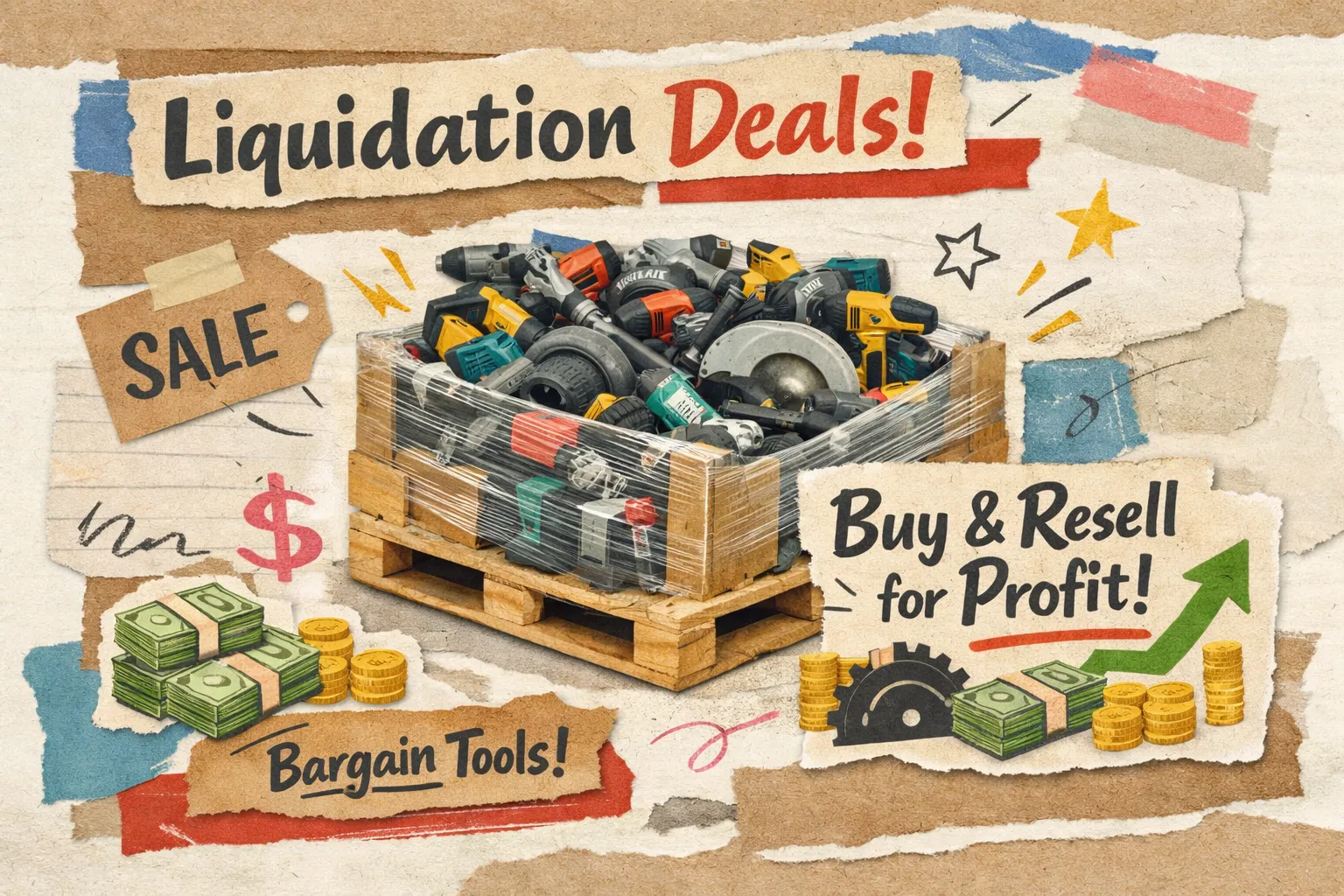
Power tools liquidation pallets: Buy smart, profit fast
Want to boost margins and turn inventory faster? Power tools liquidation pallets put bulk stock within reach, cutting per-unit costs that single-item sourcing can’t match. A single pallet can include dozens of SKUs ready for resale or refurbishment, and return or overstock lots lower your cost per unit so you can scale faster. Popular lots move quickly at B2B auctions or fixed-price drops, so plan bids and logistics before you buy.
Next sections cover where to source pallets, how to inspect manifests and simple refurbishment steps that help you buy smart and protect margins. Use the practical tips below to reduce risk and speed resale.
Key takeaways
- Buy for scale: Palletized power tools cut unit costs and speed turnover; match lot size to your sales channels to protect margins.
- Inspect the manifest: Confirm SKU, brand, model, condition and accessories, especially batteries and chargers, before you buy—missing parts are the main margin killer.
- Run the numbers: Use a simple ROI formula, for example (estimated retail value × sell-through) minus fees, shipping, repairs and purchase price, to set a maximum bid and avoid emotional buys.
- Source reliably: Favor manifested lots on reputable B2B platforms or fixed-price drops and use buyer protections to reduce risk.
- Test then scale: Start with one test pallet to validate repair time and sell-through, then increase purchases once your process and margins are proven.
Why buy power tools liquidation pallets?
Power tools liquidation pallets deliver volume, steady inventory and more predictable margins than sourcing items one at a time. Discount stores use pallets to refill shelves quickly, while Amazon and eBay resellers lower per-SKU inbound costs. Repair shops and DIY retailers get a steady stream of parts and refurb stock; the two biggest advantages of pallet buying are lower cost per unit and faster turnover.
Match pallet type to your operation and bandwidth to avoid surprises. New pallets arrive factory-sealed and carry lower risk at a higher price. Customer returns are mixed and need inspection, shelf pulls are near-new and often require little work, and salvage lots are parts-only and best for repair shops. Use the quick mapping below to pick the lot type that fits your model.
- New: For retail stores and high-volume online sellers who want minimal refurbishment and fast resale.
- Customer returns / shelf pulls: Good for eBay and Amazon FBA sellers who inspect, test and relist quickly.
- Salvage: Best for repair shops and parts resellers who break pallets for cores and components.
Brand mix and accessory completeness determine how fast items sell and what price they fetch. A branded tool with a battery sells far faster than a bare body, so plan purchases around brand demand and confirmed accessory counts. The next section explains where to source the best pallets and which platforms move the most inventory.
Where to source power tool pallets (marketplaces & auctions)
Start with large B2B auction networks like B-Stock power tools auctions and Direct Liquidation when you want scale and predictable sourcing. Many lots on those platforms are manifested with SKU-level details, though some sell as-is without detailed manifests, and sellers often require business registration and a resale certificate. Bid with a firm maximum, favor manifested lots to reduce risk and avoid last-second bidding wars by using proxy bids or preset limits.
Fixed-price pallet sellers beat auctions when you need speed, predictable SKU mixes or clear arbitrage on branded items. Compare advertised retail value to recent sell-through on marketplaces; MSRP rarely equals realistic resale and manifests show the true upside. Use completed listings and condition notes to estimate margins before you buy — consider established wholesale marketplaces like Liquidation.com for power tools when you want a fixed-price, manifested lot.
If you buy smaller quantities, check CPO outlets, local salvage yards and regional liquidation hubs for FOB pickups and small truckloads. CPO channels and refurb dealers sell individual refurbished tools or small lots that convert quickly but cost more per unit, while local salvage lets you inspect items hands-on and turn inventory faster. Some regional sellers post live video previews and offer FOB options, which helps buyers who cannot handle full truckloads manage inventory scale more conservatively. Match the source to your risk tolerance, scale and logistics capacity before you bid. For specific wholesale pallets, some suppliers publish wholesale power tool pallets and manifest details to aid buying decisions.
What to expect: prices, lot sizes and condition by pallet type
Expect wide variability in price and lot composition when shopping power tools liquidation. New pallets often list around $800 and contain 3–35 retail-boxed tools ready for quick resale, while returns lots can start at a few hundred dollars and climb into the thousands for larger manifests. Truck or warehouse lots commonly include 100–300 pieces, with combined retail values between roughly $3,000 and $15,000 depending on brand mix and manifest detail. Condition patterns are predictable: customer returns show the most variance, shelf pulls and overstock present lower risk, and salvage loads usually supply parts rather than turnkey items.
Brand mix strongly drives resale value. On secondary marketplaces, refurbished cordless drills and drivers typically sell from $70 to $180 with batteries, while bare tools go for $40 to $90 and combo kits sell from about $120 to $350. A healthy battery can add $40 to $120 to a tool’s resale value, so confirm battery counts on the manifest and ask for sample photos or split-lot options when possible. Manifest accuracy is the main driver of real ROI, so request invoice-level SKUs and recent grading notes before you commit. If you specialize by brand, consider dedicated pallets such as DeWalt Tools Liquidation Pallet Wholesale | Pallet Spot Deals, Dewalt Tools Pallets, Pallets Liquidation or Milwaukee Tools Liquidation Pallet Wholesale | Pallet Spot to keep SKU mixes consistent.
Inspecting the pallet: a practical checklist for tools
Read the manifest carefully and flag obvious red flags before you buy. Look for clear columns for SKU, brand, model, condition, quantity and notes about batteries or missing parts, because vague entries or bulk descriptions often hide variation or damage. If the manifest is thin, request additional photos, serial numbers or short video walk-throughs that show the lot spread and a few items powered on.
On arrival, run a quick visual and functional inspection using a checklist so you do not miss common faults. Scan for cracked housings, stripped gears, damaged switches, missing accessories, rusted metal and frayed cords, and verify whether batteries and chargers are present. Then run a short functional protocol to confirm basic operation before you invest time in repairs.
- Power on: confirm the unit boots or spins freely without smoke or harsh vibration.
- Basic load test: cut or drill a soft material for 10–20 seconds to verify torque and motor sound.
- Battery charge check: measure charge with an indicator or swap a known-good battery when possible.
After inspection, triage items into resell-ready, repairable and parts-only bins to streamline processing and pricing. Estimate repair costs for common fixes: carbon brushes $10 to $30, belts $5 to $20, cord or plug replacements $10 to $40 and battery packs $30 to $120 depending on brand. Factor parts, labor and a margin into your resale price, and source components from OEM suppliers, reputable aftermarket sellers or bulk parts auctions. With those costs accounted for, you can decide whether to liquidate by pallet or sell items individually.
Pricing math and the resale playbook
Use a consistent bid formula every time: (estimated retail value × sell-through) minus fees, shipping, handling, repairs and purchase price equals expected profit. For example, a 45-piece pallet bought for $750 with an average retail of $60 per tool has $2,700 total retail. If you model a 70 percent sell-through that yields $1,890, subtract 12 percent marketplace fees ($227), $150 shipping and handling, $300 in repairs and your $750 purchase price to arrive at an expected profit of about $463. Run this math before you bid so you do not chase lots emotionally.
Repairs and parts salvage can change the math quickly, so use conservative estimates. Minor fixes typically run $5 to $20, battery replacements $30 to $80 and major motor or gearbox repairs $50 to $150. For mixed returns, plan a sell-through between 60 and 80 percent and assume many liquidated tools will lose value without batteries or chargers.
Choose sales channels based on fees, speed and item condition, and keep channel selection consistent so your pricing becomes repeatable. eBay reaches wide audiences and often gets the highest prices for branded single items, while Amazon works well for OEM kits and high-demand SKUs despite higher fees. Facebook Marketplace and local pickup avoid platform fees and move damaged or repairable units quickly, and local wholesale buyers can take bulk lots for cash at lower per-unit prices. Match branded, complete tools to online marketplaces and send repairable items to local buyers or salvage channels.
Logistics, protections and next steps to buy safely
Most platforms require quick registration and, for resellers, a resale certificate so you do not pay sales tax at purchase. Expect buyer fees on auction sites, including percentage premiums, transaction fees and occasional pallet handling charges. Decide early between delivered freight, which simplifies logistics but raises per-tool cost, and FOB pickup, which saves money if you have transport. Factor in free shipping thresholds, often around $2,500, when calculating per-tool cost and break-even prices.
Reduce risk by using every inspection tool available: read manifests, examine photos and consider third-party inspections for high-value lots. Document arrival with timestamped photos and video during unpacking, note missing SKUs and keep packaging as evidence for disputes. Know the dispute window for your platform and the seller’s return policy, and understand chargeback risk if you rely solely on credit card protections. Transit insurance for loss or damage is often affordable and worth adding on larger buys.
Prioritize suppliers that publish manifests, inspection checklists and clear buyer protections to reduce surprises and speed resale. Pallets Liquidation USA sources weekly from top U.S. retailers, ships nationwide from Wisconsin, and provides manifest support and 24/7 live online assistance to help evaluate lots. They also offer free shipping on orders over $2,500 and a 100 percent money-back guarantee on qualifying purchases. Those practices lower your workload and improve sell-through by aligning lot quality with what the seller promises.
Three practical steps will cut risk: pick the right marketplace, use an inspection checklist and run the pricing math before you bid. These habits make pallet buying repeatable and protect your margins over time.
Ready to buy power tools liquidation with confidence
Power tools liquidation pallets give scale, steady inventory and more predictable margins when you source returns and overstock. You can unlock steep discounts, often 70 to 90 percent off retail, by choosing lot sizes that match your resell strategy and logistics. Start with a single test pallet, inspect the manifest and calculate expected ROI before you bid, then scale once your process proves profitable. Small tests help you control risk and keep cash flowing as you grow.
Leave a Reply
You must be logged in to post a comment.