


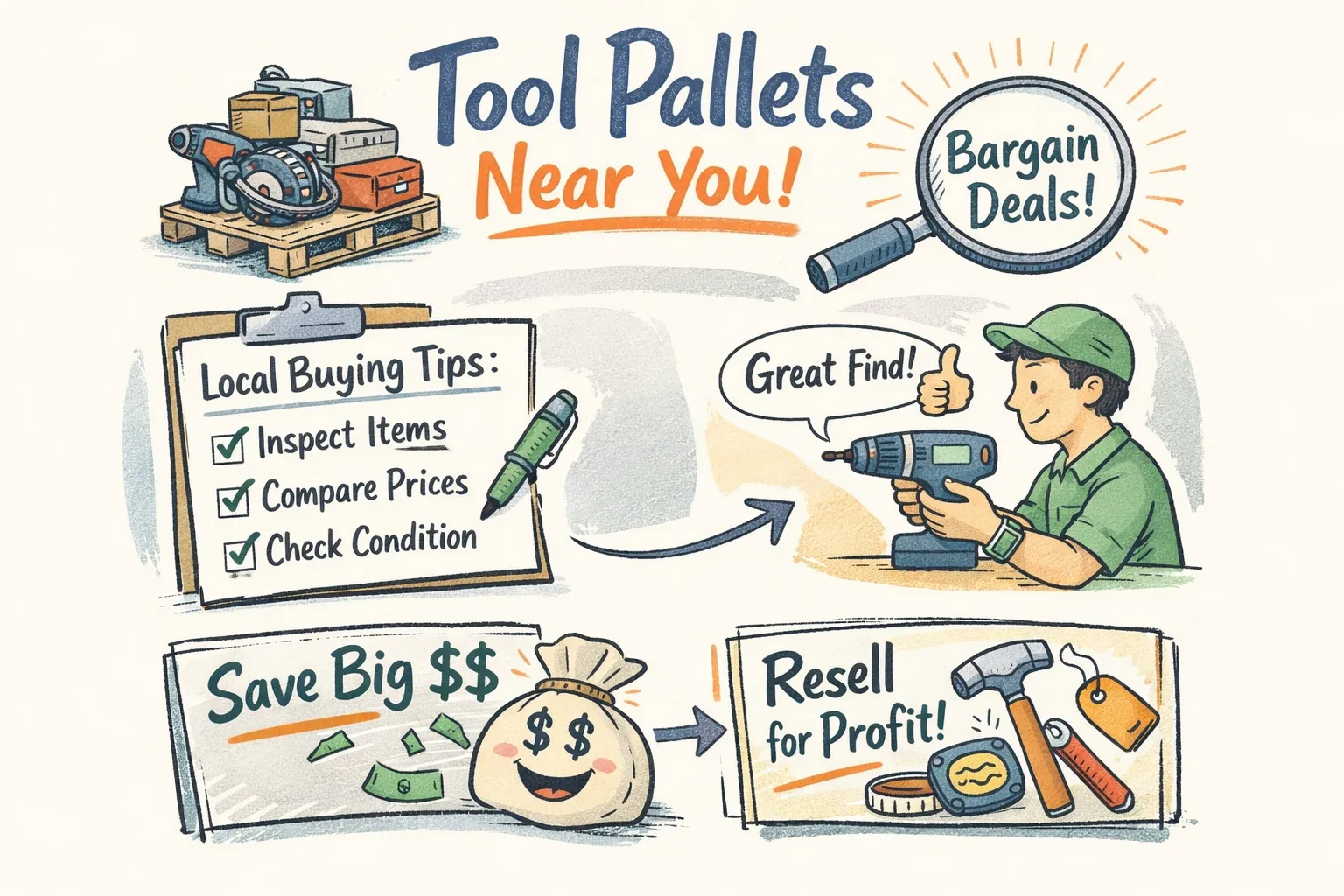
tool liquidation pallets near me: local buying checklist
Looking for tool liquidation pallets near me can turn a slow inventory cycle into a fast margin boost when you buy with a plan. Focused buying makes power-tool and closeout pallets steady profit drivers instead of sources of surprise returns.
Quick summary
Start local. Use ZIP- and city-targeted searches and auction calendars to find nearby tool pallets you can inspect in person for faster turnaround. Local pickup often speeds listing and reduces freight exposure.
Demand manifests. Request a CSV manifest, recent photos, and a physical address before you bid or drive, and verify SKUs, counts, brands, and stated condition to avoid surprises. Written pickup and claims windows help you price and plan.
Set price benchmarks to filter buys quickly. Small mixed pallets typically fall between $400 and $1,500, while higher-manifest branded pallets often range $3,000 to $6,000; use your ROI formula to protect margins before you commit.
Inspect at pickup and document everything: bring PPE, a flashlight, a barcode app, and charged batteries, and record video or photos of counts and damage before you leave. Prefer local pickup when inspection matters; otherwise budget LTL shipping and add repair, fee, and labor estimates into your offer.
Where to find tool liquidation pallets near me
Begin with a local-first search to surface nearby liquidators and auction calendars quickly. Use queries such as “tool pallets liquidation near [ZIP],” “tool liquidation pallets near me,” or “power tool return pallets [city].” Focus on independent liquidators, retail recovery yards, and estate or industrial auction houses because they usually post pickup windows and may require appointments or paid onsite pickup.
When you need scale, balance local hunting with national marketplaces. Check B-Stock (including Amazon Liquidations), Liquidation.com, Quicklotz, That Liquidation Place, and American Liquidations; many of these platforms offer LTL shipping and some list local pickup options. Be aware some marketplaces are business-only and may require a resale certificate or business account, so filter by “tools” or “power tools” and sort by shipping method to match your logistics. Keep manifest and photo requests front and center when buying sight-unseen.
Don’t overlook neighborhood feeds for one-off bargains: big-box closeouts, shelf-pulls, dealer returns, Facebook Marketplace groups focused on liquidation, and Craigslist often show truckload or pallet-sized offers. Save searches and set Google Alerts for phrases like “power tool pallet” plus your city to catch drops early. Community forums and local auction calendars can lead to repeat sources once you build relationships. After you shortlist lots, inspect manifests and estimate ROI before you bid or pay.
How to vet sellers and verify manifests
Require documentation before you bid or pay. Ask for a full manifest in CSV or spreadsheet format listing SKU, UPC, brand, count, and stated condition, plus clear photos of the pallet face and several unboxed sample items. Request a bill of sale, a defined pickup window, and a written claims window so you know how long you have to dispute issues. These items shorten claim time and let you price items before arrival.
If a seller cannot provide a manifest, treat the lot as high risk and reduce your offer accordingly; a practical rule is to subtract 25 to 50 percent from your maximum bid to protect against unknown defects or mismatched SKUs. Verify the seller’s identity by checking business registration, phone number, Google reviews, and BBB or Trustpilot listings, and ask for transaction references. Use secure payment methods such as credit card or platform escrow and avoid direct wire transfers to unknown sellers. Look for these red flags before you commit:
- No manifest or photos available
- Seller pressures you to pay by wire only
- Inconsistent pricing across listings or sudden steep discounts
- No formal claims process or written pickup/claims window
Marketplaces vary in buyer eligibility and auction terms; many auction lots sell as-is with no returns, and some platforms require reseller certificates while others accept individuals. Factor platform fees, buyer premiums, and expected claims handling time into your bid so your ROI stays realistic. With these checks in place, you can move on to on-site inspection and listing strategy covered in the next section. For a practical step-by-step guide, see the complete checklist for buying liquidation pallets.
Price benchmarks, pallet sizes and grading expectations
Typical tool pallet prices depend on composition and source. Small or assorted tool pallets often sell for $400 to $1,500, branded pallets usually range from $3,000 to $6,000, and full truckloads commonly run about $16,000 to $17,000 for 22 to 30 pallets. Item counts generally fall between 100 and 300 pieces per pallet, and price shifts with pallet height, box density, and whether the lot is retailer returns or salvage.
Run the numbers before you buy. For example, a $700 mixed-tools pallet with roughly 200 items and a 70 percent sellable rate yields about 140 sellable units; if the average resale is $20 you would gross about $2,800. Subtract the pallet cost and you have $2,100 before shipping, fees, repairs, and labor, which equals about $10.50 gross per sellable item before expenses. Use this per-item approach to compare lots when searching for tool liquidation pallets near me or nationwide offers.
Grading sets expectations for working-condition mix and listing strategy: new sealed lots typically yield 95 to 100 percent working items, customer returns tend to be 70 to 90 percent working, and salvage or parts lots often provide 20 to 50 percent usable units (see pallet grades A, B, C). Quick heuristics include counting sealed boxes, checking for batteries and chargers in photos, and flagging visible damage to estimate usable-item count from a manifest or images. Freight and minimums affect final cost, so decide between single pallets or truckloads and account for LTL versus curbside delivery, liftgate requirements, and tall pallets that increase LTL charges. If you need construction or building items for a project, consider a Building Materials Liquidation Pallet | Wholesale Construction Supplies option when appropriate. Before you buy, run a break-even checklist: pallet cost plus shipping plus expected repairs plus labor equals the minimum gross resale needed.
Pickup inspection checklist: what to test, count and document
Before pickup, assemble the right kit and confirm logistics so the process is fast and clean. Bring personal protective equipment, a phone with video, a small flashlight, a barcode app, an assistant, and tools to test such as charged batteries and a multimeter. Confirm your appointment, dock access, and pallet numbers on the manifest, and make sure the seller has a contact who can answer on-the-spot questions.
Run quick, high-value functional checks first to avoid wasting time on low-margin items. Prioritize name brands and items prone to battery failure: remove sample batteries to test chargers or briefly run cordless tools to confirm motors and basic functions. If you cannot power items, inspect batteries for swelling, corrosion, and missing labels, and test chargers for correct brand matches. Use a sampling plan such as testing 10 percent of items or the top 10 branded tools; if more than 25 percent fail in your sample, walk away or renegotiate the lot.
Document everything to preserve claim rights and resale value: log counts, serial numbers, and UPCs for mismatches, and take time-stamped photos and short video of unboxing and random tests. Ask the seller to initial or sign any noted discrepancies at pickup and file claims within the seller’s specified window, presenting manifest versus actuals with your media as proof. If you buy from a seller offering a money-back guarantee and 24/7 support, use their channels to speed claims, then grade and price items for resale as described in the next section.
Shipping, local pickup networks and quick turnaround options
Choosing between pickup and shipping comes down to inspection needs, speed, and cost. Pickup lets you inspect the load, avoid large freight fees, and often move inventory faster, while shipping widens your inventory reach but adds freight risk and accessorial charges. Battery-containing items add complexity because carriers restrict or charge extra for them, so factor that into your logistics plan.
When scheduling pickup, confirm dock access and whether you need a forklift or liftgate. If you rely on LTL, get detailed pickup and delivery quotes and ask about accessorials, minimum charge weights, and insurance for freight damage. Plan for curbside releases if necessary and build a margin buffer for potential freight losses. For carrier rules and restrictions on shipping batteries, review FedEx’s guidance on how to ship batteries.
Estimate resale ROI and decide whether to buy
Estimate ROI before you commit using a simple formula: ROI % = ((expected resale revenue − pallet cost − shipping − repairs − fees − labor) / pallet cost) × 100. For example, a $700 pallet with $150 shipping, $100 repairs, and 140 sellable items averaging $18 net each yields $2,520 revenue. Subtract platform fees of $300 and $100 labor to get $1,170 net profit, which equals about 167 percent ROI. To calculate per-item breakeven, divide total cost ($700 + $150 + $100 + $300 + $100 = $1,350) by 140 units to get roughly $9.65 per item, and set a green-light rule such as ROI greater than 40 percent before tax.
Match selling channels to lot grade and effort: Amazon FBA fits high-volume, high-condition items but expect 15 to 30 percent fees and stricter condition rules; eBay handles mixed or parts lots with typical fees around 10 to 12 percent plus listing costs; local classifieds and Facebook Marketplace charge no fees and deliver quick cash but offer lower reach. Repair and parts sales yield higher margins but require more labor and parts sourcing (see Auto Parts & Accessories Liquidation Pallet – 200 Items). For liquidation pallets, grade A/B lots suit FBA and eBay while C and parts lots are better for local sales and repairs. Factor channel fees and expected labor into your ROI model when deciding whether to buy.
Negotiate with simple rules that protect margin and keep offers conditional on manifest accuracy or battery inclusion. Example scripts include: “If batteries are included and tested, we can offer $X; without batteries we will subtract $Y,” or “We can pick up today for $X if you can hold the pallet until noon.” For bidding, set a maximum from your ROI model, consider using a proxy bidder to avoid emotional overbids, and compare buy-now offers. Walk-away rules include clear red flags that should end negotiations immediately.
Carry a short checklist to every pickup: verify the manifest and seller identity, sample-test high-value tools and batteries, photograph and document each pallet, and run a quick ROI check before you commit. Pair local scouting with vetted national options to reduce risk when searching for tool liquidation pallets near me. When you find a lot that meets your green-light rules, request final manifests and schedule pickup or shipping promptly.
Final checklist for finding tool liquidation pallets near me
Use this compact checklist to find tool liquidation pallets near me: start with ZIP-targeted searches and demand documentation before you buy. Vet sellers by verifying manifests, photos, and seller history so you know what you will receive. Apply price benchmarks and grading expectations to filter lots and protect your margin.
Run a search like “tool pallets liquidation near [ZIP]” and shortlist two sellers, then request full manifests and recent photos for each lot. Use live chat or platform manifest review to confirm grading and shipping options before you commit, and set a firm walk-away rule based on your ROI model. For direct liquidation sourcing, consider Tool Pallets, Pallets Liquidation; they ship nationwide from Wisconsin and often list pallet lots at 70–90% off retail. They offer free shipping on orders over $2,500, a 100% money-back guarantee, and 24/7 live online support for manifest questions. With manifests in hand and this checklist, you can place a confident, low-risk order and start turning pallets into cash flow.
Leave a Reply
You must be logged in to post a comment.