


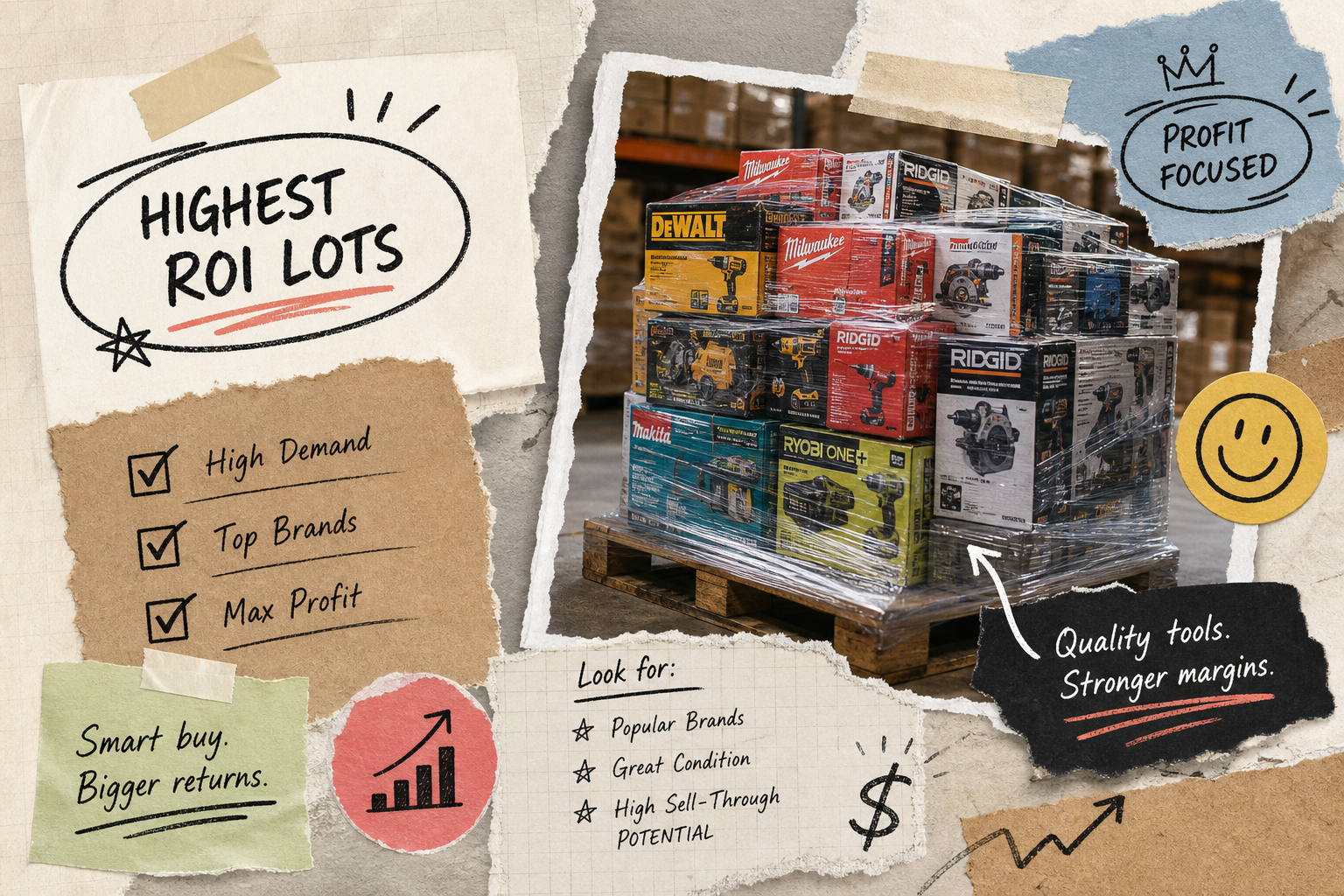
Power tool pallets: how to find the highest-ROI lots
Many first-time buyers of power tool pallets do it backwards. They fixate on the sticker price and ignore everything that decides whether they will profit. The difference between a $1,200 lot that nets $3,800 and a pallet that sinks your cash comes down to the decisions you make before you pay.
This is a field-tested playbook drawn from hands-on liquidation work and buyer reports. If you want consistent margins, you need a repeatable way to read manifests, score condition, price risk, and lock in protections before a truck ever leaves a dock.
By the end of this guide, you will know how to grade condition accurately, identify high-ROI brands and models, calculate true landed cost, and protect your capital with the right shipping and return policies. Profit follows process. Let’s build yours.
What’s actually inside power tool pallets (and what the grades mean)
The five condition grades and what they do to your margins
Most suppliers use a similar grading scale: New (factory sealed), Like New (opened but unused), Used/Tested Working, Open-Box/Untested Returns, and Salvage/Parts-Only. In mixed Amazon return tool pallets and retailer returns, the practical breakdown often skews to roughly 20% new, 40% working, and 40% salvage or damaged. Untested does not mean broken, but it does mean you own the testing time and any repair cost after the sale. In listings for power-tool liquidation pallets, grade mix directly sets your defect risk and your labor load, which is why two pallets from the same retailer can deliver very different ROI. If you are evaluating salvage tool pallets, assume a higher parts-out rate and plan to recover value through components.
Why manifests are your most important pre-purchase document
A proper manifest lists each SKU, UPC or ASIN, brand, unit-level condition, quantity, and original MSRP. Top-tier suppliers keep variance to 5, 8%; average operations drift 20, 40% (rules of thumb cited by Tier‑1 supplier guidance and buyer reports). No manifest, no purchase. Demand detail and use it to project revenue against real comps before you spend a dollar.
- Every line should include brand, model, SKU or UPC/ASIN, and a condition code.
- MSRP should match major retailers within a few dollars, not fantasy pricing.
- Prefer item-level grading over lot-level. It is the only basis for accurate ROI math.
Which brands command the best resale prices
DeWalt, Milwaukee, and Ryobi consistently lead sell-through and value in wholesale tool pallets. Brand recognition speeds turnover on eBay and Amazon, and parts availability makes repairs economical when needed. Harbor Freight and off-brand generics tend to dilute per-unit value, so a “cheap” pallet heavy on generics often underperforms a pricier manifest loaded with recognizable SKUs. Buy brand mix, not just box count. For a deeper strategy and examples, consult Pallet Liquidation: A Comprehensive Guide To Profit.
Realistic price ranges and how to calculate your true cost per unit
Buying a pallet at $1,200 does not make your cost $1,200. Freight, handling, and the non-functional percentage change the math fast. Your baseline per-unit cost should be calculated on sellable units only, not total pieces on the manifest.
What you should expect to pay by pallet tier
Single pallets from direct liquidators and auction platforms commonly range from $500 to $2,800 depending on brand mix, grade, and piece count. For example, Texas Tool Pallets lists untested mixed-tool pallets at $500, $1,500 and occasional heavy lots around $2,800, while American Liquidations shows Home Depot returns pallets in the $499, $1,099 band. Truckloads from general merch and home improvement sources typically start near $5,800 and can extend to $17,000 or more for 24, 30 pallets. Auction sites like B‑Stock let sellers set low starting bids to spur competition; in our sampling of 2026 B‑Stock closing results, many tool lots settled around 10, 30% of MSRP, though results vary widely by condition and bidder activity. At Pallets Liquidation USA, current listings generally fall within these bands and are manifested so you can model margins, confirm details on each product page.
The landed cost calculation resellers skip
Use a simple formula: (purchase price + shipping + handling) ÷ total units = baseline cost per unit. Then adjust for defects by dividing the total spend by expected sellable units. For example, a $1,200 pallet with 60 units and $100 freight pencils to $21.67 per unit on paper. Remove 20 non-sellable units and your real cost per sellable piece jumps to $32.50. In 2026, many LTL lanes price closer to $250 per pallet regionally, which would push that same scenario to $36.25 per sellable unit. This is the number your resale price must beat after marketplace fees.
How to identify power tool pallets with the highest ROI potential
Reading condition grades on power tool pallets as ROI signals, not just descriptions
Grade A pallets cost more upfront but give you predictable margins with minimal rework. Grade B tested-working lots still perform well when the brand mix is strong. ROI risk spikes with untested returns: defect rates can run 30, 40% and repair costs vary by fault type. Common fixes include carbon brushes at $5, $60, switches at $10, $25, and cords at $10, $30; motor or armature failures often require $80, $200 in pro work and can exceed resale value. Brushes are cheap, motors are not, so scan manifests for brushed models you can service versus high-risk failures that should be parted out.
Which models move fastest and why that matters for your turnover rate
Profit is margin multiplied by speed. When evaluating B‑stock tool pallets, cross-check specific models against eBay sold listings, not active ones. eBay sold data in 2026 shows why certain SKUs deserve a premium in your buy model. The models below cleared consistent used prices across multiple 90‑day windows (eBay Sold Listings; April 2026 snapshot, recheck before you buy).
- DeWalt DCD791D2 20V compact drill/driver kit: about $95 sold (range $75, $125).
- DeWalt DCF887B 20V impact driver (bare): about $65 (range $50, $85).
- Milwaukee 2804-20 M18 Fuel drill/driver (bare): about $85 (range $65, $110).
- Milwaukee 2853-20 M18 Fuel impact driver (bare): about $90 (range $70, $115).
- Ryobi P238 One+ drill/driver kit: about $45 (range $35, $60).
- Ryobi P343 One+ reciprocating saw (bare): about $35 (range $25, $50).
A tool listed at $120 but consistently selling for $70 used is a $70 comp for your math. Build your buy box around SKUs with fast sell-through and stable used prices so capital turns quickly.
Using Pallets Liquidation USA’s inventory as a sourcing benchmark
Pallets Liquidation USA advertises frequent sourcing from U.S. retailers; check current listings to confirm recency. Our manifested lots let you run the ROI model up front: reconcile our SKU list against eBay solds, apply your landed cost per sellable unit, and pressure-test margins before checkout. As advertised on our site, we offer a 100% money-back guarantee on misrepresented lots and 24/7 support, review our current Terms of Sale and Refund Policy to confirm coverage and any limits. Framing your bids against a consistent sourcing and policy baseline reduces two major risks in tool pallet liquidation: buying blind and having no recourse if a lot is misrepresented. For market context on return pallets specifically, see this Helium 10 analysis of Amazon return pallets.
The pre-purchase checklist: what to verify before you place an order
A clean manifest and a fair price on power tool pallets do not finish the job. A short, disciplined checklist protects you from avoidable losses and turns good-looking opportunities into reliable profit. Do this work once, then repeat it for every lot you buy.
How to verify a manifest before trusting it
Ask the supplier for their stated manifest variance percentage and how they measure it. Ten percent or less is acceptable, five to eight percent is ideal, and anything over twenty percent is a red flag for ROI modeling. Sample a handful of high-value SKUs and cross-check MSRP against major retailers to spot inflation. Confirm whether condition is graded per item or applied at the lot level, since item-level codes are far more useful for calculating revenue, parts recovery, and listing workflows. If you’re new to this process, read Buying Liquidation Pallets: Complete Guide For New Resellers for a step-by-step checklist and templates.
Red flags that signal a bad lot (or a bad supplier)
- No manifest provided, or refusal to share it before purchase.
- Vague condition like “mixed returns” without a grade breakdown or piece count.
- MSRP totals that feel inflated relative to the lot price, which suggests cherry-picking already happened.
- Unknown or evasive retailer source, inconsistent photos, or blurred labels.
- Recalled models in the mix, such as certain Ryobi circular saws, RIDGID or Kobalt nailers, and Craftsman table saws noted in recent CPSC notices.
- Payment-only pressure with wire or cash and no documented buyer protection.
Shipping logistics and return policies that protect your profit margins
Getting pallets to your door finishes the cost stack and defines your recourse if something goes off-spec. Logistics and policy clarity are not afterthoughts. They are part of the buy decision because they change your margins and your risk profile.
What freight actually costs on power tool pallets and how to factor it in
Expect 500, 1,000 pounds per pallet. In 2026, domestic LTL rates for a single pallet typically run $150, $300 for local moves under 300 miles, $400, $800 for regional hauls up to 1,000 miles, and $500, $1,800 for cross-country lanes depending on class and accessorials. The national average sits near $513 for a 500‑pound Class 70 shipment, plus common handling fees of $20, $50, often excluded from advertised list prices (FreightQuote LTL market data, April 2026). Always quote freight before you bid or buy, and use free-shipping thresholds to your advantage. At Pallets Liquidation USA, orders over $2,500 may ship free within the contiguous U.S., see our Shipping Policy for current thresholds, coverage, and exceptions. For additional freight pricing context, review how much freight delivery costs.
Why return policies matter as much as the purchase price
Most tool pallet liquidation is sold AS‑IS, which is fine when the manifest is clean and supplier variance is tight. The problem is misrepresentation. A real buyer protection policy is the only meaningful backstop when you purchase $1,000‑plus lots sight unseen. Before you pay, get the policy in writing, including what triggers a valid claim, what photos or videos you need to submit, and refund timelines. Per our posted policies, Pallets Liquidation USA offers a money-back guarantee on misrepresented lots and 24/7 support, review Terms of Sale and Refund Policy for current coverage. Price is only a deal when protections are clear.
Conclusion
Power tool pallets offer some of the strongest margins in liquidation, but only for buyers who treat each lot like a business decision rather than a roll of the dice. The formula is repeatable: verify the manifest, read condition as a risk signal, model landed cost against real sold comps, screen for recalled models, and buy from suppliers who publish variance and stand behind their manifests.
The resellers who win here are not luckier, they run the same system every time. If you are ready for consistent results, start with manifested inventory and clear buyer protections. Explore Pallet Liquidation: Discover Profitable Resale Opportunities to compare manifests, confirm current shipping thresholds, and review our guarantees. Run your numbers, pick your lot, and let the process do the heavy lifting.
Leave a Reply
You must be logged in to post a comment.