


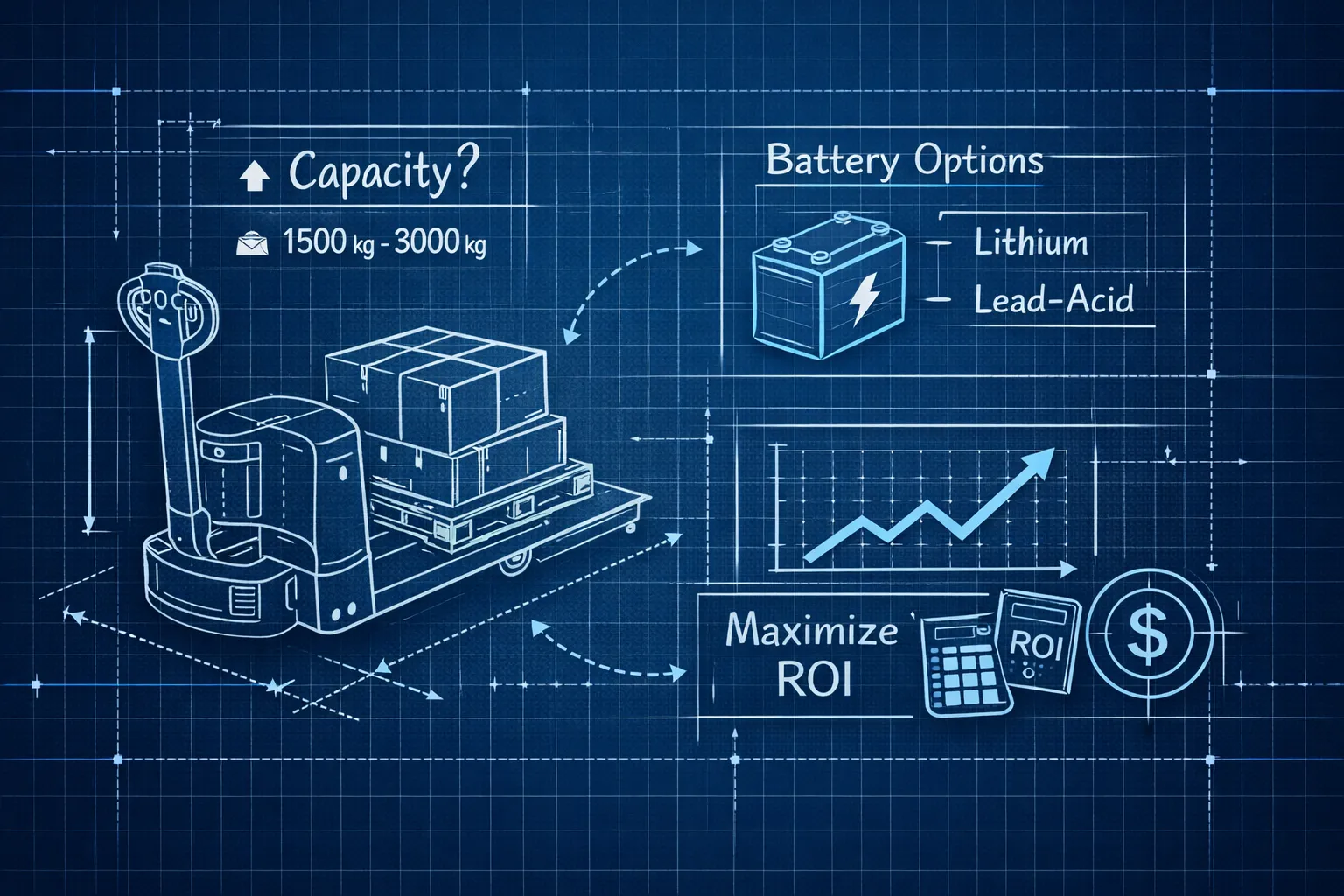
Powered pallet trucks: choose capacity, battery, ROI
If your team spends hours pushing pallets each day, powered pallet trucks can cut time and reduce strain. They replace repetitive hand-pumping with motorized movement and raise throughput, while manual pallet jacks still fit occasional short-distance tasks and keep upfront costs low. The sections below walk through capacity, battery choices, total cost of ownership and a practical trial plan.
Quick summary
Before you shop, prioritize capacity, battery chemistry and total cost of ownership. The bullets below help you weigh features and estimate payback.
- Match capacity: pick a truck with roughly 20 percent headroom over your typical pallet weight and size, sizing to real-floor loads rather than advertised lift alone. Also check load center and pallet condition when you calculate required capacity.
- Prioritize battery: lithium-ion works for long runtime and opportunity charging on multi-shift floors, lead-acid lowers upfront cost, and TPPL sits between those options. Consider charging logistics and replacement intervals when weighing chemistry choices.
- When to switch: powered pallet trucks generally pay when you move about 50 or more pallets a day or operate multiple shifts, thanks to labor savings and higher throughput. Estimate labor savings per move to confirm payback.
- Calculate total cost of ownership: include purchase price, battery type, maintenance, energy and expected uptime when estimating payback. Request demo runtime specs and vendor estimates to ground your assumptions.
- Train and maintain: certify operators, follow OSHA and ANSI guidance, and run preventive maintenance to protect uptime and safety. Keep records of training dates and inspections to support compliance and continuous improvement.
Powered pallet trucks vs manual pallet jacks: the quick reality
Powered pallet trucks and manual pallet jacks address different needs on the floor. Motorized units remove most of the physical pushing and raise throughput for repetitive moves, while manual jacks remain the lowest-cost option for occasional tasks. Choose the configuration that matches aisle width and duty cycle. Walkie pallet trucks shine in tight aisles and short hauls, while rider trucks pay off for longer runs and continuous flows. Manual pumps keep maintenance simple, but as move counts climb they add operator fatigue and slow operations. If you need a refresher on manual jack limits, see guidance on how much weight a pallet jack can lift.
Capacity is another deciding factor—size machines for your actual loads and load center rather than rated lift alone. The next section breaks capacity into practical bands and shows how to add a safety margin before you buy.
Choosing the right capacity for your workload
Match truck capacity to the reality of your floor, not only to advertised numbers. Capacities cluster into three practical bands that cover most operations; use the list below to find the best fit and then factor in how you actually load and move pallets.
- Light-duty (3,000–4,400 lb). Best for retail backrooms and small warehouses where pallets are lighter and agility matters. Typical loads include boxed apparel, packaged food and single-layer stock.
- Standard-duty (4,400–6,600 lb). The common band for general warehouses and distribution centers handling mixed cases and full pallets. It covers most daily moves without compromising durability.
- Heavy-duty (6,600–8,000+ lb). Suited for bulk transfers, dense loads and ride-on scenarios where long runs and heavy stacks are routine. Typical settings include manufacturing, lumber yards and operations moving tile, metal parts or double-stacked pallets.
Load center, pallet condition, ramps and rough surfaces all reduce effective capacity. An offset or high load center lowers rated capacity, and a cracked pallet transfers stress unevenly, so assume a reduced safe working load in rough environments. Factor these conditions into your selection and pick a larger band if needed.
Use a quick three-step method: measure a representative sample of loaded pallets, identify your worst-case pallet and add a 20–25 percent safety margin. Then choose the next capacity band above that adjusted weight. For example, a 4,500 lb worst-case pallet plus 25 percent becomes 5,625 lb, which points to the standard-duty or low heavy-duty band.
Battery choices for powered pallet trucks: lithium-ion, lead-acid and TPPL
Lithium-ion batteries deliver the longest runtime and the fastest opportunity charging. Expect lithium packs to provide more uptime per shift than comparable lead-acid units, with opportunity top-ups or full charges in about one hour; lead-acid typically needs 8–12 hours to recharge plus a cooldown period before reuse. TPPL falls between these two options for both charging and maintenance. Cycle life mirrors runtime: roughly 2,000–3,000+ cycles for lithium-ion, 1,000–1,500 for TPPL and about 500–1,000 for lead-acid, which affects replacement schedules and shift planning.
Charging and battery upkeep shape shop layout and routines. Lead-acid batteries require watering, venting and dedicated charger bays to manage hydrogen off-gassing and cooldown windows, while TPPL reduces watering needs but still needs controlled charging. Lithium-ion units need minimal maintenance and support distributed opportunity charging, allowing chargers to be placed across the floor for shorter walks back to charge points. When sizing chargers for a fleet, account for location, ventilation and clear labeling.
Lithium-ion units cost more up front but usually lower downtime, energy consumption and replacement frequency. If you run multi-shift operations or have high daily hours, lithium-ion often pays back within 12–24 months through labor and uptime savings. For a deeper look at the lithium-ion vs TPPL battery comparison, review vendor lifecycle and charging profiles before deciding.
Total cost of ownership and pricing by capacity
Expect wide price ranges based on capacity and features. Basic electric walkie models rated around 3,000–5,500 lb typically list between $2,000 and $3,300; mid-level units with lithium batteries and longer duty cycles cost more, and heavy ride-on trucks are substantially pricier. Manual pallet jacks remain the low-cost option at about $400, while used or leased machines can cut upfront spend but add variability in remaining life and warranty coverage.
Battery replacement, maintenance and downtime drive most lifetime costs. Battery technology and replacement interval determine recurring capital needs, while regular service and operator training influence reliability and productivity. Look for features such as regenerative braking, efficient motor controllers and easy service access to shorten repair time and lower shop hours.
Use a short ROI checklist before buying so you can make a clear comparison. Track acquisition cost, expected useful life, annual maintenance and battery expense, energy cost per year, labor hours saved per day and estimated residual value to estimate true payback.
Example: assume a $4,000 standard unit with a five-year life, $500 annual maintenance and $200 annual energy cost. If it saves 1.5 labor hours per workday at $15 per hour over 250 workdays, labor savings are about $5,625 per year. Subtracting maintenance and energy leaves a net annual benefit around $4,925, so payback approaches 10 months; use this framework to compare new, used and lease offers and to review financing, warranty and incentives before you commit.
Safety, training and maintenance: keep uptime high
OSHA 29 CFR 1910.178 sets the baseline for powered industrial trucks and ANSI covers design and guarding standards. Operator training and documented certification are mandatory, capacity must never be exceeded and any structural modification requires manufacturer approval. Keep training records with course dates, refresher sessions and incident follow-ups to demonstrate compliance and to identify gaps quickly.
Practical site controls reduce common incidents in mixed-use warehouses. Consider the following fit-for-purpose add-ons and controls:
- Horns and audible alerts to warn pedestrians during maneuvers. Set volume levels appropriate to your facility and test them with staff.
- Blue spot lights in pedestrian zones to increase visibility before turns. Position lights at eye level and check coverage during day and night shifts.
- Load backrests on ride-capable units to prevent toppling with tall stacks. Confirm backrests are rated for your tallest loads and inspected regularly.
- Overhead guards where falling-object risk exists, and proximity sensors where traffic is dense. Combine guards and sensors with clear traffic patterns to reduce collisions.
Set a maintenance rhythm that matches your duty cycle and battery chemistry. Do daily pre-use checks covering brakes, steering, forks, controls and battery condition, plus a monthly technician walk-through and deeper servicing every four to six months for heavy use. Track inspections in a simple digital log with timestamps and corrective actions, and plan battery replacement at roughly three to five years depending on lithium-ion or lead-acid life and intensity of use. For practical tips on regular maintenance required to keep pallet trucks functioning, follow vendor recommendations and log corrective actions. When your team trains consistently and records are clear, uptime stays high and claims fall.
Next steps: model shortlist, ROI checklist and Pallets Liquidation USA help
Start with a shortlist by capacity and price band: a light-duty walkie for agile handling (3,000–4,400 lb; roughly $2,000–$4,000), a mid-level lithium-ion model for multi-shift standard duty (4,400–6,600 lb; roughly $6,000–$12,000), and a ride-on or heavy-duty truck for continuous high-capacity work (6,600–8,000+ lb; about $12,000–$25,000). Treat these bands as starting points; the exact fit depends on your floor plan, pallet mix and throughput. When you narrow models, look to trusted makers such as Crown, Yale and Hyster.
Pallets Liquidation USA helps liquidation resellers and small buyers match weekly pallet manifests to capacity and battery recommendations, coordinate vendor quotes and loaner trials, and validate ROI before purchase. Inventory is updated weekly and sourced directly from leading U.S. retailers across categories such as electronics, apparel and home goods. Examples include category-specific lots like the Auto Parts & Accessories Liquidation Pallet – 200 Items and tool-focused offerings such as the DeWalt Tools Liquidation Pallet Wholesale. Use the site’s 24/7 chat or schedule a consult to get model quotes and plan loaner tests that reflect the actual pallets you receive. Take warranty and financing options into account before you commit.
Follow a short trial plan before committing. Sample and weigh representative pallets, run a loaner truck for a full shift and record charge cycles and operator feedback. Obtain maintenance and warranty quotes, then apply the ROI checklist to total cost of ownership. Use acceptance criteria such as at least 92 percent uptime during a shift, recharge times that fit your break windows and positive operator comfort ratings.
- Weigh sample pallets and log load centers. Record these figures in a spreadsheet for easy comparison across lots.
- Run a loaner unit for a full shift and record cycles. Track run time, number of charges and any downtime during the trial.
- Collect operator feedback and safety notes. Ask operators to rate comfort, visibility and handling and to flag any near-misses or concerns.
- Gather servicing and warranty estimates. Compare warranty coverage, turnaround times and what is included in scheduled maintenance.
- Apply the ROI checklist to total cost of ownership. Use a conservative estimate for residual value and stress-test the model against heavier-than-expected loads.
Choose powered pallet trucks that match your floor and ROI
Choosing powered pallet trucks is a matter of balancing capacity, battery type and how quickly the truck pays for itself.
Leave a Reply
You must be logged in to post a comment.