


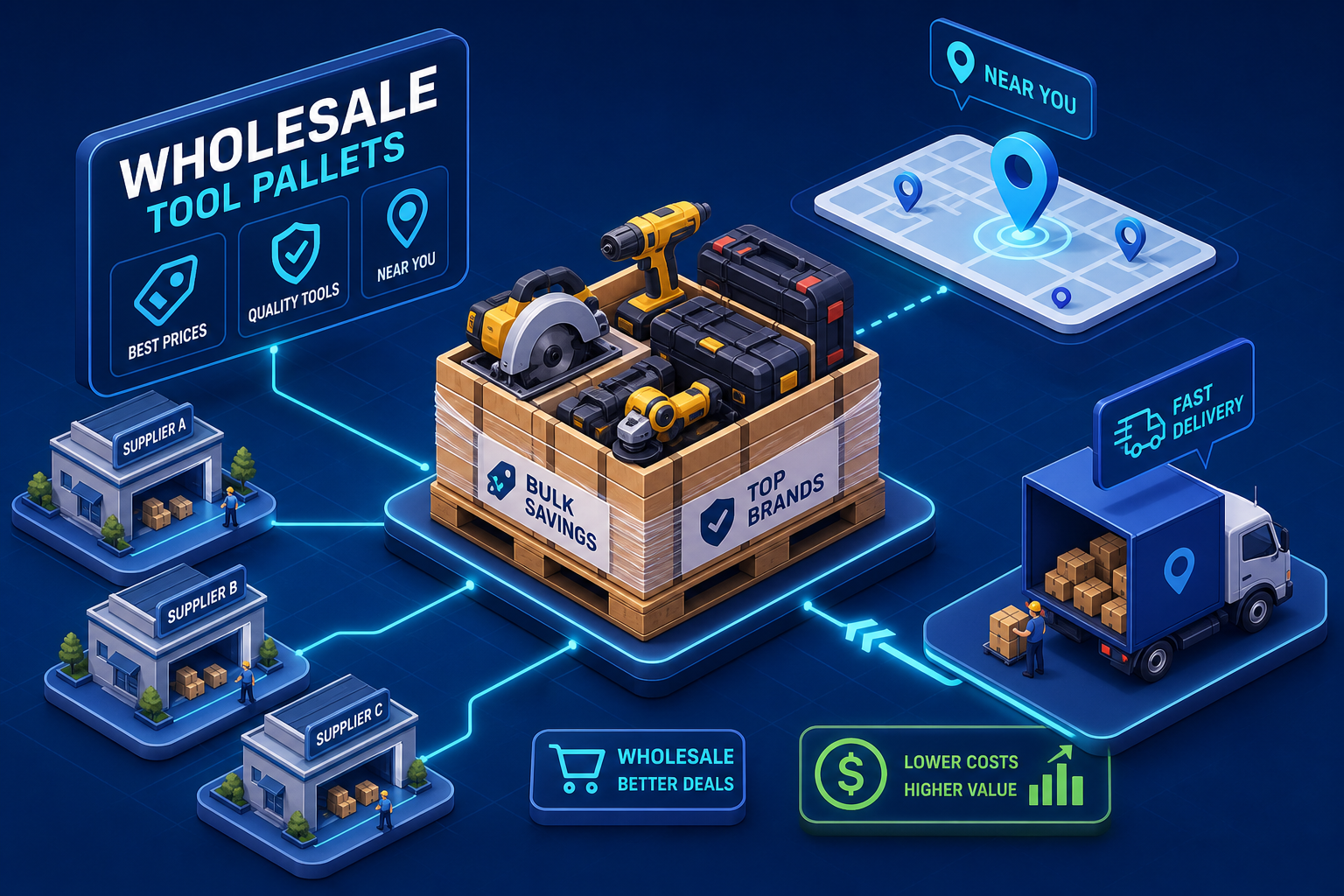
Wholesale Tool Pallets Near You: Best Sources and Prices
If you’re searching for wholesale tool pallets near me, you already know the opportunity is real. Brands like Milwaukee, DeWalt, Makita, and RYOBI show up regularly in these lots, and the resale math is compelling: a single pallet purchased for $1,200 can carry $6,000 or more in retail value. Tool pallets can offer strong margins, particularly for premium brands, though results vary by manifest, condition grade, and seller expertise. The problem isn’t the opportunity. The problem is finding a reliable source without overpaying, getting burned on undisclosed condition issues, or watching your margin disappear in freight costs.
Many new resellers start with auction sites or warehouse visits without a repeatable sourcing system, which makes scaling difficult. This guide gives you a faster, smarter path: where to find wholesale tool pallets near you, what they actually cost in 2026, how to inspect before you commit, and how to get inventory home without blowing your numbers. Throughout, we’ll reference Pallets Liquidation USA as a benchmark for pricing and buyer protections, verify current terms directly on their site before purchasing.
Where to find wholesale tool pallets near me
National liquidators with local pickup options
Several national liquidators operate physical locations or allow buyers to arrange local pickup, which eliminates freight costs entirely. Half Off Wholesale runs two physical locations and carries power tools, generators, and air compressors available by the pallet or truckload. Texas Tool Pallets operates fully online but offers pickup as an option alongside shipping. American Liquidations, based in Connecticut, lists Home Depot power tool pallets in the $949 to $1,099 range. That Liquidation Place specializes in Home Depot, Lowe’s, and Harbor Freight inventory, with truckload pricing running from $5,800 to $17,000 depending on brand and condition mix.
Before you drive anywhere, call ahead. Confirm that pickup is available, ask whether the pallet is manifested, and verify that loading equipment is on site. That single five-minute call will save you hours of wasted trips.
Local liquidation warehouses and cash-and-carry stores
Local liquidation warehouses operate on a simple model: they buy bulk inventory from national liquidators and resell it regionally, usually on a cash-and-carry basis. You walk in, inspect the lot, negotiate a price, load it yourself, and leave. No shipping delays, no blind buying. Searching “tool liquidation warehouse [your city]” or “cheap wholesale tool pallets near me” will surface most of these stores within a few minutes.
The catch is consistency. These stores move inventory fast, and the best tool lots are gone within days of hitting the floor. Weekly visits beat waiting for a website to update. Building a relationship with the owner or manager puts you first in line when premium lots come in.
Online auction platforms as a sourcing layer
Platforms like Liquidation.com let buyers bid on pallets remotely, then arrange pickup or shipping after winning. Auction pricing can be competitive, but bidding wars on popular brand names eat margin quickly. Use condition-grade filters to target specific inventory quality and set a firm ceiling before you bid. These platforms work best as a supplemental sourcing channel, not your primary one, especially when you’re searching for manifested power tool pallets near me at a predictable price point.
What’s actually inside a tool pallet
Common brands and why they matter for resale
Milwaukee and DeWalt carry the highest resale velocity in the liquidation market. Contractors and serious DIYers actively search for these brands by name, which means faster sell-through and stronger pricing power on eBay, Facebook Marketplace, and Amazon. A pallet heavy in Milwaukee M18 or M12 tools will move significantly faster than a generic assortment. Makita, RYOBI, and RIDGID are also solid, though they typically command slightly lower resale prices than the top two. Understanding brand mix before you buy directly affects how quickly you recover your investment.
Condition grades: what “as-is” actually looks like in practice
Tool pallets typically contain a mix of customer returns, shelf pulls, and overstock, all sold as a bundled lot. Customer returns range from like-new (opened box, never used) to non-functional units that need repair or replacement parts. Shelf pulls are usually the cleanest inventory: removed from store displays but otherwise untouched. Overstock is new product, often without full retail packaging. Most local sellers don’t grade individual items, so expect a condition spread across the lot.
A manifested pallet lists every SKU, unit count, and condition grade. An unmanifested lot is a blind buy with higher risk and usually a lower purchase price. Manifested pallets cost more upfront but eliminate the guesswork, which matters when you’re calculating resale potential before you commit.
Typical unit counts and pallet configurations
Assorted hand tool pallets typically run 100 to 300 units. Mixed power tool lots average 60 to 150 units. Premium, manifested power tool pallets can be as compact as 45 units but carry significantly higher per-unit value. Knowing unit count before you buy helps you estimate sort time and listing workload, not just purchase cost. A 300-unit hand tool pallet at $600 is a great deal on paper, but if sorting and listing takes 15 hours, factor that labor into your margin math.
How tool pallet pricing works and how to calculate your margin
Real price ranges across pallet types in 2026
General assorted hand tool pallets run $450 to $850. Mixed tool lots fall in the $850 to $2,400 range. Premium, manifested power tool pallets typically start around $750 and can reach $3,500 or more depending on brand concentration. Truckloads through national liquidators run $5,800 to $17,000. Retail recovery value on a single pallet commonly ranges from $5,000 to $12,000, which means even conservative resellers target a 2x to 3x return on investment. Aggressive individual-item sellers on eBay or Amazon can push 6x to 12x on premium tools when condition and brand align. For an additional breakdown on typical pallet pricing and cost drivers, see this guide on how much do pallets cost.
Negotiation leverage when buying locally
Local cash-and-carry sellers expect negotiation, especially on unmanifested or visibly imperfect lots. Your strongest leverage points are cash payment, a commitment to buy multiple pallets at once, and specific damage or missing components you identified during your inspection. Asking directly for a “walk-away price” can unlock meaningful discounts off the listed lot price without much back-and-forth, though the actual number depends on the seller, the lot condition, and local demand. Complete your inspection first, then make your offer based on what you actually found.
Quick margin calculation framework
Start with estimated resale value of sellable units, then subtract pallet cost, freight, sort time, and listing fees, what’s left is your gross profit. A practical example: a $1,200 tool pallet with $6,000 in retail value, where 60 percent of items are sellable at 50 percent of retail, yields $1,800 in revenue and roughly $600 in gross margin before platform fees. Adjusting your sellable percentage assumption based on condition grade is the single biggest variable in the math. Overestimating sellable yield is the most common mistake new buyers make. For a deeper dive into wholesale pallet buying strategies, consult the Ultimate Guide To Buying Wholesale Liquidation Pallets In 2025, Pallets Liquidation.
Inspecting a tool pallet before you commit
The fast on-site inspection routine
Start with the pallet itself: check for cracked stringers, missing deck boards, and protruding nails. Then check shrink wrap integrity and whether the load has shifted or looks unstable. After that, sample the top layer by opening 5 to 10 boxes at random to read the condition distribution across the lot. Look for recognizable brand names, check power tools for visible housing damage or missing batteries and chargers, and note whether items still carry original UPC stickers and packaging.
Five minutes of targeted checking beats 30 minutes of regret after you’ve already loaded the pallet and driven home. You’re not trying to inspect every item, you’re trying to validate the condition story the seller is telling you. A quick pallet audit checklist can help structure your walkaround and ensure you don’t miss key visual cues.
Red flags that should change your offer or make you walk
Walk away from, or negotiate hard on, any lot showing visible water damage, off odors, or evidence of pest contact. Bent runners, warped deck boards, and exposed fasteners suggest the load was mishandled and may have taken impact damage. Inside the lot, watch for a disproportionate number of broken housings, missing components, or off-brand knockoff tools buried in the mix, signs the seller has already skimmed the valuable items.
Any red flag is either a negotiating point or a reason to walk. Treat them as data, not automatic dealbreakers. A pallet with two or three water-damaged boxes can still be a strong buy at the right discount. For a more detailed list of common inspection failures, review a pallet quality inspection checklist.
Pickup vs. shipping: logistics and what it actually costs
When local pickup is worth the effort
For pallets priced under $1,500, local pickup in a pickup truck, cargo van, or rented box truck is often more cost-effective than freight, particularly given that standard haul-away services start around $79 for a single pallet and LTL rates can run $150 or more even for short hauls. If the seller has a loading dock and a forklift on site, the process takes under 30 minutes. Confirm dock access and loading equipment before you make the drive, and always factor in distance and pallet weight when comparing pickup against shipping costs.
Freight options when distance or volume makes pickup impractical
For multiple pallets or long-distance purchases, LTL (less-than-truckload) freight is the standard option. In 2026, LTL rates for tool pallets within the continental U.S. typically run $150 to $300 for local hauls under 250 miles, $250 to $550 for regional moves, and $500 to $800 or more for cross-country shipments. Dock-drop deliveries, where you bring the pallet to a carrier facility rather than scheduling a pickup, generally cost less than home or business delivery. Budget freight as a hard line item in your margin calculation before you commit to any remote purchase. Use a dedicated pallet shipping cost guide to estimate LTL and pallet shipping costs for your specific routes.
When free shipping changes the whole equation
Some wholesale liquidators offer free shipping above a purchase threshold, which fundamentally changes the margin math on multi-pallet orders. According to Pallets Liquidation USA, orders over $2,500 qualify for free shipping, verify current terms on their site before purchasing. At that level, a two-pallet order of premium tool inventory ships to your door at no additional freight cost, which can offset $200 to $400 or more in LTL expenses depending on distance and pallet weight. Factor shipping costs into every purchase decision before you say yes, not after.
What serious resellers do when local supply runs dry
Why local supply is inconsistent by nature
Local liquidation warehouses replenish unpredictably. A premium tool lot available Monday morning can be gone by Tuesday afternoon. If you’re building a consistent resale operation, relying solely on local pickups creates inventory gaps that stall your business. High-volume resellers maintain at least one reliable national wholesale source alongside their local circuit, so sourcing never fully stops when a nearby warehouse runs thin. Searching for wholesale tool pallets near me and bookmarking the best regional options is a start, but it’s not a complete system.
How Pallets Liquidation USA fits into a smart sourcing strategy
According to Pallets Liquidation USA, they source power tools, hand tools, and outdoor equipment from major U.S. retailers, offering significant discounts off retail across categories. The company reports a money-back guarantee and free shipping on qualifying orders, confirm current terms on their site before purchasing. For resellers who want manifested lots, predictable supply, and documented buyer protections without driving hours to inspect a pallet in a warehouse parking lot, a national source like this fills a genuine gap in any sourcing strategy. Learn more about sourcing strategies in Unlocking Profits With Liquidation Pallet: Your Key To Wholesale Savings, Pallets Liquidation.
Use local warehouses for speed and hands-on inspection. Use Pallets Liquidation USA as your consistent backstop when local options are thin, overpriced, or limited to unmanifested lots. The combination gives you flexibility without gaps.
Build a sourcing system, not a one-off hunt
The resellers who consistently profit from bulk tool inventory treat sourcing as a repeatable system. They know their sources, understand the pricing ranges, inspect before they commit, and build logistics costs into the margin math before they ever say yes to a lot. The opportunity in palletized tool inventory is real, but it rewards buyers who operate with discipline, not just enthusiasm. For a detailed workflow and checklist, read the Buying Liquidation Pallets: Complete Guide For New Resellers.
Local sources give you speed and the ability to inspect in person. National liquidators like Pallets Liquidation USA give you consistency, buyer protections, and shipping advantages at scale. Used together, they cover each other’s weaknesses. The right mix depends on your volume and storage capacity relative to the margin targets you need to hit.
Search “wholesale tool pallets near me” to see what’s currently available in your area, then check the inventory at Pallets Liquidation USA to compare pricing, manifest quality, and buyer terms. The best lots move fast on every platform. Get your sourcing system in place before the next one does.
Leave a Reply
You must be logged in to post a comment.