


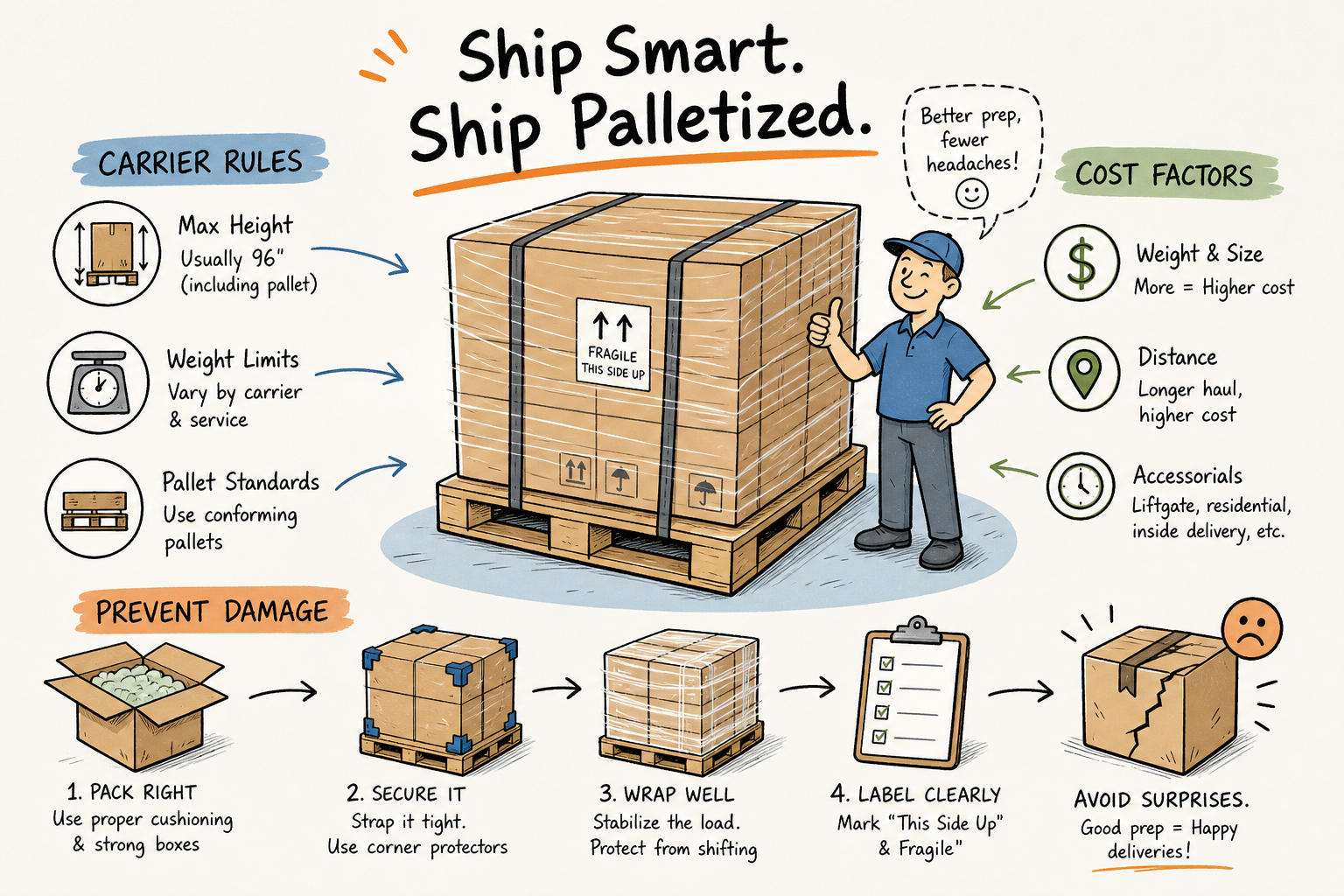
Palletized Delivery: Carrier Rules, Costs, and Damage Tips
Palletized delivery can make or break a shipment, here’s why. You open a trailer and your heart sinks. Cartons are crushed, boxes have shifted, and a freight claim is already writing itself. Most damage and accessorial fees are attributable to improper packaging, unstable pallets, and missed accessorials, common, documented causes in carrier packaging guides and LTL claims data (FedEx Freight; Old Dominion; NMFTA).
Palletized delivery means loading freight onto a pallet so the pieces become one stable, unitized load. That single unit is the backbone of LTL and bulk freight in the U.S. because forklifts and pallet jacks can move it fast with fewer touches. For resellers receiving bulk shipments from wholesale suppliers like Pallet Liquidation USA, knowing what happens between your supplier’s dock and your door protects margins and gets inventory resale‑ready on arrival.
This guide gives you the playbook. You will see what drives cost, the carrier rules that matter, how the final bill is calculated, and a 10‑step checklist to stop damage before it starts. Use it to quote with confidence and keep claims out of your day.
What palletized delivery actually involves
How a palletized load works in transit
Palletization turns loose boxes into a single unit that carriers can handle quickly and consistently. Forklifts slide into the pallet, not the product, which means fewer touches, faster dock turns, and less per‑unit handling risk than floor‑loaded freight. Fewer touches mean fewer opportunities for damage.
That efficiency is why pallet freight dominates commercial movement. Terminals are optimized around the common 48 × 40 inch GMA‑style pallet footprint and equipment compatible with four‑way entry pallets and standard pallet jacks (GMA 48×40 reference). When your load is square, tight, and within the pallet edges, it flows through that system cleanly from pickup to delivery.
When LTL pallet shipping is the right move
Use LTL when your shipment weighs roughly 150 to 15,000 pounds and does not need a full trailer. Your pallets share space with other shippers’ freight, which is what keeps your cost down compared to dedicated truckload. Shared trailers also mean shared handling rules: your skid must be stable enough to withstand several transfers across hubs.
Before pickup you need the basics dialed in. That includes accurate weights and dimensions, proper wrapping and securement, and clear labels that match the bill of lading. Meeting those standards keeps your freight moving and prevents rework fees at the terminal.
What drives the cost of pallet freight
The three main pricing variables: weight, distance, and pallet count
LTL pricing in 2026 clusters around three levers. Weight sets the base, distance sets the lane, and pallet count influences how much trailer space you reserve. Across common lanes, a practical current range runs about $150 to $600 per pallet, with denser freight and short hauls at the low end and long, bulky moves at the high end (Coyote Logistics: LTL rates; C.H. Robinson LTL guide). For another practical breakdown of the cost of LTL shipping, see carrier and broker comparisons that list typical surcharges and per‑pallet averages.
Shippers also see per‑hundredweight pricing between $20 and $50 per CWT. Distance pushes totals further: under 250 miles often rates at $150 to $300 per pallet, 250 to 500 miles at $200 to $550, 500 to 1,000 miles at $250 to $900+, and cross‑country moves can reach $350 to $1,800+ per pallet. The mix of class, service level, and accessorials rounds out the bill. If you’re benchmarking pallet shipment cost, compare by density, class, and lane, not just headline price.
Why lighter shipments often cost more per pound
LTL is priced on the space your freight occupies as much as on its weight. A light but bulky pallet consumes the same trailer real estate as a dense one, so carriers use freight class and dimensional rules to account for that. This density paradox is why two same‑size pallets can yield very different invoices.
The fix is not guessing. Measure your skid, calculate density, and choose packaging that compacts volume. Improving density nudges your freight toward a lower class and a better rate without changing the actual product.
Carrier rules every shipper needs to know
Standard pallet dimensions and weight limits
The North American standard is the GMA 48 × 40 inch pallet. Most LTL docks, forklifts, and trailers are built around that footprint. In practice, carriers treat 2,000 to 2,500 pounds per pallet as the normal operating range, and some publish piece‑weight limits a little above 3,000 pounds that may require prior approval. Always verify the current rules tariff for your carrier before booking (FedEx FXF 100; ODFL 100).
Pallet condition matters. Carriers can refuse pickup if your skid has broken boards, missing deck slats, protruding nails, or structural defects. Keep product fully within the pallet edges and ensure two‑way or four‑way fork entry is unobstructed. No overhang, no exceptions. For a quick reference chart of common pallet footprints, review standard pallet sizes with charts.
How NMFC freight class affects what you pay
LTL carriers use the National Motor Freight Classification system, from Class 50 to Class 500. Class is determined by density, stowability, handling, and liability. Denser, easier‑to‑handle freight earns a lower class and a better rate; lighter or more delicate freight gets a higher class.
Here is a quick density example: a 48 × 40 pallet, stacked to 48 inches, weighing 500 pounds occupies 53.3 cubic feet, which yields 9.4 pounds per cubic foot. That typically lands around Class 100. Misclassify your freight, and the carrier can reclass at delivery, often with added fees and a higher effective rate.
How carriers calculate your final freight bill for palletized delivery
Dimensional weight and why it matters
Many carriers compare actual weight to dimensional weight and rate the higher number. DIM weight is calculated as Length × Width × Height divided by the carrier’s DIM factor. For parcel and some LTL rating models, a common divisor is 139 (FedEx Service Guide). For an LTL‑specific look at how dimensions and weight restrictions affect billing, see this LTL dimensions and weight restrictions overview.
Example: a pallet measuring 48 × 40 × 72 inches has 138,240 cubic inches. Divide by 139 and the billable weight is about 995 pounds. If the actual weight is only 250 pounds, you will be rated on 995 unless your LTL tariff strictly uses class. Accurate measuring before you book helps prevent reweigh and reclass fees at delivery.
Accessorial fees that catch shippers off guard
Add‑on services sit on top of the base line‑haul. Typical 2026 averages: liftgate $75, $150, residential delivery $75, $175, and appointment delivery $25, $50. Limited access locations, inside delivery, and reweigh or reclass charges also apply when conditions demand them. Published fees vary by carrier and lane, consult the current rules tariffs for details (XPO 190; FedEx FXF 100).
Accessorials are not trivial. A great base rate can become a mediocre total if you miss a liftgate need or mark the address as commercial when it is residential. Call out every service on the quote so your palletized delivery is priced apples to apples.
A 10‑step checklist for damage‑free palletized delivery
Steps 1 through 6: building and securing the load
- Start with a sound pallet. Use an undamaged 48 × 40 or size‑appropriate skid with no broken boards or protruding nails, and match the pallet footprint to the load.
- Build a heavy base. Place the densest items on the bottom and distribute weight evenly so the load cannot tip or lean during transfers.
- Stack tight and square. Keep cartons flush with the pallet edges and avoid overhang; interlock or column‑stack cleanly with aligned corners (interlocking alternates box orientation for lateral stability; column‑stacking aligns corners for maximum vertical strength).
- Eliminate internal voids. Use void fill, pads, or internal bracing so items cannot rattle or shift inside their cartons.
- Add corner boards. Edge protectors prevent strap cut‑in, improve vertical strength, and reduce carton crush on heavy or high‑value loads.
- Anchor the wrap to the pallet. Start your stretch wrap at the base, capture the pallet deck, and work upward with roughly 50 percent overlap to create containment.
Steps 7 through 10: protecting, labeling, and inspecting before pickup
- Strap tall or heavy skids. Use plastic or steel banding to secure the load to the pallet when wrap alone is not enough.
- Plan for stacking pressure. If a carrier may double‑stack, use strong outer cartons, internal dividers, and top protection to prevent crush.
- Label all visible sides. Include consignee info and handling marks like Fragile, This Side Up, or Do Not Double Stack, consistent with the bill of lading.
- Do a final walk‑around. Confirm no overhang, no loose film tails, no visible damage, and no movement when you nudge the load by hand.
Each step closes a known failure mode. Overhang leads to punctures and abrasion. Uneven weight creates tipping risk. Inadequate wrap and missing bands lead to load separation when a terminal bumps your skid across the floor. Make the pallet one solid unit and you starve claims of oxygen. For detailed packaging standards, see guidance from FedEx Freight, Old Dominion, and the NMFTA’s LTL freight packaging guidelines.
Dock scheduling, delivery coordination, and getting accurate quotes
Why dock scheduling directly affects damage rates and delays
Most damage does not happen at highway speed. It happens in rushed terminals and crowded docks where schedules slip, forklifts hurry, and instructions are unclear. Appointment control reduces chaos and protects your freight.
Confirm delivery windows in advance, share pallet count, weights, dimensions, and any liftgate or limited access needs, then build buffer time into your plan. For example, a missed receiving window can force an extra terminal transfer at peak, adding touches and increasing the chance of carton crush or wrap failure. Suppliers that coordinate windows and hand off full freight details keep docks calm and claims low. If you need help aligning shipping details with your order, contact Pallet Liquidation USA to discuss current options.
How to get and compare pallet delivery quotes
Measure every skid. Determine density and likely NMFC class, then flag the accessorials you will need. Enter those details into two or three carrier portals, or work with a reputable broker, and compare not just price but transit time, claims ratios, and pickup reliability.
The lowest rate is not always the best choice. A slightly higher quote from a carrier with cleaner terminals and fewer damages can be your cheapest option by the time product hits the shelf. Quote the reality of your shipment, not an optimistic version of it. If you’re sourcing liquidation loads and need a reliable pallet delivery service, start by matching lanes and service levels to your receiving capabilities.
Quick FAQs on palletized delivery
What drives pallet shipment cost the most? Density (NMFC class), distance, and space used (pallet count/dimensions). Accessorials like liftgate or residential delivery can materially change the total.
Do I need a liftgate? If you don’t have a receiving dock or forklift, yes. Carriers charge a liftgate fee and may require appointment delivery at residences or limited‑access locations (see current rules tariffs).
Will carriers double‑stack my pallets? Many do when safe and permitted. If your freight cannot be double‑stacked, mark it clearly and use top protection; note that “do not stack” may affect your rate.
Conclusion
Palletized delivery is predictable when you respect the rules before a truck ever arrives. Costs come down to weight, distance, and space. Carrier requirements are straightforward when you match the standard pallet, classify accurately, and call out accessorials. The 10‑step checklist turns loose boxes into a unitized load that survives every handoff.
For resellers, this discipline keeps margins where they belong. Whether you are shipping outbound orders or receiving inbound lots from Pallet Liquidation USA, tight pallet handling means fewer claims, fewer surprises on your freight bill, and product that arrives resale‑ready. If you’re new to liquidation buying, see why you should take advantage of a pallet liquidation sale, and read our Buying Liquidation Pallets: Complete Guide for step‑by‑step tips.
Bookmark the checklist and get three quotes on your next move using real dimensions and class. Then add dock scheduling to your receiving SOP. Do these and your pallets will start arriving the way you pictured them, intact, on time, and ready to sell.
Leave a Reply
You must be logged in to post a comment.