


Tool pallets for sale: liquidation vs. overstock guide
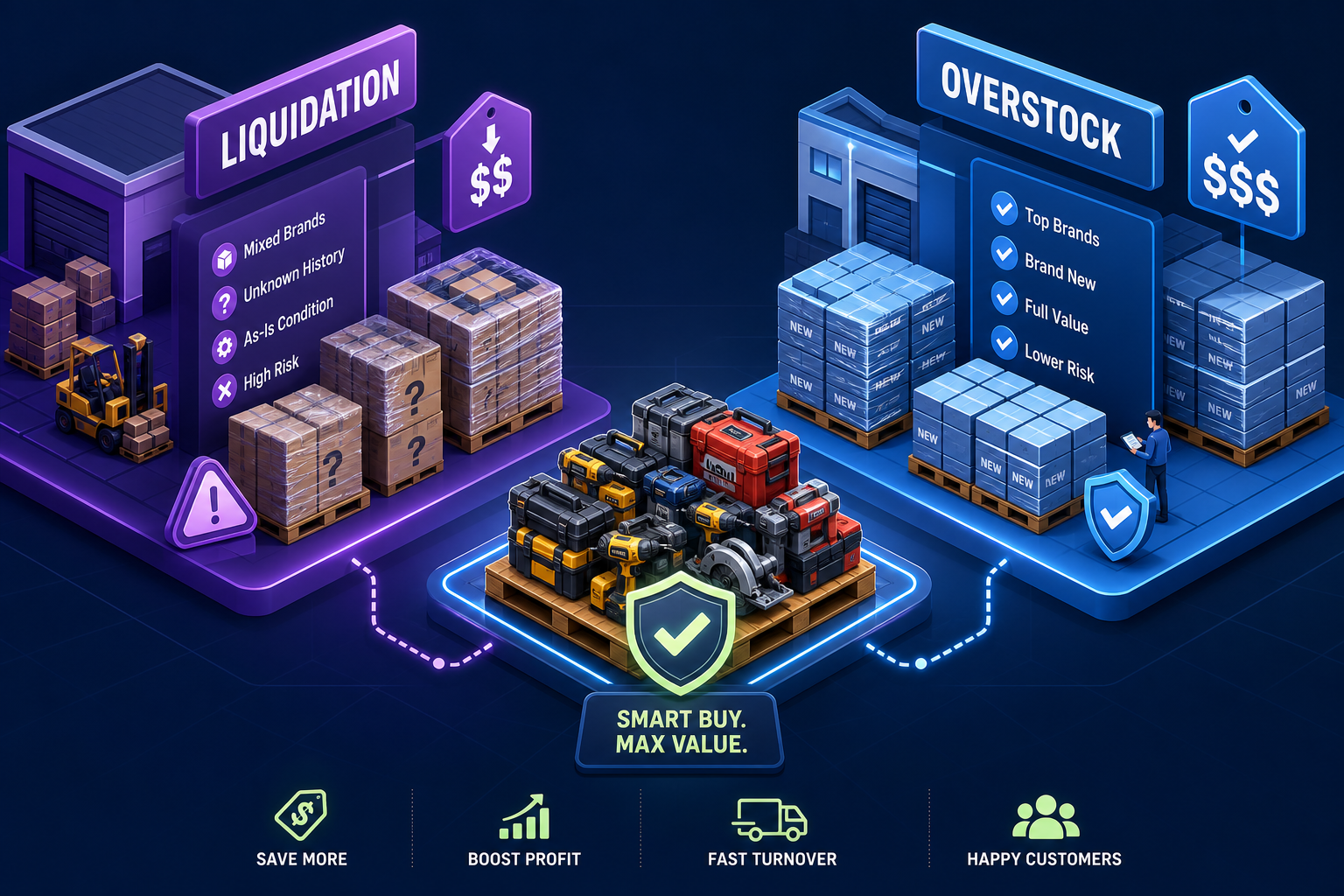
If you’re comparing tool pallets for sale, you likely have two listings open. One is a $950 DeWalt liquidation pallet loaded with customer returns. The other is a $1,100 overstock lot from the same source, all new-in-box. Same brand, similar piece count. Which one do you buy? That choice separates resellers who turn inventory fast from those who sit on dead capital.
Both sources feed the reseller pipeline, yet they carry very different risk, workload, and margin profiles. Confusing the two, or pricing them the same, is how good money gets trapped in slow movers or repair benches. The fix starts with understanding your source, reading the manifest honestly, and running real ROI math before you commit.
If you’re sourcing through Pallet Liquidation USA (southernliquidationpallet.com), check the current listings for availability and manifests. Expect Milwaukee, DeWalt, Makita, and mixed power tool lots to appear over time. Use this guide to weigh source differences, pricing tiers, manifest reading and grading, brand-level margins, freight math, and a supplier vetting checklist you can put to work immediately.
What separates liquidation and overstock tool pallets for sale
Liquidation pallets: customer returns and the unknowns that come with them
Liquidation tool pallets come from customer returns, RTVs, shelf pulls, and seasonal resets. Expect a real mix: open-box tools that work perfectly, units missing batteries or chargers, and some that show visible job-site wear. Many buyers casually call these used tool pallets. You are buying a range of conditions, not a guarantee, which is why grading and testing matter. For a deeper breakdown of grading, pricing and common red flags, see Tools Liquidation Pallets: Grades, Pricing, And Red Flags, Pallets Liquidation.
Pricing reflects the uncertainty. Return-based tool liquidation pallets commonly land around 20 to 50 percent of retail at the pallet level; ranges vary by source and grading. The spread is where execution pays. Tight testing workflows, smart parts pairing (batteries/chargers), and fast listing cadence can lift margins and cash velocity. As a benchmark, operators who turn tested items in 3, 7 days routinely beat similar buyers who sit 14, 30+ days on the same SKUs.
Overstock pallets: new inventory with less guesswork
Overstock pallets are new, unsold merchandise. No prior ownership, consistent packaging, and minimal variance by unit. That predictability shows up in your workflow: fewer returns, less bench time, and faster listing.
The trade-off is price. Overstock costs more than liquidation because condition risk is lower, yet it often converts faster on eBay, Facebook Marketplace, and local retail where buyers pay closer to retail for new-in-box tools. That predictability helps you align the buy with your capital position and your preferred selling channels.
Pricing tiers for tool pallets for sale: what you pay and what you actually get
Small lots (20, 50 pieces): low entry, higher cost per unit
Small mixed lots usually run $200 to $450 for about 20 to 50 pieces. These are ideal if you are validating a category, testing a brand platform, or learning a supplier’s grading without overcommitting. You will often see more accessories and hand tools in this tier with a few headline power tools mixed in.
Per-piece cost is higher than larger buys, which compresses margin if you expect too much. The upside is controlled downside: you learn your local sell-through patterns and pricing sweet spots without tying up large amounts of cash. As a simple anchor, a $400, 40-piece lot runs about $10 per unit; the same mix often averages $6, $8 per unit once you step up to a medium pallet.
Medium pallets (100, 300 pieces): the reseller’s sweet spot
Standard tool pallets typically price between $450 and $1,500, with 100 to 300 pieces. This is where most active resellers live. Your cost per unit drops, grade mix evens out, and the diversity helps spread risk across the lot.
It is common to see a $1,200 DeWalt pallet with an estimated retail around $3,000. That is roughly a 40 percent cost-to-retail ratio before individual resale margins and fees. Focus on expected sell-through, not just the headline MSRP, and you will make smarter buys at this tier. For tactics on maximizing ROI when buying branded pallets, review our guide Power Tool Pallets: How To Find The Highest-ROI Lots, Pallets Liquidation.
Full truckloads (650, 1,600+ pieces): volume buying for serious operators
Truckload buys run $5,800 to $17,000 or more for 22 to 30 pallets. Per-item cost bottoms out here, which is powerful if you have capital, storage, and the throughput to process fast. Expect hundreds of SKUs across popular cordless platforms, chargers, batteries, and tools, classic bulk tool pallets for high-volume operations.
The caution is carrying cost. If your intake, testing, and listing pipeline cannot keep pace, cheap per-unit turns expensive. Build the operations first, then scale with full loads.
Reading manifests and decoding condition grades
What a solid manifest should include for tool pallets for sale
A reliable manifest lists brand and model, product title, UPC or SKU, quantity per line, and retail value. If UPCs or clear product descriptions are missing, treat it as a yellow flag and price in more uncertainty. Transparency on the manifest is your first layer of protection.
Use the UPC to pull recent sold prices on eBay and current offers on Amazon. Those checks beat any stated MSRP for predicting what you will actually get. Remember that manifest MSRP is a reference, not a promise, and some platforms allow small variances in counts. If you need specific guidance on handling return-based lots, the checklist in Tool Return Pallets: What To Inspect Before Buying, Pallets Liquidation is a practical companion to manifest review.
- Estimate ROI before you buy: pull comps for the top-value SKUs by UPC and note realistic sold prices.
- Apply rule‑of‑thumb grade heuristics (ranges vary by category and completeness): for example, A‑grade items can resell near 80, 95% of new when complete, B‑grade around 50, 70%, and C‑grade at parts value.
- Subtract fees and costs: marketplace fees, shipping if you offer it, parts and accessories, and your labor per unit.
- Add inbound freight to your landed cost, then divide expected net revenue by landed cost to confirm your target ROI.
How A, B, and C grades translate to real resale risk
Grade A tools are new or like-new, often overstock or clean shelf pulls. These list fast and close to retail, but they command higher buy-in at the pallet level. You are paying for predictability and speed.
Grade B tools are the backbone of most returns pallets. They work, but expect cosmetic wear or missing accessories like batteries and chargers. Your job is to sort, test, and bundle smartly, then price at the sweet spot where they move quickly.
Grade C tools are heavily used, incomplete, or non-functional. Treat them as parts or refurbishment candidates, not instant flips. If a lot leans C-heavy, the math changes completely, and you should value it at parts yields rather than retail percentages.
Brand-level margins: Milwaukee, DeWalt, and Makita in real numbers
Why Milwaukee consistently outperforms on resale velocity
Milwaukee’s M18 and M12 ecosystems enjoy strong loyalty from tradespeople, which keeps demand high across eBay, Facebook Marketplace, and local cash buyers. Based on 2026 eBay sold listings for tested and complete kits and bare tools, Milwaukee items often resell around 55 to 75 percent of new retail; outliers do exist by SKU and condition.
That velocity often justifies a slightly higher buy-in compared with other brands. If your operation is set up for fast intake and same-week listing, Milwaukee pallets can turn capital quickly, even when margins per item are tighter on top-tier SKUs.
DeWalt and Makita: solid options with narrower margins at pallet level
DeWalt pallets often land around a 40 percent cost-to-retail ratio at the pallet level, for example a $1,200 buy against $3,000 estimated retail. Individual resale depends on the grade mix: clean kits can achieve 50 to 60 percent of retail, while tool-only or heavier-wear units run lower.
Makita pallets show similar cost-to-retail ratios, commonly around 40, 45 percent at the pallet level in sample listings and reseller comps reviewed in 2026. They sell well among home improvement resellers and DIY audiences. Compared with Milwaukee, sell-through can be slower on some platforms, so price to move and bundle thoughtfully.
Shipping and freight: what it actually costs to receive a pallet
Domestic freight benchmarks for a pallet of tools
For one tool pallet shipped LTL inside the United States, plan for about $150 to $300 on regional moves and $300 to $800 or more cross-country. Weight, distance, freight class, and destination type all affect the final number. Many boxed hand and power tools rate in the class 60 to 100 range; lower class usually means a lower cost per hundredweight.
Tools are dense, which helps on freight class compared with bulkier categories. Add typical accessorials as needed: liftgate service can add $50 to $100 if you lack a dock, and residential delivery or appointment scheduling can add more. Always quote freight into your ROI before you commit. For quick pallet shipping cost estimates and benchmarks, see this pallet shipping cost guide. To check how your SKUs will rate, use a reliable freight class calculator.
What to have ready before your pallet ships
Confirm pallet weight, dimensions, and height with your supplier. Standard 48 x 40 inch pallets load and rate best, while oversized or loosely stacked pallets attract surcharges. Provide accurate pickup and delivery details so carriers avoid reweighs or reclass fees.
Some suppliers occasionally run free‑shipping thresholds or regional delivery promotions on tool pallets for sale, verify current terms and factor any savings into your landed cost, not your gross margin assumptions.
How to choose a trusted supplier and avoid getting burned
Supplier trust signals worth verifying before you send a deposit
- Physical warehouse address, posted hours, and verifiable phone and email. Live chat is a plus for quick answers.
- Clear photos or videos of the actual lot, plus a manifest with UPCs or SKUs and quantity per line.
- Operating history and transparent sourcing statements. Consistency in grading and freight transparency.
These markers show a real operation with accountability. If anything is missing, proceed cautiously and price the risk into your offer, for example, discount by 10, 15% to offset uncertainty, or cap your exposure on a first buy. On a $1,200 pallet, that’s a $120, $180 adjustment to protect downside.
Red flags that signal a bad deal
- Unrealistic pricing and vague listings with no manifest or missing UPCs.
- Pressure to pay immediately via wire, Cash App, Zelle, or other non-protected methods.
- No return or buyer protection language, and no freight details until after payment.
- Stolen photos, stock images only, or a seller unwilling to answer basic questions.
If the deal evaporates when you ask for proof, walk. The pallet you skip is often the profit you keep. For practical advice on how to avoid scams when buying pallets online, review this guide: avoid scams when buying pallets online.
Why Pallet Liquidation USA stands out for tool pallets
Pallet Liquidation USA lists a range of tool liquidation pallets and overstock options across major brands like Milwaukee, DeWalt, and Makita, plus mixed tool pallet lots and category-specific batches (chargers, batteries, cordless platforms). Listings typically include clear pricing and a manifest so you can run comps before you commit.
Before you buy, review the seller-stated policies on returns, shipping, and buyer protections at southernliquidationpallet.com. If you want a single place to evaluate wholesale tool pallets with transparent manifests and responsive support, start there. For a broader market perspective on liquidation pallet providers and what to expect from reputable operators, see this overview on liquidation pallets tools.
Conclusion
The decision is straightforward. Liquidation offers a lower entry price and bigger upside, along with more testing, parts, and sorting. Overstock costs more per unit but delivers predictable, fast-selling inventory with less bench time and fewer surprises. Pick the lane that matches your cash, channel, and workflow.
Every variable you have read about, grade, brand, freight, supplier, collapses into one number: your true ROI. The cheapest pallet on your screen is not always the best buy once everything lands and starts moving through your process. When sourcing tool pallets for sale, weigh brand strength, grade mix, manifest quality, supplier reputation, and freight against your sell-through data.
Ready to work the numbers on live inventory? Browse our current tool pallets for sale or see what’s available this week at Pallet Liquidation USA.
Leave a Reply
You must be logged in to post a comment.