


LTL Pallet Shipping: Cut Costs, Pack Right, Get Quotes
LTL pallet shipping is where a lot of resellers quietly bleed margin, not because carriers are expensive, but because many shippers get the freight class wrong, skip proper packing, or pull quotes without accurate data. Industry audits consistently show that misclassification, accessorial surprises, and inaccurate inputs are the primary drivers of inflated invoices, and corrections billed after delivery can add anywhere from 15, 50% over what you initially saw, depending on the shipment. That’s a serious dent in margin on any resale operation.
This article covers the full mechanics of LTL pallet shipping: what drives your cost, how freight class is assigned, how to prep a pallet that survives terminal handling, and how to get quotes that actually hold. Resellers who source liquidation inventory from suppliers like Pallets Liquidation USA often avoid inbound freight headaches entirely since free shipping is built into the deal. But for every other shipment you touch, understanding how LTL pallet shipping works is real money on the table.
We’ll cover five areas: LTL vs. full truckload, cost factors, freight class, pallet prep, and quote strategy. Work through all five and you’ll ship smarter starting with the next booking.
LTL vs. full truckload: which option actually fits your shipment
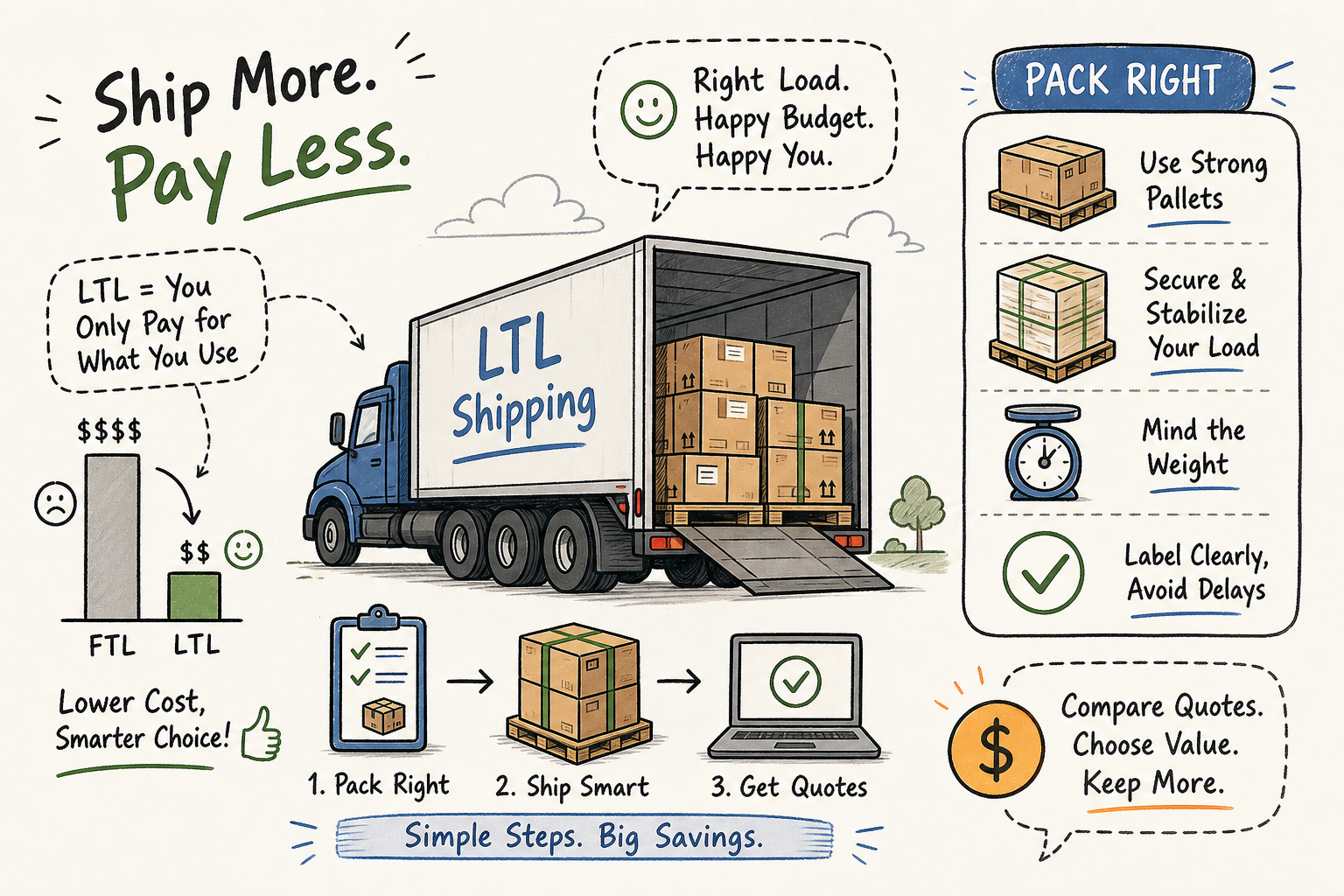
LTL, or less-than-truckload, shares trailer space with other shippers’ freight. You pay only for the space your pallets occupy, not the entire trailer. Standard LTL shipments run from 1, 6 pallets, typically 100, 15,000 lbs total, and use up to 12 linear feet of trailer space. Carriers consolidate multiple LTL shipments at terminals, which adds transit time but dramatically reduces cost per pallet compared to booking a dedicated truck.
Full truckload pricing is flat, terminal-free, and faster. It becomes worth considering earlier than most shippers expect, carrier-dependent, but often once you approach 4, 6 pallets or exceed 12 linear feet of trailer space, comparing full truckload and volume LTL side by side is worthwhile. LTL pallet shipping layers in freight class, density assessments, and accessorial fees that can push a final invoice well above the initial quote. A practical rule of thumb: if your LTL quote approaches 70% of a spot full-truckload rate, book the truck instead.
The gray zone often begins around 4, 6 pallets, though carrier rules vary. Shipments in that range frequently fall into “volume LTL” or partial truckload pricing, which carriers quote separately from standard LTL. Getting both rates and comparing them is worth the extra 15 minutes before committing. Volume LTL can offer significantly better per-pallet economics than standard LTL for that size range without the full truckload commitment.
LTL pallet shipping rates and the real cost factors
LTL pallet rates scale with both distance and weight. In 2026, typical ranges run $150, $300 for regional shipments under 500 miles and $500, $800 or more for cross-country lanes. A standard 500, 800 lb pallet runs $150, $300 regionally; a 1,000+ lb pallet costs more in absolute terms but delivers a better per-pound rate. Per-pallet cost also drops as pallet count increases, so two pallets on the same lane almost always come in cheaper per unit than one.
Density is the factor most shippers ignore, and it’s the one that hurts the most. Carriers care about how much space your freight occupies, not just how much it weighs. Low-density loads consume trailer capacity without adding billing weight, so carriers compensate by pushing those loads into higher freight classes. Density is calculated as total weight divided by cubic footage (length × width × height, divided by 1,728). For example, a pallet measuring 48″ × 40″ × 48″ that weighs 400 lbs has a volume of 53.3 cubic feet and a density of roughly 7.5 lbs/cu ft, a figure that typically lands in class 125 or higher. Add 200 lbs to that same pallet and the density climbs to 11.2 lbs/cu ft, which can drop it to class 100 or below and meaningfully cut the rate. Improving pallet density by stacking tighter and reducing dead air space can move you an entire freight class.
Accessorial fees are the second major cost driver, and they’re billed after delivery if not flagged upfront. Liftgate service runs $100, $400 per shipment. Residential delivery adds $100, $600 depending on location. Industry-standard detention charges accumulate at roughly $50, $75 per 15-minute interval once free time expires. Reweigh and reclassification fees stack on top of the corrected rate whenever the declared weight or class doesn’t match what the carrier measures at the terminal. Always disclose delivery location type and any special access requirements when requesting LTL pallet shipping quotes.
Freight class for pallets: the number that makes or breaks your quote
The NMFC system and freight class guides assign freight classes from 50 to 500 based on four factors: density, stowability, handling difficulty, and liability. Since the July 2025 NMFC reform, density dominates classification more than ever. Lower-density freight gets pushed into higher classes, and higher classes cost significantly more to ship. The same pallet on the same lane can carry a rate anywhere from $400 to $1,400 depending on its class assignment.
For common resale product categories, LTL freight class ranges typically look like this (consult your NMFC code and carrier guide for confirmation, as individual product specs and packaging affect the final assignment):
- Electronics: typically class 92.5, 125, driven by fragility and liability
- Clothing and apparel: class 175, 250 for standard packed goods
- Tools and auto parts: class 65, 85 for dense, durable items
- Construction materials and heavy goods: class 50, 65
The financial cost of misclassification is not abstract. The difference between class 85 and class 125 on the same cross-country pallet can easily run several hundred dollars. To put it in concrete terms: a $600 quote based on an incorrect class can realistically become a $1,000+ invoice once the carrier reclassifies at the terminal and adds the reclassification fee, with no warning until after delivery. Carriers inspect freight at terminals, and if the declared class doesn’t match what they measure, they reclassify and charge accordingly.
To get the class right before booking, calculate your density first. Divide total weight by cubic footage to get pounds per cubic foot, then cross-reference with the NMFC density table and NMFC code references for your product category. Most LTL brokers and carrier portals provide online density calculators, use them before entering any quote form. Then verify with your NMFC code directly, because stowability or fragility flags can bump the class above what density alone would suggest.
LTL pallet shipping: packing and labeling best practices
The standard GMA pallet (48″ × 40″) fits most LTL trailers and carrier equipment. Keep total load height at or below 60 inches for stability and carrier compliance. Place the heaviest items on the bottom layer and stack boxes column-to-column, corner to corner, for maximum vertical compression strength. Interlocking patterns look stable but actually reduce load capacity. Insert corrugated tie sheets between stacking layers to distribute weight evenly and prevent box-on-box crushing.
Wrapping starts at the bottom and works upward, with each pass of machine-stretch film overlapping the last by 40, 60%. Anchor the wrap to the pallet itself with at least a 3-inch overlap at the base. For heavier loads, add polyester or steel straps over the stretch wrap, but never strap across forklift entry points. Full-length corner boards protect edges and dramatically increase vertical load strength under the rough handling conditions common at LTL terminals.
A pallet that arrives at its destination intact doesn’t happen by chance. It’s the result of how you built it.
Labeling is the step most shippers treat as an afterthought, and it’s the one that causes the most post-delivery problems. Label every box in the shipment and the pallet itself. Pieces separate at terminals regularly, and the pallet label is the last line of defense for a complete delivery. Each label needs shipper name, consignee name, addresses, and phone numbers. Place labels on box tops, not over seams, and confirm barcodes are scannable. Compliant labeling is also your strongest protection against reweigh and reclassification disputes, because carriers reference the bill of lading and labels at every checkpoint.
Getting accurate pallet shipping quotes and using consolidation to lower costs
Accurate LTL pallet shipping quotes require specific inputs: origin and destination zip codes, pallet dimensions (length × width × height), total weight, freight class or NMFC code, and a full list of accessorial needs. Pulling a quote without the freight class or with estimated dimensions almost always results in a corrected invoice after delivery. The carriers aren’t wrong to adjust; the problem is the inaccurate input that went in at the start. Get the numbers right upfront and the final invoice matches the quote.
Compare at least two to three freight quote platforms or broker portals before booking. LTL pallet rates vary by carrier on the same lane, sometimes significantly, based on which carriers have capacity in that corridor at that moment. In practice, spending 10, 20 minutes comparing two to three quotes typically yields better rates and fewer surprises. It doesn’t require a 3PL or a freight manager; it just requires the right data and three browser tabs.
Freight consolidation offers another lever for shippers with regular pallet volume. Consolidation combines multiple smaller shipments into a single trailer, spreading fixed carrier costs across more pallets and reducing per-pallet rates by 10, 50% compared to booking each piece individually. Small businesses with predictable shipping patterns can negotiate consolidation agreements directly with regional carriers or use a 3PL that pools freight from multiple clients. The more consistent your volume, the more leverage you have to lock in discounted rates.
For resellers sourcing palletized freight regularly, inbound freight cost is a margin killer that often gets overlooked in the ROI calculation. Pallets Liquidation USA ships free on all orders over $2,500. For resellers sourcing bulk liquidation pallets of electronics, tools, or apparel weekly, that embedded freight benefit directly improves margin without a single freight class calculation required. It won’t solve every outbound shipping challenge, but for inbound sourcing, it removes one of the biggest hidden costs in the resale supply chain.
For resellers sourcing palletized freight regularly, negotiating or selecting suppliers that build freight into the price is an underused margin lever. If inbound sourcing is part of the picture, check suppliers who build freight into the price. It’s one less quote to pull and one more margin point to keep.
For resellers sourcing bulk liquidation pallets of electronics, tools, or apparel weekly, that embedded freight benefit directly improves margin without a single freight class calculation required.
Putting it all together before your next LTL pallet shipping booking
LTL pallet shipping costs are driven by density and freight class more than any other factor. Getting those two right before booking is where most of the savings come from. A properly calculated freight class prevents reclassification fees. A high-density, well-stacked pallet keeps you in a lower class bracket and out of corrected invoice territory.
A properly built pallet also moves through LTL terminals with fewer delays, damage claims, and billing disputes. The wrapping, strapping, labeling, and stacking practices covered in this article aren’t optional best practices, they’re the difference between a clean delivery and a damage claim that wipes out the margin on the shipment.
Before your next booking: pull your pallet dimensions and weight, calculate density, verify your NMFC code, then compare at least three LTL pallet shipping quotes before committing. If inbound sourcing is part of the picture, check suppliers who build freight into the price. It’s one less quote to pull and one more margin point to keep.
Leave a Reply
You must be logged in to post a comment.