


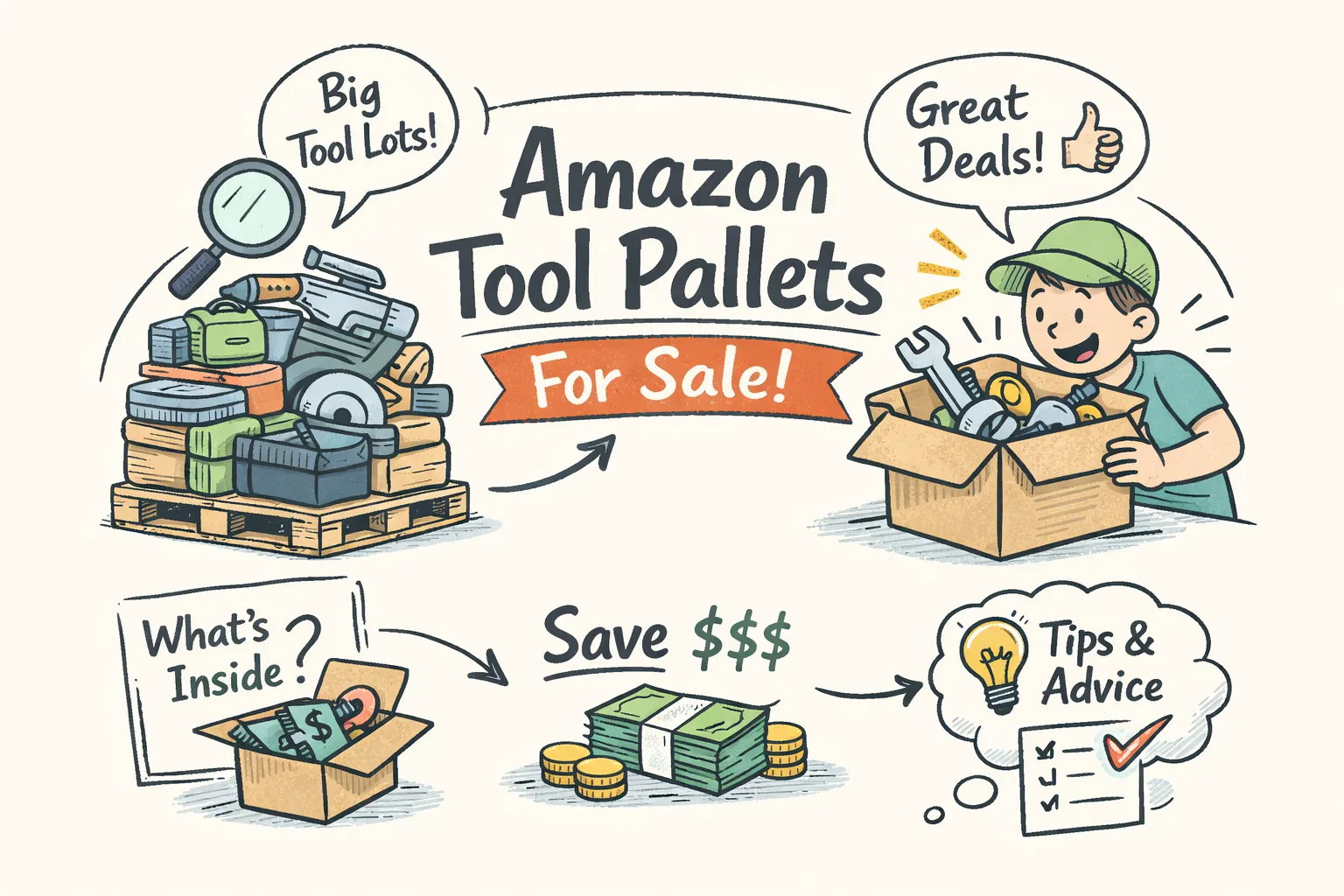
Amazon Tool Pallets for Sale: Buyer’s Guide
If you’re searching for amazon tool pallets for sale, you’ve landed in a market with real margin potential, and real traps. Brand-name power tools from DeWalt, Milwaukee, and Makita move through Amazon’s returns pipeline every week, and buyers who source them correctly can land inventory at 70 to 85 percent below retail. The problem is that the same opportunity attracts scammers, overpriced auctions, and sellers who inflate manifest values while burying the actual condition breakdown in fine print.
This guide covers the full picture: where to source legitimate wholesale tool pallet lots, what to expect inside, how to price them realistically, how to spot fraud before it costs you, and how to calculate ROI before you commit a dollar. If you want to skip the auction grind, Pallets Liquidation USA sources tool pallets directly from top U.S. retailers every week, with fixed pricing, free shipping on orders over $2,500, and a 100% money-back guarantee. Start with the framework below and you can evaluate any supplier on your own terms.
Where to buy Amazon tool pallets for sale: your sourcing options compared
Auction-based liquidation marketplaces
Three platforms dominate the auction-style liquidation market in the U.S. B-Stock is the largest B2B liquidation network, connecting buyers to nine of the top 10 U.S. retailers through branded auction channels. Liquidation.com runs an open auction format where Amazon returns, including power tool pallet lots, typically open between $100 and $5,000 depending on size and grade. Direct Liquidation offers manifested wholesale lots in an auction format, giving buyers more information upfront before bidding.
The tradeoff with auction platforms is real: price discovery works in your favor when competition is low, but popular tool lots with recognizable brand names attract multiple bidders. Closing prices on branded power tool pallets regularly exceed what a first-time buyer expects, compressing the margin they planned on at registration. Auction platforms reward buyers with patience, data, and a hard ceiling on what they’ll pay.
Direct liquidation suppliers as a faster alternative
Direct liquidation pallet suppliers like Pallets Liquidation USA bypass the bidding format entirely. Inventory is sourced weekly from major U.S. retailers, priced at fixed points, and available without competition from other buyers. For resellers building a repeatable sourcing operation, this model removes the biggest variable in auction buying: not knowing your actual cost until the hammer falls. Fixed-price sourcing lets you plan your landed cost, margin, and listing strategy before you spend a dollar.
Trust signals that separate legitimate sellers from noise
Before committing to any supplier, run through a short checklist. Legitimate sellers provide manifests listing every SKU, UPC, retail value, and condition code. They have a verifiable warehouse address, consistent reviews on third-party platforms, and a clear return or dispute policy. Any seller who refuses to share a manifest, can’t confirm a physical location, or pushes the sale through social media direct messages is not worth the risk, regardless of how good the price looks.
What’s actually inside an Amazon tool pallet
Brand and product mix to expect
Power tools dominate most Amazon liquidation pallet loads. DeWalt, Milwaukee, Makita, Ryobi, and Black and Decker appear most frequently based on current auction listings and supplier manifests. Drills, impact drivers, and circular saws make up the bulk of high-value units, alongside angle grinders and combo kits. Hand tools, wrenches, pliers, screwdrivers, measuring equipment, also appear, typically in smaller quantities and at lower per-unit resale values. Pallet sizes vary widely, from around 100 units on a smaller lot to 300 or more on a larger, tiered load.
Condition breakdown: new, like-new, and customer returns
A typical Amazon returns pallet blends roughly 20 to 40 percent new (factory-sealed), 30 to 50 percent like-new (opened but unused, with minor packaging damage), and 20 to 40 percent items that are damaged, incomplete, or require inspection and repair. These ratios shift depending on the sourcing grade the seller offers, so always request a condition distribution before purchasing. Some sellers label lots as “new” or “open box” while still including non-functioning units, since pallets are sold as-is with no replacements for individual items.
How to read a manifest before you bid
A manifest is a line-by-line inventory of every unit on the pallet: SKU, UPC, listed retail value, and condition code. Buyers who skip the manifest are guessing on margin, not calculating it. Use the manifest to cross-reference items against real eBay and Amazon sold listings, not the listed retail values, which are almost always higher than what units actually clear at resale. Treat any seller who refuses to share a manifest as a non-starter, not an exception worth making. For practical breakdowns of what return pallets typically contain and how manifests map to resale value, see this detailed guide on Amazon return pallets for additional context from AMZPrep.
Pricing, lot sizes, and what shipping actually adds
Price ranges by pallet tier
Budget pallets with mixed or low-grade tool returns typically run $100 to $500. Mid-tier lots featuring branded power tools like DeWalt or Milwaukee range from $1,200 to $2,400 per pallet. High-value auction lots with curated, higher-grade loads can close between $8,000 and $13,000 for large truckload-style quantities. The average Amazon return pallet across all categories sits around $300 to $400 before shipping, though tool-specific lots skew higher due to strong resale demand for power tools.
How shipping costs affect your landed price
Shipping is the number that first-time buyers consistently underestimate. Standard pallets on some U.S. platforms ship for around $30, but heavy tool pallets loaded with power equipment and battery kits weigh significantly more and can trigger freight pricing that adds hundreds of dollars to your landed cost. Free shipping thresholds change this math considerably. Pallets Liquidation USA offers free shipping on orders over $2,500, which means buyers purchasing multiple lots at once can absorb shipping as part of the deal rather than a separate line item eating into margin.
Units per pallet and how that changes your per-unit math
No standard unit count exists across the industry, and sellers don’t use a consistent format. Your job is to pull the unit count from the manifest, then divide your total landed cost, purchase price plus all shipping and fees, by the number of sellable units to get a realistic cost basis per item. From there, compare that number against actual sold comps on eBay and Amazon to determine whether the margin justifies the buy. Build your model before you bid, not after.
Red flags and scam tactics that cost buyers real money
Listing red flags that signal fake or inflated inventory
The clearest warning sign is a price that’s too good to be true. Legitimate tool pallets with DeWalt or Milwaukee inventory don’t sell for $100 to $200 when the market floor is $300 to $800 and up. Watch for stock photos that don’t match the seller’s listed warehouse location, vague descriptions with no manifest, and sponsored social media ads promising 90 percent off Amazon returns with no verifiable seller information. That last pattern is the most consistent marker of liquidation fraud: the ad looks polished, the offer looks incredible, and there’s no trail to follow once you’ve paid. For examples of common pallet liquidation scams and how attackers structure fake offers, Malwarebytes has a helpful breakdown on identifying pallet liquidation scams.
Seller behavior that signals a scam in progress
Scammers follow a predictable playbook. They move conversations off email and onto WhatsApp or Telegram, demand payment via Venmo, Cash App, Zelle, or cryptocurrency, none of which carry buyer protection, and create urgency around limited availability to prevent you from doing due diligence. Legitimate sellers use business email, accept credit card payments, and don’t pressure a timeline. If a seller can’t wait 24 hours for you to verify their business registration, that delay is your answer. For additional tips on avoiding scams when buying pallets online, this practical guide covers common red flags and safe buying steps from Repackify.
How to verify a supplier before sending a dollar
Cross-reference the seller’s business name against your state’s business registration database. Search for reviews on third-party platforms outside their own website. Request a physical warehouse address and verify it independently. Ask for a sample invoice or proof of a past transaction. If they deflect any of these requests, walk away. Established platforms like B-Stock, Direct Liquidation, and Pallets Liquidation USA maintain verifiable business histories and buyer protections that eliminate most of this risk upfront.
Calculating ROI on amazon tool pallets for sale before you commit
Recovery value vs. manifest retail: what the numbers actually show
Tool pallets are typically priced at 15 to 35 percent of their listed manifest retail value. A pallet carrying $10,000 in listed retail might cost $1,500 to $3,500 to purchase. The problem is that actual resale prices on individual units rarely match listed retail values. Build your margin model around real eBay and Amazon sold listings for comparable items in comparable condition, not the manifest ceiling. That one adjustment separates resellers who profit from those who break even or worse.
The four variables that determine your actual margin
Every tool pallet’s profitability comes down to four numbers, and skipping any one of them produces a model that looks better than reality:
- Landed cost per sellable unit: purchase price plus shipping plus platform fees, divided by the number of units you can actually sell.
- Realistic resale price: based on actual sold comps, not listing prices.
- Refurbishment yield: how many damaged units can be repaired, parted out, or bundled to recover value.
- Time cost: budget one to two hours per pallet for triage, testing, and listing.
To simplify your pre-purchase math, use a wholesale profit calculator to run scenarios against different recovery yields and shipping assumptions, it helps turn assumptions into numbers before you press buy. Try a dedicated wholesale profit calculator to model your expected ROI.
What reseller results actually look like
Outcomes from tool pallet buying show wide variance. To illustrate the range: a buyer who purchases a pallet for $350 might recover only $169 from a handful of quick sales while stalling on the remainder, a loss driven by overestimating the sellable unit count. On the other end, a reseller who sources multiple pallets close to actual recovery value and works a disciplined exit channel can generate returns that justify the operation. Profitable outcomes consistently come from buyers who purchased close to actual recovery value and avoided chasing high-retail manifests. The math works when you’re disciplined about your entry price, not when you’re optimistic about your exit price.
Why Pallets Liquidation USA is worth considering for tool buyers
Weekly tool pallet inventory sourced directly from U.S. retailers
Pallets Liquidation USA replenishes inventory every week from leading U.S. retailers, which means tool pallet availability is consistent rather than dependent on auction timing or platform cycles. Buyers don’t need to monitor multiple sites or wait for the right lot to surface at the right price. Available categories include tools, electronics, home goods, and apparel, so buyers can either focus exclusively on tool lots or diversify across categories to smooth out cash flow between sourcing cycles. Examples of specific lots you may encounter include Jardineria Target Tools Pallets, Pallets Liquidation and specialized loads such as Building Materials Liquidation Pallet | Wholesale Construction Supplies, in addition to brand-specific tool lots like the Milwaukee Tools Liquidation Pallet Wholesale.
Buyer protections that reduce first-purchase risk
A 100% money-back guarantee backs every purchase, which matters most for buyers who haven’t yet built the experience to absorb a bad buy. The 24/7 live chat support connects buyers to real people who can help evaluate a specific lot, clarify manifest questions, and resolve claims quickly. For a first-time tool pallet buyer putting $1,500 or more into an unfamiliar product category, a guaranteed refund policy and direct support access are protections that carry measurable dollar value.
How it stacks up against auction-only platforms
Auction platforms offer price discovery, but they also deliver price volatility, bidding competition, and the real risk of overbidding when a desirable lot attracts multiple experienced buyers. Direct sourcing through Pallets Liquidation USA gives buyers a stable cost basis to plan around, free shipping on orders over $2,500, and zero bidding pressure. For resellers building a repeatable sourcing system rather than chasing one-off deals, that consistency is often worth more than the occasional savings a low auction close might deliver.
The buying framework in summary
The opportunity in tool pallet liquidation is real, but it’s not automatic. It requires verified suppliers, manifests you’ve actually read, landed costs you’ve calculated before committing, and a resale model built on real comps rather than listed retail values. Buyers who skip any part of that framework end up with inventory they can’t move at prices that don’t work.
When amazon tool pallets for sale are sourced with discipline, they deliver consistent margin for resellers who know what they’re buying and where it’s going. Pallets Liquidation USA offers a direct path to that inventory: weekly restocks from major U.S. retailers, clear lot information, strong buyer protections, and no auction pressure. For resellers who want a sourcing channel they can rely on week after week, that combination is hard to beat.
Browse current tool pallet availability at Pallets Liquidation USA and apply the framework in this guide to evaluate every lot before you buy. The margin is there, when the due diligence is done.
Leave a Reply
You must be logged in to post a comment.