


DeWalt Pallets for Sale: Pricing, Sourcing and Resale Tips
If you’re hunting for DeWalt pallets for sale, here’s what you need to know before spending a dollar: the market is real, the margins are real, but so is the noise. DeWalt is a widely recognized consumer and professional tool brand, and that recognition translates directly to resale velocity. Buyers who know what to look for can pull returns of 2.5x to 10x on their pallet cost when working with DeWalt liquidation inventory, though results vary significantly by condition grade, resale channel, and how carefully you run your numbers. Demand on eBay, Amazon, and at flea markets remains strong across most tool categories.
The problem is the competition for your attention and your money. Auction platforms, direct wholesale suppliers, Facebook Marketplace listings, and outright scammers all want both. Without a clear framework, it’s easy to overpay, buy the wrong condition tier, or wire cash to a seller who disappears. This article walks you through what DeWalt tool pallets actually contain, what they cost by condition, where to source them safely, and how to inspect a lot before committing. By the end, you’ll have a sourcing and buying strategy ready to execute.
What’s actually inside a DeWalt tool pallet
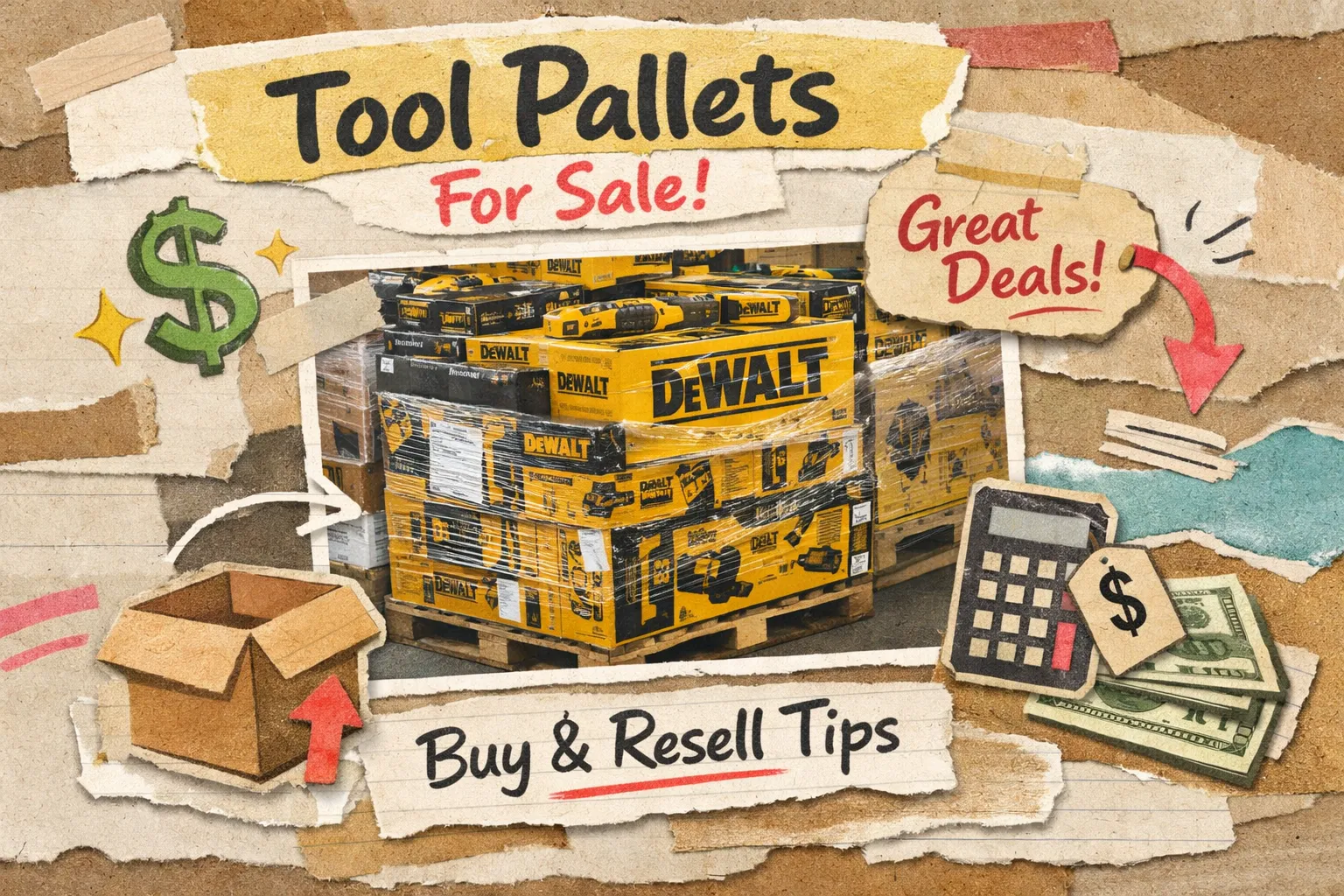
Most DeWalt pallets contain 20 to 70 or more items, depending on lot size and source. Common SKUs include 20V MAX cordless drills, impact wrenches, circular saws, battery 2-packs, chargers, and jobsite radios. Higher-value pallets pack flagship cordless kits alongside a range of accessories. Return channel pallets sometimes mix in Milwaukee or other brands, so reviewing the manifest before you buy is the only way to know exactly what you’re getting.
Manifests list each SKU by quantity and estimated retail value. Buyers who skip the manifest take on unnecessary risk, plain and simple. A $850 pallet with $5,000 to $6,000 in stated retail value looks very different from one where the seller just says “assorted tools.” The manifest is your underwriting document. It’s how you calculate margin before committing.
How condition grades shape what you get
DeWalt liquidation lots typically fall into four condition tiers, and understanding the distinctions matters before you buy. Grade A covers new, shelf-pull, or factory-sealed inventory; these pallets carry the most predictable resale value and fit cleanly into Amazon FBA or eBay listings without additional handling. Grade B includes tested customer returns with light wear or open-box status; they require more handling time but deliver strong margins on the right resale channels. Mixed or untested return pallets carry the highest variance and the highest potential margin, but they demand more inspection work on receipt.
Salvage-grade pallets contain non-functional tools sold strictly for parts. These are a different business altogether, suited for repair shops or specialty parts sellers rather than general resellers. Condition grade directly determines which resale channel fits: Grade A moves cleanly on Amazon, Grade B performs well on eBay, and mixed lots do best at flea markets, discount stores, or through direct local sales.
Where to find DeWalt pallets for sale
The main sourcing channels each carry distinct trade-offs. Auction platforms let buyers bid on bulk DeWalt tool lots directly from major retailers, and platforms like B-Stock provide real manifests with condition details. The downside is competition: winning bids are unpredictable, and in active auctions, prices can climb past what your margin math supports. Auction settlement and shipping timelines can also delay confirmation of a win by days or longer, depending on the platform.
Direct wholesale suppliers offer fixed-price pallets with manifests, cleaner shipping timelines, and more consistent lot quality. Facebook Marketplace claims to offer tool pallets, but it carries a disproportionate scam risk. Buyers frequently find that pallets arrive incomplete, misrepresented, or not at all, and payment through those channels rarely comes with protection. If you want a straightforward starting point for DeWalt inventory, consider browsing a dedicated DeWalt tool pallets collection that lists manifests and condition details before purchase: DeWalt tool pallets.
Why Pallets Liquidation USA fits serious resellers
Pallets Liquidation USA operates as a direct wholesale option for buyers who want pricing transparency and predictable sourcing rather than auction outcomes. Their inventory includes tool lots across multiple condition grades, which means you aren’t stuck waiting for a specific lot to appear on an auction calendar. Manifests reflect current retail values, so you’re working from accurate numbers when you run your margin math. They also list mixed-brand lots, including Milwaukee and DeWalt tools for buyers who prefer combined pallets.
Free shipping on orders over $2,500 changes the landed-cost math significantly for buyers moving multiple pallets. On a qualifying two-pallet order, that threshold can save a meaningful amount in freight, directly improving margin without any change to the pallet price itself. Pallets Liquidation USA also backs purchases with a 100% money-back guarantee and 24/7 live chat support, so you have a direct line for lot selection help and claims resolution if a shipment doesn’t match its manifest. For resellers scaling past their first few pallets, that combination of buyer protection and predictable sourcing is difficult to replicate on auction-only platforms.
Price ranges and what drives them
New or overstock DeWalt pallets typically run $500 to $1,600, with stated retail values of $5,000 or more. That puts the retail-to-cost ratio at roughly 2.5:1 to 4:1. Grade B return pallets land in the $500 to $1,400 range with ratios of 3:1 to 5:1. Mixed or untested return pallets push $500 to $2,000, but their retail-to-cost ratio can reach 5:1 to 10:1 or higher depending on what’s actually in the box, and that upside comes with corresponding uncertainty.
Those ratios only hold if you sell at or near retail. Most resellers realize 60% to 80% of retail on eBay or Amazon after platform fees are factored in. eBay averages around 13% in fees for power tools, and Amazon FBA runs 12% referral plus fulfillment costs that typically land your total platform take at 28% to 33% of sale price, for a clear breakdown of Amazon FBA fee components, see this guide to Amazon FBA fees.
DeWalt pallets price by grade: running your numbers before you commit
Run this math before you buy, not after. Take the manifest’s stated retail values, apply a realistic resale discount of 60% to 80% of retail, subtract pallet cost and platform fees, then factor in freight and any estimated refurbishment on Grade B items. On a $850 pallet with $5,500 in stated retail value, a 70% resale realization gives you $3,850 in gross revenue. Subtract $850 for the pallet, $500 in estimated platform fees, and $350 in freight, and you’re left with $2,150 in gross profit on a single pallet.
Battery rebuilds on returned tools run $30 to $135 depending on pack size, and those costs add up fast across a full pallet. Buyers who skip this calculation end up surprised by thin or negative margins on lots that looked attractive on paper. Build your numbers from the manifest up, and you’ll know whether the deal works before you commit to it.
Vetting suppliers and spotting scams
The warning signs in fraudulent DeWalt pallet listings follow predictable patterns. Prices far below market, such as combo kits listed at a few dollars each, are the most obvious signal. Demands for wire transfer or gift card payment, vague or missing manifests, urgency language pushing quick decisions, and newly registered domains are all reasons to walk away immediately. DeWalt does not sell directly to the public through liquidation channels, so any site claiming to be an official DeWalt liquidation outlet deserves skepticism from the first click. For a recent overview of common pallet liquidation scams and how to spot them, consider this security write-up on pallet liquidation scams and how to recognize them.
The supplier verification checklist
Before sending money to any supplier, run through these steps. Verify the seller’s physical address via Google Maps and confirm it corresponds to a warehouse, not a residential address or P.O. box. Check the BBB for ratings, complaint volume, and how long the business has been operating. Run a domain age check using a WHOIS tool; sellers with domains under one to two years old warrant extra scrutiny.
- Search the company name alongside “scam” and “complaint” to surface reports from previous buyers
- For any supplier claiming DeWalt authorization, cross-reference against the official authorized retailer list at dewalt.com
- Insist on a buyer-protected payment method before proceeding, and never use non-refundable transfers
- Request a manifest and photos of the actual pallet before finalizing any purchase
Legitimate suppliers operate transparently. They’ll provide manifests, respond to pre-sale questions through verifiable contact channels, and have a documented return or claims process. If a supplier pushes back on any of those requests, treat it as a disqualifying signal.
How to evaluate DeWalt pallets for sale by condition
Before the pallet ships, do the due diligence remotely. Request a full manifest with SKUs, quantities, condition descriptions, and per-item retail values. Cross-check those retail values against current Amazon and Home Depot listings to confirm the numbers are realistic, not inflated. Ask for photos or a short video of the actual pallet, not stock imagery pulled from a manufacturer’s website.
Suppliers who won’t provide a manifest, or who decline to photograph the physical pallet, are telling you something important about what’s inside. That document determines whether you make money on the lot, it isn’t optional.
Post-receipt grading and what to do with each tier
Once the pallet arrives, move through it systematically. Test every power tool: power on, confirm battery compatibility, run the motor under light load. Grade each item into three buckets: resalable as-is, needs minor refurbishment, and parts-only. Document anything that doesn’t match the manifest immediately and contact the supplier within the claim window while the issue is fresh.
Resellers who establish this workflow from the start separate clean sellable inventory from problem inventory within hours. That keeps their listing pipeline moving, their storage space organized, and their claims filed before deadlines pass. Fast identification and escalation is the habit that separates margin from loss when condition discrepancies show up.
Shipping costs and how they reshape your bottom line
Domestic LTL shipping for a single tool pallet runs $100 to $800, with heavier pallets consistently landing toward the upper end. An 800 to 1,300 pound pallet shipped 300 to 500 miles might cost $300 to $450 in freight alone. Add liftgate fees of $25 to $100 if your receiving location lacks a loading dock, and account for freight class adjustments on dense or heavy cargo. If you need to estimate how freight class will affect pricing, use a reliable freight class calculator to test scenarios.
A “cheap” pallet can become an average deal quickly once the freight invoice lands. Consider a $300 freight surprise on an $850 pallet: that single line item shrinks your projected gross profit by roughly 14% before you’ve sold a single tool. For practical breakdowns of typical pallet shipping cost ranges and what drives them, see a guide on pallet shipping cost. The math is straightforward, but only if you run it before you buy, not after.
Building your true landed cost before you buy
Landed cost equals pallet price plus freight plus handling plus estimated refurbishment. On a two-pallet order with Pallets Liquidation USA that crosses the $2,500 free shipping threshold, eliminating freight on both pallets can represent a material improvement to your margin, especially when you’re comparing suppliers side by side. Factor that threshold into your sourcing math from the start.
Buying a second pallet to cross that threshold often pencils out, because the freight savings on both pallets can exceed the cost of the additional inventory at liquidation pricing. Run the full landed-cost comparison before committing to a single-pallet order elsewhere.
Your buying framework, ready to execute
The DeWalt liquidation pallet market rewards buyers who do the homework upfront. Know what’s in the pallet via a verified manifest. Understand what each condition tier should cost and what retail-to-cost ratio is realistic after fees and freight. Source from vetted suppliers with transparent manifests and documented buyer protections. Inspect every lot on receipt using a systematic grading workflow. When evaluating DeWalt pallets for sale, calculate your full landed cost before committing, pallet price, freight, platform fees, and estimated refurbishment together, not in isolation.
Pallets Liquidation USA is a practical starting point for buyers who want current inventory across multiple condition grades, free shipping on qualifying orders, and a money-back guarantee backing every purchase. Their 24/7 live chat connects you with real people who can help you pick the right lot and resolve claims efficiently. Browse current tool pallet inventory, pull the manifest, and run your numbers, start by checking their combined DeWALT and Milwaukee tool listings to find a lot that matches your target grade and price point: DeWALT and Milwaukee tool pallets. The right lot sells fast, and the math either works or it doesn’t, before you buy.
Leave a Reply
You must be logged in to post a comment.