


DeWalt Wholesale Tool Pallets: A Reseller’s Profit Guide
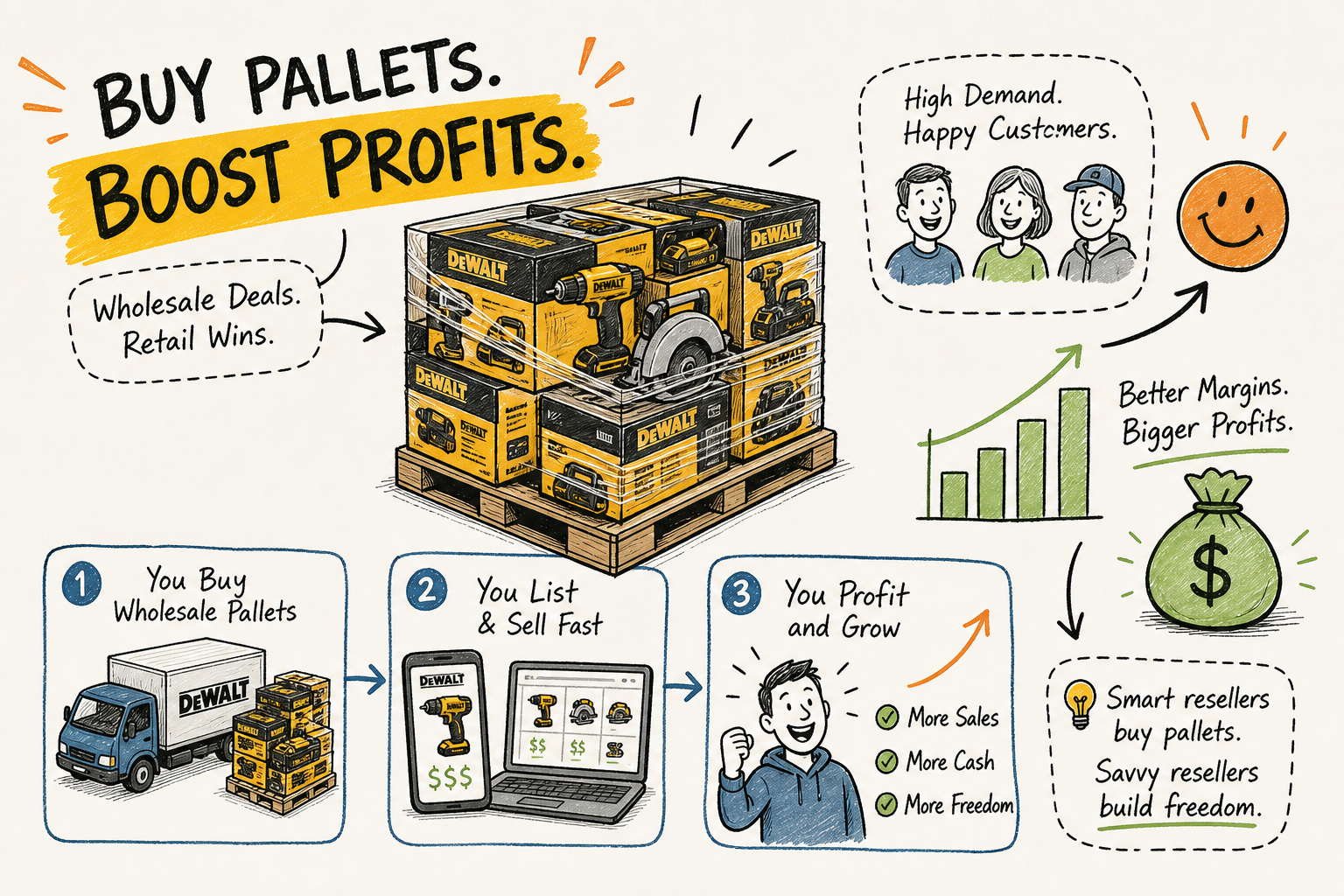
A single pallet of DeWalt tools can hide $5,000 or more in retail value, often purchased for $500 to $850. If you are shopping a dewalt tools wholesale pallet, the upside comes from knowing how to read the lot, price your sell-through, and protect yourself from fakes and freight surprises.
It’s common for first-time buyers to lose money when they skip the fundamentals: sourcing from credible pipelines, checking pricing benchmarks, validating authenticity, and planning freight. Experienced resellers treat these lots as one of the more consistent margin builders in power tools when they follow a disciplined process.
By the end of this guide, you will know where to buy genuine DeWalt return pallets, how to estimate cost versus realistic retail, how to spot condition and authenticity red flags, how to run margin math that includes freight and fees, and the exact next steps to buy safely and resell with confidence.
What’s actually inside a DeWalt tool pallet
Set expectations before you spend a dollar. A typical DeWalt-labeled pallet contains 20 to 70 or more items, and the mix varies by pallet size, tool category, and the originating retailer. A “DeWalt pallet” is rarely one product type; it is almost always a mixed tool lot with batteries and accessories.
Across mixed lots, the rough condition blend runs 60 to 70 percent new or shelf-pull, 20 to 30 percent customer returns, with the remainder salvage or parts-only. Manifests tell the story if they include model numbers, counts, and condition codes you can verify.
Power tools, batteries, and the items that drive value
Expect cordless drill and impact driver kits, circular and reciprocating saws, compact routers, jobsite radios, and accessories. The real margin hinges on power: FLEXVOLT and 20V MAX battery packs, especially higher capacity 5.0Ah units, and the chargers that keep bundles complete. ToughSystem boxes and larger bit sets add clean, fast-turn add-ons to your listings.
Batteries and chargers swing your profit more than any single bare tool. If your manifest shows multiple 5.0Ah packs or dual chargers, your margin floor rises. These resell quickly at strong prices, even when you discount tools to move them faster.
How condition grades affect what you’re actually getting
Grade A new or sealed pulls generally sell at 40 to 55 percent off MSRP in wholesale form, giving you a safer but thinner upside. Grade B tested returns or refurbished units discount 60 to 85 percent off MSRP and create the widest spread from buy to sell, though they demand more inspection, testing, and photo work.
Unsorted or salvage levels price at 90 percent off or more and carry parts-only risk. Think of grades as a risk-to-reward spectrum, not just a discount ladder. Grade B customer returns usually deliver the best margins if you have time and a simple testing checklist.
Pricing benchmarks: dewalt tools wholesale pallet costs and tiers
You need numbers before you approach any supplier. In 2026, most DeWalt power tool liquidation tool pallets fall into three predictable tiers tied to condition and expected retail value.
Cost ranges by condition and typical retail value
- New or overstock lots: $500 to $700 per pallet with $5,000 to $7,000 or more in retail value.
- Shelf pulls and box-damage: $600 to $850 per pallet with $5,000 to $6,000 retail value.
- Mixed customer returns: $500 to $850 per pallet with $5,000 to $7,000 or more in retail value.
The margin floor comes from how low you are forced to price to move slower SKUs, while the margin ceiling comes from premium kits and battery packs that sell near market-leading prices. The most competitive entry point for new buyers is the $500 to $600 mixed-condition pallet. It balances upside with workable inspection time per unit.
Running the cost-to-retail math before you commit
Work the numbers with conservative assumptions. Use a $650 mixed pallet with a manifested retail value of $5,500 as the example and assume resale at 55 to 65 percent of MSRP depending on condition and channel.
- Purchase and freight: $650 purchase plus, say, $300 LTL shipping lands your cost at $950 to your door.
- Projected revenue: If you list at 60 percent of MSRP, $5,500 becomes $3,300 expected gross sales across platforms.
- Fees and incidentals: eBay seller fees often average about 13 percent plus $0.30 per order (see eBay’s fee schedule: https://www.ebay.com/help/selling/fees-credits-invoices/fees-private-sellers?id=4364); Amazon typically charges a 15 percent referral fee on tools, with additional FBA pick-and-pack if you use FBA (see Amazon fees: https://sellercentral.amazon.com/help/hub/reference/G521). On $3,300 gross, 13 percent ≈ $429; 15 percent ≈ $495. A blended 14, 16 percent across eBay/Amazon yields roughly $460, $530 before any fulfillment charges. Facebook Marketplace may range 0, 5 percent for shipped orders (see: https://www.facebook.com/business/help/1264548985913669).
- Net and ROI: $3,300 gross minus $950 cost minus ~$500 in fees leaves roughly $1,850 net before labor. That is about a 195 percent return on cash outlay. Price at 55 percent of MSRP and you still clear a strong margin while turning faster.
Note how freight changes the picture: add $300 freight to a $650 buy and your landed cost jumps 46 percent. That alone can compress a mid-20s margin into single digits if you ignore it.
Where to source genuine DeWalt return pallets
This is the decision that makes or breaks your first quarter in tools. Buy where the documentation is tight, the inventory is fresh, and the freight math is transparent. Look for DeWalt pallet liquidation listings that include manifests with SKU-level detail and photos of actual lots.
Direct liquidation platforms vs. third-party brokers
B-Stock auction storefronts run branded auction storefronts for major retailers like Home Depot, Lowe’s, and Amazon, which gives you transparent bidding history and manifests tied to specific return channels. Quick Liquidations Pallets posts fixed pricing around $850 per pallet with manifests included. 1001 Pallet Liquidation lists DeWalt tool lots starting near $500 with assorted counts and emphasizes retailer return sourcing.
The core rule is simple: prioritize liquidators with direct retailer pipelines or documented partnerships that consistently include DeWalt in tool returns. Avoid small-lot aggregators that cannot provide verified manifests or SKU-level detail. Documentation gaps create authenticity risk and can cut warranty coverage.
Why Pallets Liquidation USA gives resellers a cleaner starting point
Pallets Liquidation USA is a national wholesaler focused on liquidation tool pallets. We encourage buyers to compare listings across marketplaces, validate manifests, and build freight into bids before checkout. That approach keeps margins honest and repeatable, whether you’re buying one lot or building a weekly rhythm. Read more about how to get the most from liquidation sourcing in Unlocking Profits With Liquidation Pallet: Your Key To Wholesale Savings, Pallets Liquidation.
Spotting counterfeits and condition red flags before you pay
Margin protection starts before checkout. Ask for the right documentation and use DeWalt’s own systems to verify what you are buying.
Verifying serial numbers and documentation
Use DeWalt’s USN Lookup tool or the DeWalt app to scan barcodes and serials. The scan confirms product identity, kit relationships, and origin data, which lets you match what you receive against the manifest.
From the seller, you want a verified manifest with SKUs, model numbers, and condition codes per item. Keep serials tied to the correct model so buyers can register their gear properly. For warranty specifics, review DeWalt’s limited warranty terms (https://www.dewalt.com/support/warranty) and battery/charger coverage; accurate registration and genuine parts help ensure eligibility.
Physical inspection signals that separate real tools from fakes
- Misaligned plastic body halves or seams that do not meet cleanly.
- Poor-quality screws that sit proud of recessed holes or strip too easily.
- Missing or incorrect UL/CSA certification labels and inconsistent font or color on rating plates.
- Off-feel triggers, uneven molding, or paint overspray around logos and vents.
- Barcodes that do not scan in the DeWalt app or serials that do not match the model label.
Before buying, demand the manifest and cross-check model numbers against DeWalt’s authorized retailer ecosystem. For pallets already in hand, the DeWalt app scan is your fastest authentication step, followed by test-charging every battery and load-testing suspect tools.
Shipping costs and freight math that actually affect your margin
Freight is the cost most buyers ignore, and it will quietly erase your margins if you guess. Build it into your bid ceiling every time.
What pallet shipping actually costs by distance
Local deliveries under 300 miles usually run $150 to $300 per pallet. Regional lanes at 300 to 1,000 miles often price between $250 and $800. Cross-country moves above 1,000 miles range from $500 to $1,800, depending on lane and season.
LTL is the right tool for 1 to 8 pallets and often lands at $120 to $600 per pallet depending on weight and freight class. Full truckload improves per-unit rates once you hit 9 or more pallets. Residential delivery with a liftgate typically adds $75 to $150, and terminal handling or hub transfers add cost as miles increase.
From a Midwest origin (e.g., Wisconsin), recent LTL quotes often land around $250 to $450 per pallet to the Southeast, $300 to $500 to the Northeast, and $600 to $1,000 to the West Coast. Two pallets on the same lane can drop your per-pallet rate noticeably, which is why consolidating orders pays. Use multiple carrier quotes or a freight marketplace calculator to verify your lane before bidding (e.g., https://www.freightos.com/freight-resources/freight-class-calculator/).
Building freight into your margin model before you buy
Ask for pallet dimensions, weight, and pickup ZIP code, then get two to three LTL quotes before checkout. If you have a loading dock, specify dock-to-dock for the best rate. If you do not, compare liftgate and terminal pickup to see which side of the last mile is cheaper for you.
Build freight into your bid ceiling and you will outlast buyers who are guessing.
Resale channels and strategies that maximize DeWalt lot margins
Buying right is half the job. The other half is matching condition to the right marketplace and keeping your testing and listing workflow tight. Spreading bulk DeWalt tools for resale across appropriate channels raises blended ROI.
Matching tool condition to the right resale platform
Grade A sealed tools win on Amazon FBA because Prime visibility converts, even after the referral fee and pick-and-pack. Grade B tested returns convert best on eBay when you write clear condition notes and post original photos. Unsorted or salvage items move fastest on Facebook Marketplace, local auctions, and flea markets where buyers expect discounts and prefer cash.
Plan for fees when you pick channels. Amazon’s referral fee on tools typically sits near 15 percent plus FBA fulfillment (https://sellercentral.amazon.com/help/hub/reference/G521); eBay averages around 13 percent plus a small processing fee (https://www.ebay.com/help/selling/fees-credits-invoices/fees-private-sellers?id=4364); Facebook Marketplace is often 0 to 5 percent depending on shipping (https://www.facebook.com/business/help/1264548985913669); local cash sales have no platform fees but cost time. Mixing channels by condition grade raises your blended sell-through and keeps you from discounting good units on the wrong platform.
Long-term margin strategy vs. quick-flip thinking
Resellers who buy pallets on a rhythm price more confidently because they know what is typical inside each lot. Track which SKUs repeat and where the hidden value sits, like spare 5.0Ah packs that sell as a separate high-margin SKU stream. For a deeper look at building a repeatable liquidation workflow, see Pallet Liquidation: A Comprehensive Guide To Profit.
Quick flips feel good, but systematic grading, testing, and repricing make the business. On customer-return lots, a steady workflow and multi-channel listings can produce outsized results when your inspection process is tight.
Conclusion
The math is straightforward when you run it honestly: source verified lots, price to the market, include freight before you bid, authenticate with DeWalt tools, and list where each grade converts. Whether you choose a dewalt tools wholesale pallet or a mixed return lot, make one disciplined buy, execute your workflow, and let the results fund the next purchase.
Compare current DeWalt lots at Pallets Liquidation USA alongside other vetted marketplaces, validate the manifest, and bid with freight baked in. One well-bought pallet sets the cadence for the rest of your tool business. For more practical buying and profit tips, visit Pallet Liquidation: Your Guide To Buying And Profit.
Leave a Reply
You must be logged in to post a comment.