


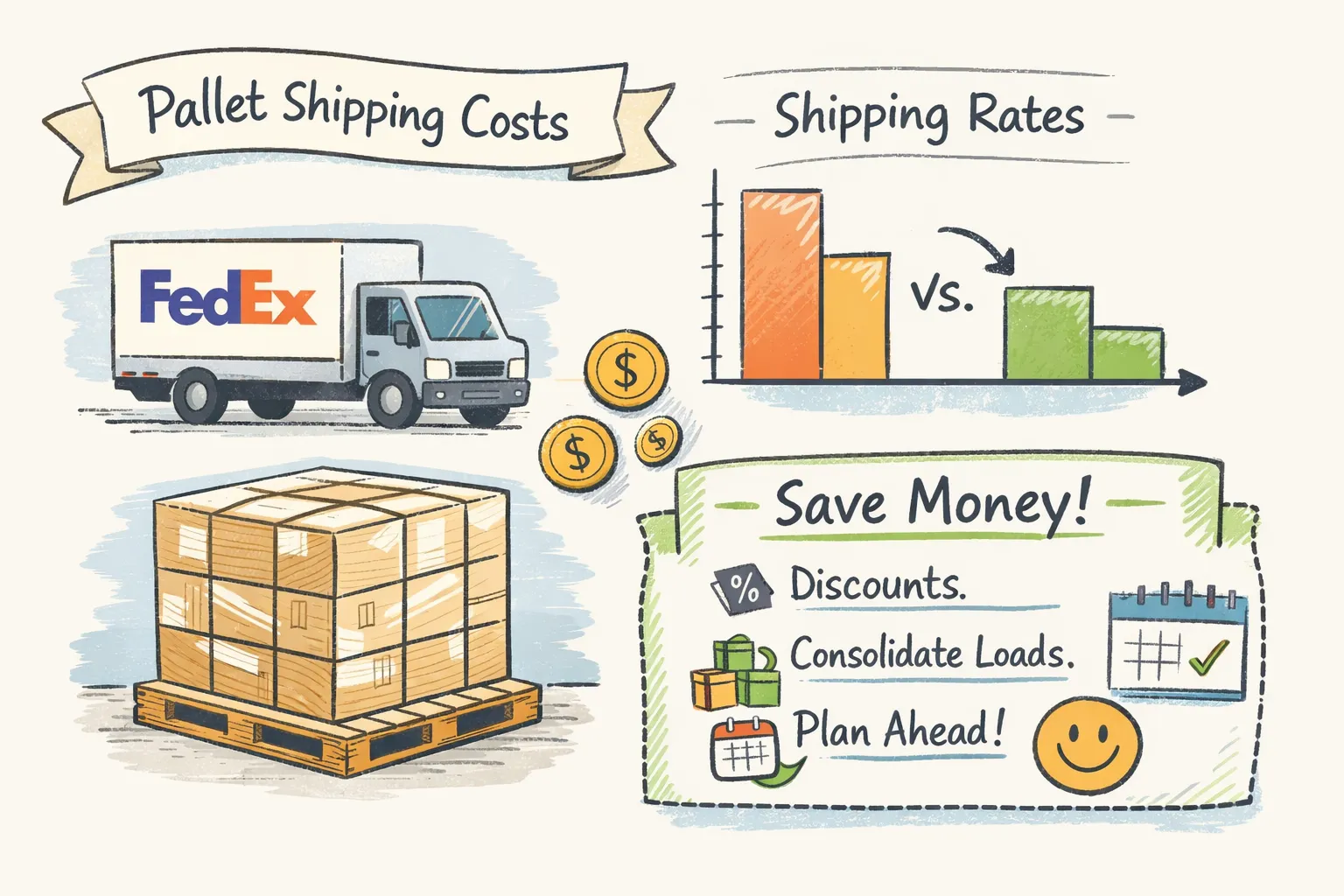
FedEx Pallet Shipping Cost: Rates, Fees, and How to Save
FedEx pallet shipping cost is one of those numbers that reliably surprises shippers the first time they see it. You build out a shipment, punch in the details, and wait for a pallet freight quote to load. The number that comes back looks nothing like what you budgeted. That gap isn’t random. The average cost to ship a pallet with FedEx isn’t a flat fee or a simple distance calculation; it’s assembled from several variables that interact differently on every single lane you run.
This article breaks down exactly how that number gets built, which fees hide in the fine print, and eight specific tactics to reduce what you pay. Whether you’re shipping product to customers or calculating total landed cost on incoming inventory (the way smart resellers at Pallets Liquidation USA do before every buy), knowing how FedEx structures pallet freight pricing puts you in control of every load.
By the end, you’ll be able to estimate FedEx pallet shipping rates for your standard routes, pull an accurate quote from their tools without missing inputs, and start applying cost-reduction tactics that compound when you stack several at once.
How FedEx pallet shipping cost is calculated
FedEx pallet shipping costs are not flat rates. They’re calculated from four primary variables that interact with each other on every shipment. Understanding each one is the first step to predicting and controlling your freight spend before the invoice arrives.
Freight class and why density is the real driver
The National Motor Freight Classification (NMFC) system assigns every commodity a freight class from 50 to 500. Class assignment is based on four characteristics: density (pounds per cubic foot), stowability, handling requirements, and liability. Of those four, density carries the most weight in practice. Higher density equals a lower class, and a lower class equals a cheaper rate.
The contrast between two pallets makes this concrete. A dense pallet of hand tools at Class 70 (density roughly 15, 22.5 lbs per cubic foot) will cost significantly less per hundredweight than a lightweight, bulky pallet of foam packaging material that qualifies as Class 200 or higher. On a cross-country lane, that class difference can translate to hundreds of dollars on a single pallet shipment.
One more thing worth flagging: the NMFC updated its classification system in December 2025, shifting more commodities to a standardized 13-class density-based scale. Shippers who assigned freight classes by habit rather than current NMFC codes may be paying the wrong rate entirely. Verify your commodity classifications before your next shipment, and use tools like the FedEx freight class calculator to confirm density-to-class mappings when you prepare your shipment details.
Zone-based pricing and the distance multiplier
FedEx Freight prices by zone, with Zones 2, 4 covering roughly 0, 600 miles (regional lanes) and Zones 5, 8 covering cross-country distances above 600 miles. A standard 1,000-lb pallet on a regional lane can run $200, $500 in base transportation charges, while the same pallet on a Zone 7, 8 cross-country lane can reach $800, $1,500 before accessorials and fuel surcharges stack on top.
Distance amplifies every other variable. A close-range Zone 3 shipment with a high freight class can still cost more than a mid-range Zone 5 shipment carrying a dense, low-class commodity. The zone multiplier doesn’t work in isolation; it scales whatever base rate your freight class and weight tier already establish.
How dimensional weight interacts with actual weight
FedEx uses the greater of actual weight or dimensional weight when pricing LTL freight. Dimensional weight is derived from your pallet’s length times width times height in inches, divided by a dimensional divisor. A pallet stacked loosely with lightweight goods can end up priced on dimensional weight even when the actual scale weight is relatively low.
The practical fix is compact, dense packing. Tightening your pallet stack increases density, which simultaneously reduces dimensional weight and can push you into a lower freight class. Both outcomes lower your rate, making dense packing one of the highest-leverage adjustments you can make before a shipment goes out. For packing best practices and pallet requirements, consult the FedEx pallet packing guide.
The accessorial fees that quietly inflate your final bill
The base FedEx freight pallet cost is only a starting point. Accessorial charges apply on top and are the source of most billing surprises. A shipment that quoted cleanly can arrive with $100, $300 in additions that weren’t visible at the quoting stage if you didn’t account for your delivery location’s characteristics.
Liftgate and residential delivery surcharges
Liftgate service (Item 890 under FedEx Freight) costs $13.18 per hundredweight for any location without a loading dock or forklift. That’s the standard for most small business deliveries and virtually all residential drops. On a 1,000-lb pallet, that’s $131.80 added to your base rate before anything else.
Residential delivery surcharges layer on separately. In 2025, FedEx charges $31 per shipment for standard residential delivery, rising to $33 in 2026. Extended residential addresses run $41.50 in 2025 and $44 in 2026. Remote locations reach $77.50 in 2025 and $83.75 in 2026. Resellers shipping pallets to individual buyers or to stores in non-commercial zones will almost always trigger at least one of these charges on every delivery.
Fuel surcharge and inside delivery costs
The fuel surcharge is a weekly-adjusted percentage applied directly to your transportation charges. As of early 2026, FedEx Freight’s LTL fuel surcharge ran at 49.50% for the week of March 25, 31, 2026, based on EIA diesel index data. Even at more moderate levels typical of mid-2025, where the surcharge ran around 31.6%, this fee adds a substantial percentage on top of every line you see at the quoting stage. For the official FedEx breakdown of recent surcharge changes, review the FedEx surcharge and fee changes.
Inside delivery (Item 566) applies whenever freight needs to be carried beyond the threshold of a delivery point that lacks a loading dock. The rate is $17.87 per hundredweight, with a $189 minimum and a $1,888 maximum per shipment. For a retailer receiving pallets inside a storefront, this charge triggers automatically. Factor it in at the quoting stage or expect it on the invoice.
Additional handling and other pallet-specific triggers
Oversized or heavy pallets can attract additional handling surcharges ranging from $21 to $83.75 per shipment depending on your location, service type, and year. Delivery area surcharges apply to hard-to-reach ZIP codes and add a flat fee per shipment regardless of weight or class. Inspection fees apply when the Bill of Lading carries inaccurate commodity descriptions or weight information, giving FedEx grounds to reclassify your freight and charge accordingly.
These are the fees that convert a reasonable-looking quote into a significantly larger invoice. The fix isn’t complicated: account for your delivery location type at quoting time, keep your Bill of Lading accurate, and never assume a base quote reflects your all-in cost.
How to pull an accurate FedEx pallet freight quote
Understanding what drives the rate lets you use FedEx’s tools correctly. Most inaccurate estimates come from missing inputs, guessed freight classes, or choosing the “basic” quote option instead of the detailed version. Here’s how to get a number you can actually build margin around.
The inputs you need before you start
Gather these before opening the calculator: origin and destination ZIP codes, total shipment weight including the pallet itself (typically 30, 50 lbs for a standard wooden pallet), pallet dimensions measured to the farthest points in inches (length x width x height), the number of pallets, and your preferred service level, FedEx Freight Priority or FedEx Freight Economy.
Pre-calculate your freight class before entering anything. The density formula is straightforward: multiply length by width by height in inches, then divide by 1,728 to get cubic feet per pallet. Divide total weight by total cubic feet to get pounds per cubic foot. Match that density figure to the NMFC class table to find your class. Doing this calculation before you open the tool ensures you’re entering the correct class rather than guessing, and a guessed class produces a meaningless quote.
Step-by-step walkthrough of the FedEx freight calculator
Navigate to FedEx.com, go to Shipping, then Freight, and select “Get Rates.” Choose the detailed quote option rather than basic; only the detailed version includes weight, dimensions, and class verification in the output. Enter your origin and destination ZIP codes, select your service type (Priority for faster transit, Economy if you have time flexibility), then input weight and dimensions per pallet along with your piece count.
Add any applicable accessorials before clicking “Get a Quote.” Liftgate, inside delivery, and residential surcharges need to be selected at this stage to appear in the estimate. Review the result for estimated transit time and freight class confirmation. Use the FedEx freight quote tool for a detailed, lane-specific estimate that includes optional accessorials so your quote more closely matches the final invoice.
Why your estimate and final invoice can still differ
FedEx can re-weigh or re-measure your pallet at pickup and adjust the freight class and rate if the physical dimensions don’t match what you entered. If your Bill of Lading carries incorrect commodity information, an inspection fee applies and the shipment gets reclassified at FedEx’s determination, not yours. The fuel surcharge is also locked at invoice date rather than quote date, so a surcharge increase between quoting and invoicing shows up as a small gap.
The safest approach: slightly overestimate weight, verify your commodity NMFC codes against the 2025 updates before shipping, and ensure every field on the Bill of Lading matches the physical shipment exactly. These habits eliminate the most common sources of invoice surprises.
Eight proven ways to reduce FedEx pallet shipping costs
These tactics directly target the levers that drive your freight rate. Several can be applied on the same shipment for compounding savings, so work through the list before each load rather than picking one at a time.
Optimize your freight class before you ship
Freight class is the most impactful lever available to most shippers. Restacking pallets more densely increases pounds per cubic foot and qualifies you for a lower class. Removing unnecessary packaging material that adds bulk without adding weight moves the density calculation in your favor. A single class reduction, from Class 100 down to Class 85 on the same lane, for example, can drop your base rate by 15, 25%.
Verify commodity NMFC codes rather than defaulting to a class you’ve used for years. The December 2025 NMFC updates changed classifications for a large number of commodities, and shippers who haven’t reviewed their codes since the update may be defaulting to outdated, higher classes on every load.
Open a negotiated FedEx account and pursue volume discounts
FedEx offers tiered volume discounts for shippers moving consistent freight volume, with negotiated accounts capable of accessing up to 70% off list rates for LTL services. Opening a direct FedEx Freight account and demonstrating volume unlocks base rate reductions that aren’t available on spot quotes through public tools.
Beyond the direct account route, five additional tactics reduce freight cost on almost every lane. Choose FedEx Freight Economy over Priority when your delivery timeline allows 3, 6 day transit instead of 1, 3 days; Economy rates run meaningfully lower on the same lane. Time shipments away from peak surcharge periods, which typically cluster around major retail holidays. Combine multiple smaller orders into one larger consolidated pallet shipment to hit multiweight thresholds and lower your per-hundredweight rate. Eliminate residential delivery surcharges by routing deliveries to commercial pick-up points where the customer can collect. And keep every Bill of Lading field accurate to avoid inspection fees and reclassification charges that inflate your final invoice.
When a freight broker or different sourcing model cuts costs further
Even with all eight tactics applied, some shipping scenarios remain expensive on FedEx list rates. Two alternatives are worth understanding before you finalize a shipping strategy.
How freight brokers unlock better FedEx LTL rates
Freight brokers aggregate volume across thousands of shippers to negotiate carrier rates that individual businesses can’t access on their own. For high-volume pallet shippers, a broker’s pre-negotiated FedEx Freight rates can undercut what a direct FedEx account offers on identical lanes, often by a meaningful margin on long-haul runs. The trade-off is an additional middleman in the transaction and slightly less direct relationship with the carrier. For shippers prioritizing the lowest per-pallet freight cost, brokers are worth quoting alongside your direct FedEx rate on every lane you run regularly.
How smarter inventory sourcing eliminates the freight problem entirely
For resellers and e-commerce sellers, there’s a different angle worth considering. If you’re calculating FedEx pallet shipping costs to estimate landed cost on inventory you’re buying, the sourcing decision itself can eliminate that math entirely. Pallets Liquidation USA ships free on all orders over $2,500, sourcing weekly from major U.S. retailers and delivering directly to your door with no additional freight charge. For a reseller pricing out a load, consider whether the catalog offers the inventory you need, for example, specialty lots like the Fishing Gear Liquidation Pallet Wholesale | Pallet Spot Deals, branded footwear options such as the Authentic Nike Sneakers Pallet, Free US Shipping, or pop-culture assortments like the Funko Pop Pallet Liquidation Wholesale | Pallet Spot Deals.
The free shipping threshold is built into the order structure rather than added afterward. That means your margin calculation starts from a clean number: purchase price against resale value, with freight already absorbed. Every pallet at Pallets Liquidation USA also comes backed by a 100% money-back guarantee and around-the-clock support, so the protection built into that cost structure is real.
Put your freight knowledge to work
FedEx pallet shipping cost is not a guesswork number. It’s the output of freight class, actual versus dimensional weight, zone, and accessorials stacked together. Once you understand each layer, you can quote accurately, anticipate what your final invoice will actually say, and apply the tactics above to bring the number down on every lane you run. Use a pallet shipping price estimator to cross-check FedEx LTL pallet rates on your highest-volume routes before committing to a carrier.
If you’re a reseller sourcing wholesale inventory, factor freight into your margin calculation before committing to a load. Or better yet, source from a supplier where freight is already covered. Pallets Liquidation USA ships free on orders over $2,500 and backs every purchase with a 100% money-back guarantee, which means your margin math starts clean from day one, without a FedEx freight line eating into it.
Leave a Reply
You must be logged in to post a comment.