


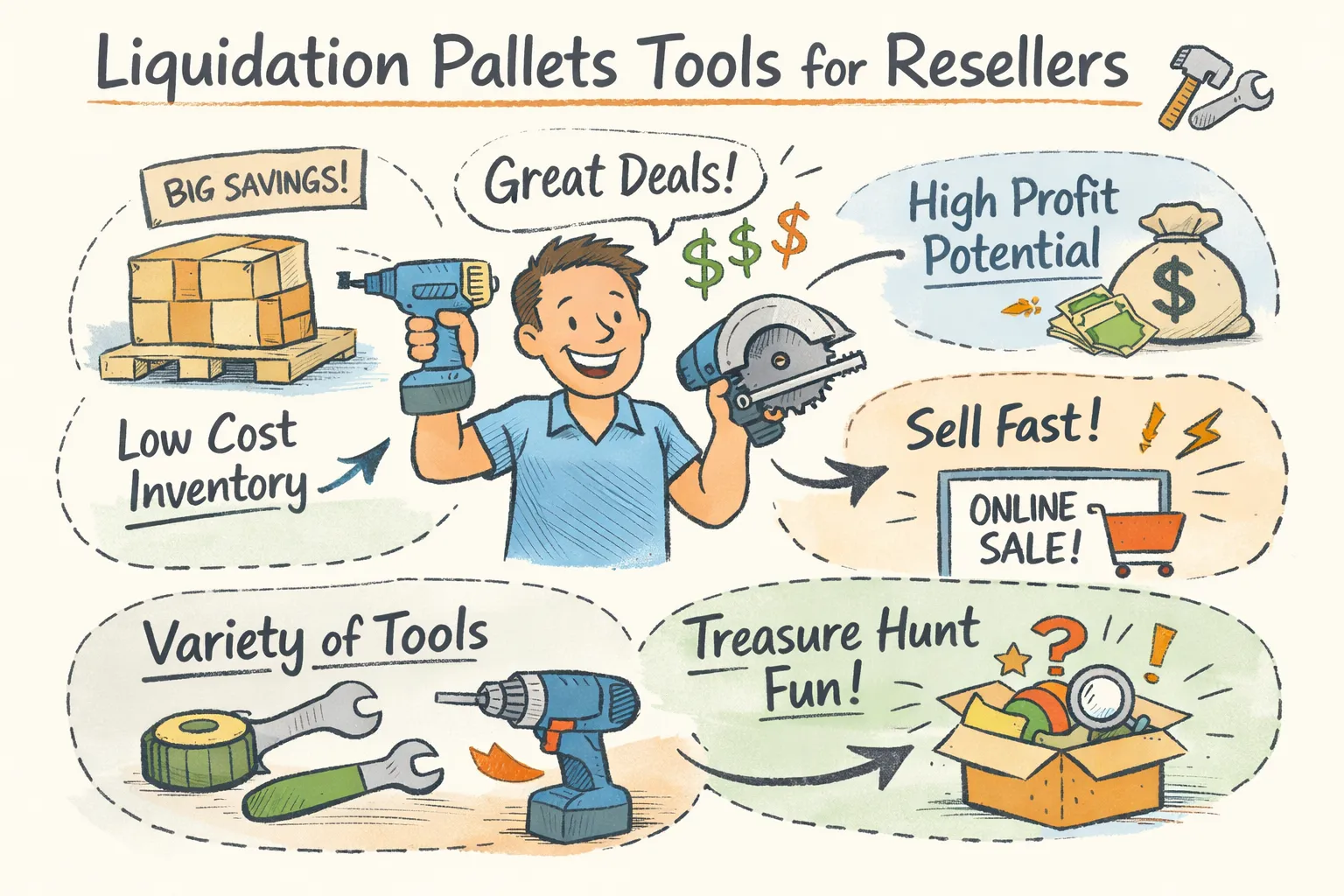
Top Benefits of Liquidation Pallets Tools for Resellers
Liquidation pallets tools compress value, variety and margin into a single purchase for resellers. Buying mixed tool pallets that combine overstock, Amazon returns and shelf pulls can cut costs 50–90% off retail. A typical $1,500 pallet often contains $7,500 to $15,000 in retail value when unpacked and resold, so even conservative sell-through tends to keep the purchase profitable and cashflow-positive.
Tool pallets also speed turnover and create a repeatable restock rhythm. Weekly drops of wholesale and Amazon tool pallets let you relist quickly and align inventory with seasonal demand. Brand-name SKUs from DeWalt, Milwaukee and Ryobi show up frequently in returned and overstock lots, which reduces listing friction and helps sell-through.
Batteries, chargers and other non-functional components add resale options as parts or repair candidates, and those pieces can carry higher margins than whole units. Start with a single pallet to validate your margins and workflows, then scale to truckloads once freight economics and SKU performance justify larger buys. The sections below give practical checks to evaluate manifests, identify high-margin lots and pick the right vendor for your business.
What you need to know
- Big margin upside: Tool pallets commonly trade at 50–90% off retail, which creates room for repair costs, fees and still leaves healthy gross margins. Even a conservative sell-through on a $1,500 lot can produce several thousand dollars in retail value. That gap is why many resellers prefer liquidation pallets tools for rapid margin improvement.
- Watch landed cost: Include LTL, liftgate, residential delivery and surcharges when modeling ROI because freight and extra fees can erase margins. Add a buffer for fuel surcharges and peak-season spikes to avoid unpleasant surprises. Accurate landed-cost math is essential before you bid or scale.
- Start small, scale: Validate SKU velocity and internal workflows with one pallet before committing to truckloads. Once you confirm pass/fail rates and repair time, scale up so freight and per-unit costs improve. Basing scale decisions on SKU-level data reduces risk as you grow.
Why buy liquidation pallets tools
Regular pallet drops create a predictable restock cadence and help you match seasonality. Brand-name items from DeWalt, Milwaukee and Ryobi shorten the sales cycle because buyers search for familiar makes, which improves conversion. For new sellers, a single pallet is a low-cost way to learn per-SKU velocity, refine bundling or repair processes and decide when to scale to truckloads.
Before you bid, learn how to evaluate manifests and grade a pallet so you protect margins. The next section walks through the key checks that separate profitable lots from time-consuming ones. Apply those checks consistently and your bidding will become more targeted.
How to judge tool pallet quality before you bid
Begin by reading the manifest line by line and treat it like a contract. Verify SKU, quantity, condition notes, UPC and an estimated retail value for each entry. If a manifest lists “mixed tools” without counts, lower your bid or skip the lot because uncertainty increases post-arrival work and cost.
High-quality manifests show brand names and unit counts, which make it easier to separate high-ROI items from junk. Note whether entries are retailer returns, shelf pulls or overstock, and flag Amazon returns when present. Brand-name SKUs with clear counts let you target the right resale channels and speed pricing and listing.
Learn the grading terms: new, overstock, customer returns, refurbished and salvage. New and overstock lots usually have near-zero defects; customer returns commonly show 5–20% defect rates depending on age and mix; refurbished lots can run around 5–15%, while salvage often has high failure rates. Since grading isn’t standardized, remain skeptical and budget for testing, repairs and parts when modeling ROI.
Watch for red flags such as no itemization, weight-only listings, missing photos and “as-is” language without a claim window. Ask sellers for close-up photos, sample SKUs or a partial manifest and confirm their return or money-back policy before you bid. After purchase, follow the seven-point arrival checklist below to preserve claims and speed resale.
Inspecting pallets on arrival: a 7-point checklist
- Pallet and packaging condition. Check deck boards, straps and any water damage because these issues affect safety and potential product loss. Photograph the pallet and packaging, note serial numbers and visible damage on the delivery receipt and refuse shipment if the pallet appears structurally unsound. Early documentation supports insurance and claim processes.
- Count items versus the manifest. Compare counts on arrival to the manifest to shorten claims resolution and prevent disputes. Mark missing lines on your delivery paperwork and take time-stamped photos as evidence. A quick initial tally saves time later in the claims process.
- Visual damage and cosmetics. Inspect housings, corrosion and heavy scratches since cosmetic damage lowers resale value. Photograph damaged units from multiple angles and log condition notes for claims or repair planning. Keep damaged items separate to avoid mixing them with sellable stock.
- Battery and charger inspection. Batteries commonly fail and can be hazardous if swollen or leaking, so inspect them carefully on arrival. Isolate suspect cells, log battery condition on your manifest and follow local disposal or repair rules. Test or replace batteries before listing to avoid returns and safety complaints.
- Basic functionality tests (sample). Perform power-on checks for a statistical sample or every high-value item to find noisy, non-starting or unsafe units. Tag units as functional, repairable or junk to speed sorting and listings. Early testing reduces return rates and helps set accurate prices.
- Missing parts, accessories and safety features. Note missing blades, guards, chargers or manuals because these items change listing strategy and repair cost. Estimate replacement costs and decide whether to sell as parts, bundle or repair for resale. Include those costs in unit pricing before listing.
- Sort, document and file claims within the window. Divide arrivals into sellable, repairable and junk piles and document SKUs, serials and weights for each. Photograph everything and file claims immediately if counts or condition do not match the manifest. Timely documentation is essential because claim windows can close quickly.
With arrival notes and photos in hand, you can grade items for resale, estimate repair budgets and set realistic prices before listing. Below are reliable marketplaces and typical price ranges so you know where to source tool pallets and what to expect to pay. Matching venue to inventory type will improve your bidding decisions.
Where to buy tool pallets and what prices to expect
Focus on established marketplaces that publish clear manifests and offer buyer protections. These venues typically move Amazon returns, retailer returns, shelf pulls and overstock so you can find lots that match your risk tolerance. Matching the venue to the inventory type saves time and helps preserve margins.
- B-Stock: B-Stock runs auctions for pallets and truckloads from major retailers and brands. Lots commonly contain customer returns and overstock, and many listings include SKU-level manifests. Use B-Stock when you want transparent historical pricing and an auction format that can yield value on underpriced lots.
- Direct Liquidation: Direct Liquidation lists frequent tool lots and often includes historical pricing data. The platform moves Amazon returns, shelf pulls and other retailer-sourced pallets. Review manifests closely on this site because listings vary by grade and detail.
- That Liquidation Place: That Liquidation Place typically offers retailer truckloads and branded assortments from chains such as Lowe’s and Home Depot. These lots can include shelf pulls and returns that mirror store assortments, which is helpful when you target similar buyers. Truckloads require more capital but reduce per-unit costs for high-volume resellers.
- Quicklotz: Quicklotz offers daily pallet and truckload drops with mixed merchandise that often includes tools. The quick turnover and variety help resellers test multiple categories. Manifests and itemization vary, so vet each listing before bidding.
- Half Off VIP: Half Off VIP focuses on wholesale liquidation lots and often lists power equipment and seasonal tool items. Their drops can include branded tools suitable for single-item listings or parts. Check membership terms and manifest detail to manage risk.
- American Liquidations: American Liquidations moves large truckloads and branded assortments similar to Home Depot-style shelf pulls; for related wholesale construction lots see Building Materials Liquidation Pallet. These lots suit resellers who can handle volume and want predictable brand mixes. Expect higher upfront cost but lower per-unit prices with truckloads.
Expect single pallets to range roughly $500 to $5,000 depending on brand, grade and manifest detail, while truckloads commonly start at $5,800 to $17,000. Retail multiples often run 5x to 10x, so run your numbers on sample SKUs before you scale. For lower-risk sourcing, Pallets Liquidation USA curates weekly tool lots with graded manifests and buyer protections that reduce upfront uncertainty.
Shipping, landed cost and simple ROI math
Freight adds up quickly. Use realistic pallet shipping prices when modeling landed cost: local moves about $150 to $300 per pallet, regional $400 to $800 and cross-country $900 to $1,800. Liftgate or residential delivery fees typically add $100 to $300 on top of base freight, and include a buffer for fuel surcharges and peak-season spikes.
(pallet cost + freight + repair + fees) ÷ sellable units. For example, $1,500 pallet plus $600 freight and $200 repairs equals $2,300, and dividing by 160 sellable units produces a $14.38 landed cost per unit. That unit landed cost becomes the baseline for channel decisions and pricing.
Choose your resale channel based on speed and margin. Sell bulk parts or to other resellers for lower margins but faster turnover, list single items on marketplaces for higher per-item margins, or use FBA for scale while accounting for referral and fulfillment fees. Target margins vary: wholesale about 20 to 35 percent, marketplace retail 40 to 80 percent and FBA roughly 30 to 40 percent after fees.
If your landed cost is $14.38 and you want a 40 percent margin on the sale price, plan to list around $24 before marketplace fees. For FBA, add estimated Amazon fees, often $5 to $10 per item, and adjust pricing so net profit stays on target. Accurate landed-cost math and channel selection are the quickest ways to protect margin on liquidation pallets tools.
Case study: Pallets Liquidation USA curates a DeWalt/Milwaukee pallet
Pallets Liquidation USA purchased a manifested pallet of 200 mixed DeWalt and Milwaukee items for $1,500 (see Milwaukee Tools Liquidation Pallet). The manifest included SKU-level counts and a short retailer claim window, which made the lot approachable for buyers who needed clear detail. The brand mix matched common Amazon tool pallets, so the team confirmed SKU-level demand before bidding to reduce risk and speed listing.
On unpacking, the team recorded 160 functional units, 25 repairable units and 15 junk units, an 80 percent functional pass rate. Most repairable units needed batteries or chargers, which are common cost drivers for power tool pallets. The company logged serial numbers and condition notes immediately to streamline listings and speed any claims.
The math was straightforward: $1,500 purchase plus $600 freight and $200 repairs equals $2,300 landed cost. Selling 160 functional units at an average $35 produced $5,600 in revenue, leaving roughly $3,300 gross profit, about a 140 percent gross margin before labor, marketplace fees and returns. Tracking pass/fail rates and repair costs kept the result realistic and repeatable.
Key takeaways: buy manifests with SKU detail, test batteries early and price conservatively. Rely on buyer protections when available, follow the seven-point arrival checklist and log conditions and serials. Use those notes to refine bidding and scaling decisions as you grow.
Final thoughts on liquidation pallets tools
Pallets Liquidation USA updates inventory weekly, offers free shipping on orders over $2,500, provides a 100 percent money-back guarantee and maintains 24/7 live online support. To get started, review three current manifests, flag the lot with the clearest SKU detail, request extra photos or a sample if needed and order one pallet to test your process. Apply the seven-point inspection on arrival, measure sell-through and scale when SKU performance and freight economics justify larger purchases.
Leave a Reply
You must be logged in to post a comment.