


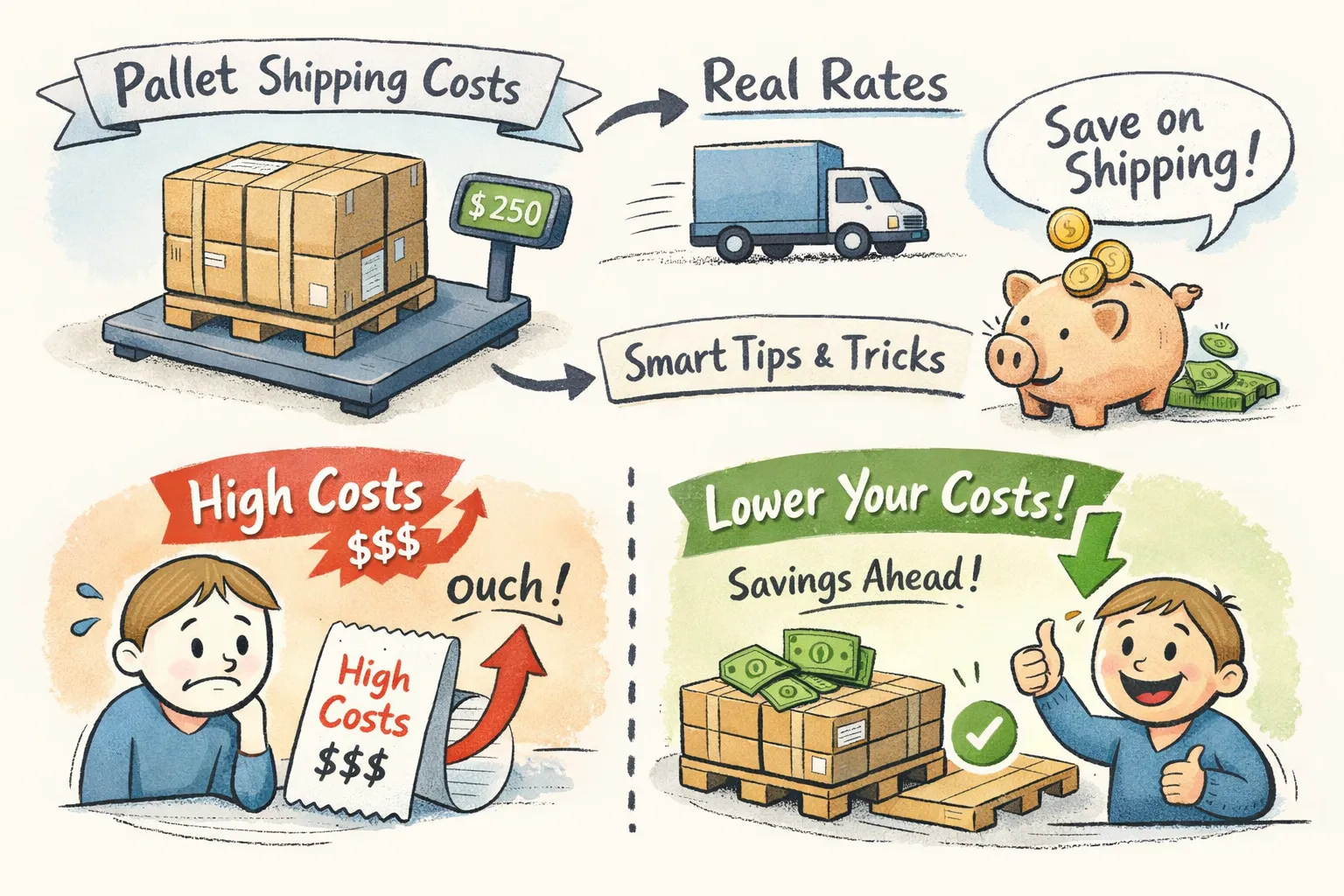
Shipping cost for a pallet: Real rates & saving hacks
Shipping cost for a pallet swings more than many buyers expect. For a single standard 48×40 pallet under 1,000 lb, short hauls typically run $100-$400, mid-distance lanes $250-$500, and long cross-country moves $350-$600 or more. Those ranges reflect differences in distance, density, and accessorials. Use these bands as a quick budget check before you request formal quotes.
Quick summary
- Realistic price bands: Short hauls $100-$400, mid $250-$500, long $350-$600+; use lane examples to budget before you quote.
- Calculate density: Weight ÷ cubic feet (L×W×H in inches ÷ 1,728) sets freight class and drives the base rate.
- Account for accessorials: Liftgate, residential, fuel and minimums often add $50-$300 each; include these in your estimate.
- Pallet prep matters: Use a standard 48×40 pallet, stack evenly, and shrink-wrap to raise density, lower class, and avoid damage fees.
- Calculate break-even: LTL typically fits 1-6 pallets, PTL 6-12 pallets, and FTL becomes cheaper at scale; run the mini-calculator before booking.
Shipping cost for a pallet: quick ranges and mini-calculator
- Short: New York City to Philadelphia (~100 mi), $125-$175 for a standard 600 lb pallet.
- Mid: Chicago to Atlanta (~700 mi), $300-$450 when class and a liftgate are involved.
- Long: Houston to Los Angeles (~1,500 mi), $350-$500 for a typical pallet; higher if volume is low or accessorials apply.
- Measure: cubic feet = (L × W × H) / 1728.
- Class: density (lb/ft³) = weight / cubic feet; map to freight class.
- Rate: total = (CWT × rate per CWT) + fuel% × (CWT × rate per CWT) + accessorials, subject to minimums.
Worked example: a 48×40×48 inch pallet at 800 lb on a 500-mile lane gives cubic feet = 53.33 and density = 15 lb/ft³, which approximates freight class 70. CWT = 8. At $18 per CWT the base is $144. Add a 12% fuel surcharge ($17.28), a $75 liftgate, and a $50 residential fee to reach about $286.28, which sits in the mid-range for that lane.
Estimates change with the rate per CWT, fuel surcharge and added accessorials, so always get final pallet shipping quotes before you buy. Below we break down the main factors that drive pallet rates: density, class, dim rules and zones.
What drives a pallet’s freight price: density, class, dim and zones
Density is the most important factor carriers use to set LTL (less-than-truckload) rates. Calculate density as pounds divided by cubic feet, where cubic feet = (length × width × height in inches) ÷ 1,728. The NMFC (National Motor Freight Classification) maps density ranges to freight classes from 50 to 500, and higher density typically means a lower per-CWT rate because dense freight uses trailer space efficiently and has lower damage risk.
- Class 50-65: very dense, heavy items that get the lowest rates.
- Class 70-100: standard pallets and most Dollar General Pallets, moderate rates.
- Class 125-250: lighter or irregular items with higher per-CWT charges.
- Class 300-500: extremely low density or high-liability goods; highest rates and extra handling fees.
Carriers can assign higher classes for fragile, oversized, or high-liability loads, which raises the cost per pallet beyond simple weight-and-space math. Distance converts into zones or lane pricing, and per-mile economics change with length: short hauls show higher per-mile rates while long hauls reduce per-mile costs but increase the absolute price. Fuel surcharge is a percentage added to the base rate and varies with diesel price, so it can move your final invoice by several percentage points.
DIM weight rules apply mainly to parcel and air, but LTL pricing still centers on density and class. Some carriers impose volumetric minimums or dim-like adjustments for very low-density freight, so use a rule of thumb: if your shipment is under roughly 6-8 lb per cubic foot, plan for a higher class or a volumetric adjustment. Pack smart to improve density and lower your pallet shipping rates.
Accessorials: the surcharges that bump the invoice
Accessorials are extra carrier fees billed on top of the base LTL charge and can quickly reduce margins. Common accessorials often cost $50-$300 each, so several of them can exceed the initial line haul. Charges vary by carrier, region, equipment, and whether the stop is commercial or residential, so plan conservatively when budgeting for pallet shipping.
- Liftgate: $50-$150
- Residential delivery: $50-$150
- Inside delivery: $75-$300
- Limited access (military, schools, docks): $75-$250
- Appointment: $25-$100
- Re-delivery: $75-$200
- Reweigh: $30-$150
Carriers often add accessorials after delivery, once the driver files the proof of delivery or the final invoice that shows conditions different from the original bill of lading. Charges appear on the carrier invoice with codes, notes, and sometimes photos; common triggers include wrong address type, driver-required equipment, failed delivery, or weight and size discrepancies. Late-added fees are harder to dispute without delivery records, so keep clear photos and timestamps to challenge unexpected charges.
You can reduce many accessorials by using commercial pickup and delivery addresses, booking terminal-to-terminal for tight lanes, confirming liftgate needs before booking, and scheduling appointments in advance. Train teams to load and unload efficiently to minimize detention and document the shipment condition to prevent reweigh or reclass disputes. Add a conservative buffer to your pallet estimate to protect margins and avoid surprises on the final invoice.
Pallet prep that lowers class and prevents damage or extra charges
Proper pallet prep lowers freight class and reduces damage claims, which cuts the overall shipping cost for a pallet before you request a quote. Start with a reliable platform: use a standard 48×40 GMA pallet, center the load, stack uniformly so the load approximates a cube, and place the heaviest items on the bottom to avoid overhang. Fill voids with dunnage or cardboard to raise pounds per cubic foot; the closer your load is to a full box, the more likely it will qualify for a lower LTL price band.
Securement matters: wrap tight at the base first, then spiral up with sufficient film to keep pallets rigid; use straps on heavy racks and banded fixtures to prevent vertical collapse. Add corner protectors and layer pads for fragile SKUs, and wedge loose items to stop lateral shift. These steps reduce trailer sorting damage and lower the chance a carrier will reclassify or assess damage fees after inspection.
Paperwork is as important as packing: put exact dimensions and weights on the bill of lading, include NMFC or commodity codes when available, and declare a realistic value to speed claims resolution. Accurate manifests eliminate surprise reweighs, reclassification, and disputes that inflate final invoices. Before you tender, run a quick pallet delivery cost estimate or use a pallet optimization guide to model lanes and density scenarios; small changes often move a pallet into a cheaper class and save dozens to hundreds of dollars.
LTL vs FTL: when a full truck saves money and how to calculate break-even
Use simple rules of thumb: LTL usually makes sense for 1-6 pallets, partial truckload (PTL) is worth considering for roughly 6-12 pallets, and FTL often becomes cheaper once you reach 8,000-15,000 lb depending on the lane. Low-density freight or oversized pieces change the math because carriers charge by density and usable floor space, and regional lanes or seasonal capacity swings also affect the break-even point. Confirm whether pallets are standard 48×40 and stackable, since nonstandard units raise the effective LTL per-pallet price.
Quick formula: break-even pallets = FTL flat rate ÷ LTL per-pallet price. For example, if an FTL flat rate is $1,100 and average LTL is $300 per pallet, $1,100 ÷ $300 ≈ 3.67, so FTL wins at four or more pallets. Include expected accessorials when you run the math because liftgate or residential fees added to each LTL pallet can raise the threshold by one or more pallets.
Exceptions that lower the break-even threshold include oversized pieces that monopolize floor space, extreme low density that triggers higher freight classes, or lanes with steep LTL accessorials. PTL is a hybrid option for 6-12 pallets, filling the trailer to a certain cube without paying for a full trailer. Ask carriers for PTL or volume LTL quotes and compare total landed cost rather than just the line haul. For buyers evaluating truckload sourcing, consider General Truckload Liquidation Wholesale options when your volumes approach the break-even point.
Nine ways to cut pallet freight costs, plus a shipping case study
Apply these nine tactical cost-savers to lower the shipping cost for a pallet and reduce surprises at delivery. Use them as a checklist when prepping, quoting, and negotiating so you capture savings quickly.
- Aggregate volume and consolidate pickups to hit carrier lane minimums and secure better rates.
- Negotiate lane-specific rates for your busiest routes instead of a one-size-fits-all contract.
- Maximize pallet density through repacking to lower freight class and price.
- Use commercial docks or terminal pickup to avoid residential and liftgate fees.
- Book flexible delivery windows; allowing a 48-hour window can reduce service-level charges.
- Use hub consolidation or zone skipping to move goods closer to destination hubs and cut miles and handling.
- Combine orders to reach free-shipping or volume discounts.
- Negotiate accessorial carve-outs or caps in your contract to limit unexpected fees.
- Shop freight marketplaces or get multiple real-time quotes before committing.
Case study: PalletDirect pooled weekly volume from regional buyers and standardized pallet specs, which improved density and dropped freight class by two grades. By negotiating a lane-specific contract for a 700-mile route with explicit accessorial caps and an agreed pickup window, they cut the negotiated base from $320 to $240 per pallet after accounting for fuel and accessorials. General Merchandise Liquidation Pallet applies similar levers for buyers by aggregating volume, standardizing specs, and passing negotiated savings to customers; they provide free shipping on orders over $2,500, 24/7 live chat, and a 100% money-back guarantee to help buyers avoid misclassification and surprise fees.
Top takeaways: Density and freight class are the primary levers, while accessorials create most surprises on the final invoice. Run the three-step calculator: measure the pallet, compute density, then apply the simple formula to estimate short, mid, or long haul ranges. For more detail on rate building and practical calculation steps, see a practical guide on how to calculate LTL freight rates. Always compare quoted totals that include accessorials, and use the worked example above as a template when you challenge carrier invoices.
Shipping cost for a pallet: budget takeaways and next steps
You now have realistic price bands and the key factors that move the shipping cost for a pallet. Density is the single biggest driver for LTL rates, while class, dim, and zones also shape the quote; accessorials are the most common invoice bump. Two simple steps to protect margins are to calculate density first and to build accessorials into your budget.
Leave a Reply
You must be logged in to post a comment.